Westminster breaks the silence: Priti Patel confronts religious persecution in Bangladesh

- Update Time : Friday, January 9, 2026
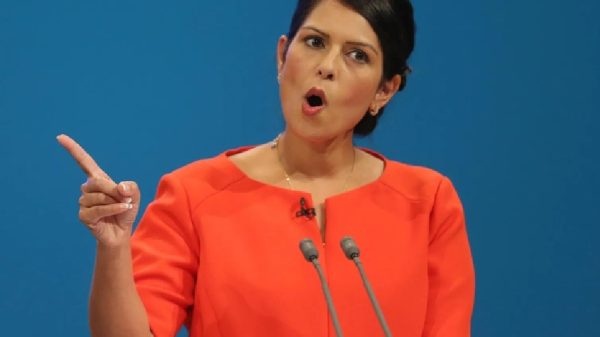
In an era when human rights rhetoric often dissolves into diplomatic evasions, a rare moment of moral clarity has emerged from the British Parliament. Rt Hon Priti Patel MP, the United Kingdom’s Shadow Secretary of State for Foreign, Commonwealth and Development Affairs, has issued a stark warning over the escalating persecution of religious minorities in Bangladesh – most notably Hindus – challenging not only Dhaka’s authorities but also the international community’s prolonged silence.
Ms. Patel’s intervention follows sustained investigative reporting by Blitz and other international outlets documenting a disturbing pattern of targeted violence. Her letter to the UK Foreign Secretary, dated January 9, 2026, leaves little room for ambiguity: the situation has deteriorated sharply, and previous assurances have failed to prevent bloodshed.
According to reports cited by Ms. Patel, at least six Hindus were killed within an 18-day period – an alarming spike that underscores the vulnerability of minority communities in Bangladesh. “This level of persecution and violence is unacceptable”, she wrote, articulating a truth that governments have been reluctant to state plainly.
Her concerns are not abstract. They are grounded in parliamentary history. During an Urgent Question in the House of Commons on December 2, 2024, the then UK Minister for the Indo-Pacific claimed to be actively monitoring the situation following a visit to Bangladesh and promised ongoing diplomatic engagement to protect religious minorities. Yet the surge in violence since then raises an unavoidable question: What, if anything, has actually changed?
Ms. Patel demands answers that go beyond diplomatic platitudes. She presses the Foreign Secretary to disclose what concrete steps have been taken over the past year, what direct representations have been made to Bangladeshi authorities, and what assurances – if any – have been received to safeguard Hindu communities from further attacks. Her letter also asks whether the Bangladesh High Commissioner in London has been formally engaged, exposing a glaring test of diplomatic seriousness.
Crucially, Ms. Patel situates religious persecution within the broader political instability engulfing Bangladesh. She warns that unchecked violence against minorities is not merely a domestic human rights issue; it is a destabilizing force with regional and international consequences. States that tolerate or fail to prevent sectarian violence rarely remain stable – and their crises seldom stay confined within borders.
Her concern extends to the Bangladeshi diaspora in the United Kingdom, many of whom live with the fear that their families back home could be next. Acknowledging this public anxiety, she calls for transparency and accountability by urging the government to make a formal statement to the House of Commons on its actions and strategy. Silence, she implies, is no longer defensible.
Ms. Patel reinforced her position publicly on X (formerly Twitter), stating:
“The situation in Bangladesh is very concerning. Religious freedoms should be protected and the murders of Hindus and persecution taking place are wrong and must stop.
The UK Government must use its influence and convening powers to work to bring about stability in Bangladesh and a future where religious freedoms are protected and Hindus are safe”.
These words carry weight because they reflect what many governments privately acknowledge but hesitate to say aloud. Her stance exposes a broader failure of the international community – one that routinely condemns human rights abuses in theory, yet avoids meaningful pressure when strategic convenience intervenes.
What makes Ms. Patel’s intervention particularly significant is that it validates the role of independent journalism in forcing accountability. Without sustained reporting and international scrutiny, the suffering of Bangladesh’s religious minorities would likely remain obscured by official narratives and selective outrage.
From moral clarity to global pressure
Ms. Patel’s letter stands out not only for its substance but for its courage. At a time when geopolitical expediency often trumps human rights advocacy, her stance reflects moral leadership rooted in democratic values. It also validates the role of independent journalism and persistent reporting – without which many of these abuses might have remained buried beneath official narratives.
Priti Patel has done what too few elected leaders are willing to do: she has spoken plainly, demanded accountability, and challenged diplomatic complacency. But one voice, however principled, is not enough. Her initiative must now be replicated across democratic capitals.
Global leaders, parliamentarians, and civil society actors must flood policymakers with letters, raise the issue relentlessly in legislative chambers, and initiate formal resolutions and bills in the UK Parliament, US Congress, Australian Parliament, Canadian Parliament, and the European Union Parliament. Diplomatic engagement with Bangladesh must be conditioned on verifiable protections for religious minorities – not empty assurances.
History is unforgiving toward those who remained silent while persecution escalated. Priti Patel has chosen to speak. The world must now decide whether it will echo her call – or be remembered for looking away.
An internationally acclaimed multi-award-winning anti-militancy journalist, writer, research-scholar, counterterrorism specialist and editor of Blitz. He regularly writes for local and international newspapers on diversified topics, including international relations, politics, diplomacy, security and counterterrorism. Follow him on 'X' @Salah_Shoaib