

Far-right German party courts Washington allies while claiming political persecution at home

- Update Time : Saturday, December 20, 2025
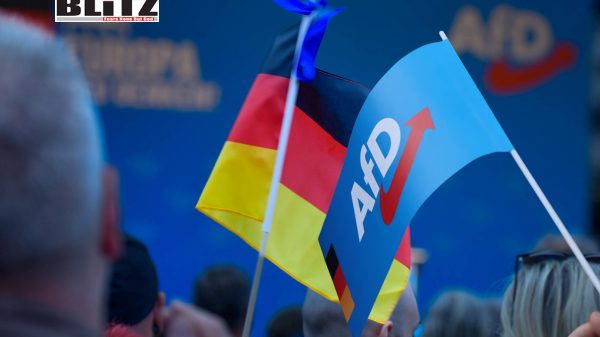
A delegation from Germany’s far-right Alternative for Germany (AfD) party has concluded a weeklong visit to the United States, using meetings with Republican lawmakers and political figures to promote its narrative of political repression in Germany and to seek international allies amid mounting scrutiny at home. The visit underscored the AfD’s growing effort to internationalize its grievances, portray itself as a victim of state persecution, and align with conservative and populist forces abroad-particularly within the US Republican Party.
The 20-member delegation, led by Bundestag member Markus Frohnmaier, framed the trip as an attempt to “strengthen” the AfD’s political position by forging partnerships across the Atlantic. In social media posts, Frohnmaier claimed that Germany’s political establishment had abandoned democratic principles, accusing authorities of censorship, judicial overreach, and the deliberate targeting of opposition parties. According to Frohnmaier, Germany has become “a land of prosecutors and censors,” a claim that mirrors the AfD’s longstanding rhetoric that state institutions are weaponized against dissenting political voices.
The visit took on a particularly controversial tone due to the actions of Petr Bystron, an AfD member of the European Parliament who has faced multiple legal investigations in Germany. Bystron posted videos and messages on X, formerly Twitter, portraying the delegation’s presence in Washington as a symbolic convergence of nationalist and populist movements in Europe and the United States. Standing in front of the US Capitol, Bystron wrote that “the nightmare of the establishment is coming true,” asserting that anti-establishment forces on both sides of the Atlantic were now “joining forces.”
Bystron also shared an article from the right-wing online outlet Journalistenwatch.com, which claimed-without evidence-that members of the Trump administration had agreed to investigate alleged money laundering and corruption within international non-governmental organizations (NGOs) operating in Europe. The article named the Organized Crime and Corruption Reporting Project (OCCRP) and several humanitarian aid organizations, characterizing them as part of a so-called “left-wing NGO complex.” No proof was provided that such investigations were planned, and the White House declined to comment on the claims.
Central to this controversy was Bystron’s alleged meeting with Ed Martin, a former Republican official and longtime ally of former President Donald Trump. Journalistenwatch described Martin as a “close confidant” of Trump and suggested he had been receptive to AfD concerns about judicial abuse in Germany and the European Union. Martin later posted a photograph of himself shaking hands with Bystron, accompanied by a casual caption, but did not confirm any discussion of investigations or policy actions. He also did not respond to inquiries from OCCRP.
The AfD has repeatedly targeted OCCRP, particularly after the investigative outlet reported earlier this year that German prosecutors had sought to lift Bystron’s parliamentary immunity. That request was linked to allegations that Bystron received payments from a Russian-linked disinformation network in exchange for advancing pro-Russian narratives in the Bundestag. Prosecutors also examined images shared by Bystron online that appeared to depict politicians making Nazi salutes, a symbol banned under German law.
In April, the European Parliament voted to lift Bystron’s immunity, clearing the way for the Munich Public Prosecutor’s Office to pursue its investigation. Authorities are examining whether Bystron received payments from the operator of the now-defunct outlet Voice of Europe, which has been sanctioned by the European Union and Czech authorities for spreading disinformation and attempting to influence European Parliament elections. Bystron has consistently denied all accusations, describing them as politically motivated attacks intended to silence him and discredit the AfD.
The legal pressure on Bystron intensified in October, when a Munich court fined him €11,250 for sharing a photo montage that judges ruled depicted the banned Hitler salute. The decision is not yet final, according to German media outlet Die Zeit, and Bystron has appealed the ruling. He continues to argue that the investigations and penalties reflect an erosion of free speech in Germany rather than legitimate law enforcement.
The AfD has attempted to reinforce this narrative institutionally. In November, the party formally asked the Bundestag to clarify whether the German government had any contact with or provided financial support to OCCRP. The AfD falsely alleged that the organization was attempting to influence elections in Germany and across the European Union. Both the Bundestag and Germany’s federal government declined to pursue an investigation, and OCCRP categorically denied the accusations.
Despite the controversy, AfD leaders portrayed the US visit as a success. Republican Congresswoman Anna Paulina Luna of Florida publicly welcomed the delegation, calling the meeting “wonderful” and describing AfD members as valuable partners at a time when alliances within the European Union are increasingly strained. Her comments drew criticism from observers who argue that such gestures risk legitimizing a party widely accused of undermining democratic norms.
Domestically, the AfD has become Germany’s second-largest party in the Bundestag, campaigning on hardline opposition to immigration, skepticism toward the European Union, resistance to climate policies, and criticism of liberal democratic institutions. While mainstream German parties have refused to form coalitions with the AfD, its electoral support has continued to grow, particularly among younger voters.
According to a recent report by Bundesverband Mobile Beratung, an organization that coordinates counseling teams combating right-wing extremism, the far right has become increasingly entrenched in German society. The report attributes this growth to established neo-Nazi networks, conspiracy-driven online communities, and right-wing populist media outlets, with the AfD playing a central role in amplifying these currents. The organization warns that the normalization of extremist rhetoric poses long-term risks to Germany’s democratic culture.
German authorities have taken note. The Federal Office for the Protection of the Constitution, Germany’s domestic intelligence agency, has placed parts of the AfD under surveillance due to concerns that certain factions seek to undermine the constitutional order. While discussions about a potential ban on the party periodically resurface, legal experts note that the threshold for banning a political party in Germany is deliberately high, reflecting historical lessons about political repression.
For now, the AfD continues to operate-and to seek validation abroad. By framing domestic investigations as political persecution and courting allies in Washington, the party appears intent on recasting itself as part of a broader international struggle against what it describes as a corrupt and authoritarian establishment. Whether this strategy will strengthen the AfD’s standing at home or deepen concerns about its trajectory remains an open question, but its transatlantic outreach signals a new phase in the party’s political ambitions.
Damsana Ranadhiran, Special Contributor to Blitz is a security analyst specializing on South Asian affairs.