US Aid cuts push Kenyan women toward unsafe abortions amid contraceptive crisis

- Update Time : Thursday, December 4, 2025
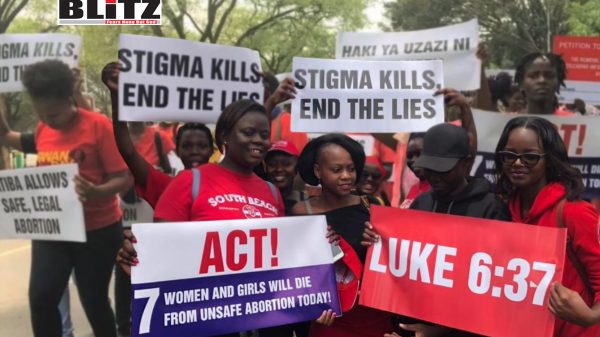
For women and girls in low-income communities across Kenya, access to contraception has never been a luxury-it has been a lifeline. It is the difference between safety and danger, choice and coercion, life and death. But today, that system of support is collapsing. The unraveling began with radical policy shifts in Washington, intensified through an ideological crusade against reproductive rights, and is now taking its harshest toll thousands of miles away in Nairobi’s informal settlements.
Experts, activists, and community health workers warn that the US government’s decision to destroy millions of dollars’ worth of contraceptives-supplies already purchased, shipped, and originally intended for African countries-will worsen an already dire public health crisis. While the Trump administration insists the stockpiles are being eliminated as part of a bureaucratic clean-out aligned with its broader ideological agenda, the consequences for Kenyan women are unmistakable: more unintended pregnancies, more unsafe abortions, and more preventable deaths.
This crisis is not unfolding organically. It is being manufactured-piece by piece-by decisions made far from the communities now suffering the fallout.
The story began with reports that $9.7 million worth of contraceptives-including intrauterine devices, hormonal implants, and birth control pills-were left idle in a Belgian warehouse rather than being distributed to Kenya, the Democratic Republic of the Congo, Tanzania, Zambia, and Mali. In November, the International Planned Parenthood Federation (IPPF) revealed that the situation was even worse: another 20 truckloads of contraceptives were being held at a hidden location in Belgium. Some of these products have already degraded due to improper storage.
These supplies were funded under programs previously supported by the United States Agency for International Development (USAID), an agency that President Donald Trump dismantled earlier this year as part of his second-term restructuring agenda. Despite multiple philanthropic organisations offering to purchase and transport the contraceptives at no cost to the US, the administration has insisted on destroying them.
IPPF estimates that the elimination of these critical supplies will deprive 1.4 million women and girls of contraception, resulting in 170,000 unintended pregnancies and an estimated 56,000 unsafe abortions. These are not abstract numbers-they represent real lives from communities that have already been stretched beyond capacity by shrinking aid and inadequate domestic health funding.
The destruction of contraceptives aligns with Project 2025, a sweeping conservative policy blueprint drafted by the far-right Heritage Foundation. The framework seeks not only to overhaul the US federal government but also to reshape America’s global footprint-especially in areas involving reproductive health.
One of its explicit goals is the reimposition of the “global gag rule”, which bars US funding from going to any foreign organisation that even discusses abortion. The aim is not simply to restrict abortion access-it is to silence, punish, and ultimately dismantle networks that provide reproductive health services worldwide.
For Kenya, which has long benefited from USAID-supported health initiatives, the effects are already visible.
In Ruaraka, a densely populated neighbourhood in Nairobi, community groups report a dramatic rise in unintended pregnancies-especially among adolescents. The Community Voices Network, which works with youth across the area, has documented a surge in repeated pregnancies among teenage girls, many of whom relied heavily on free contraceptives previously supported by US funding.
“We are struggling to link adolescents and young people to the right and safe abortion services,” said Mercy Mugecha, the group’s communications lead. “We regularly lose girls and women to unsafe abortions.”
In Kenya, unsafe abortions are the leading cause of maternal deaths. A 2014 study by the African Population and Health Research Center estimated that 14% of pregnancies end in unsafe abortions-procedures often conducted under dangerous conditions, by untrained providers, and without proper medical follow-up. These unsafe abortions claim the lives of 2,600 Kenyan women every year, with the highest concentration of deaths in informal settlements.
The USAID cuts have hit at the worst possible time. Several community-based health organisations in Ruaraka have shut down due to the depletion of foreign funding. Those that remain are overwhelmed, understaffed, and unable to meet growing demand.
For 22-year-old Lucy Njeri, reproductive health care is not an ideological debate-it is daily survival. Njeri became pregnant at 17, before she understood how to access reliable contraception. Now a staff member with Sauti Zetu, a youth-centred reproductive health initiative, she tries to help others avoid the same fate. But her own access to contraception has become inconsistent.
Public hospitals where she routinely receives injectable birth control ran out of supplies multiple times this year. In July, she went nearly two weeks without protection.
“I had to go to a pharmacy,” Njeri said. “But not everyone has money for that.”
In areas like Ruaraka, where families struggle to afford even basic necessities, private healthcare is out of reach. As supplies vanish, so does choice. Women are being forced into hardship-or into danger.
With contraceptive shortages worsening, reproductive health organisations in Kenya have been forced to change their messaging. Instead of focusing on empowerment, autonomy, and reproductive freedom, they are now urging young people to abstain from sex-because they simply cannot guarantee access to contraception.
For Mugecha and her colleagues, this shift feels like a devastating regression. “This is an intentional act of reproductive coercion,” she said, warning that the destruction of contraceptives will push vulnerable young people toward unsafe abortions and long-term trauma.
The Kenyan Ministry of Health insists that there is “no immediate risk” from the USAID cuts. Dr. Albert Ndwiga, manager of the National Family Planning Program, says the government is implementing contingency plans, including:
- A special budget allocation for contraceptives
- Diversification of funding sources
- Strengthening of local manufacturing
- Expansion of health insurance coverage
In theory, these are sound policy responses. In practice, experts question whether the government has the financial capacity or administrative readiness to execute them.
The Sexual and Reproductive Health and Rights Alliance, which attended consultations with the Ministry of Health, argues that the proposals lack realistic funding. “A policy framework alone is insignificant without dedicated financing,” said Ramwaka Nyadzuwa, the group’s youth engagement officer. “Without adequate investment, progress will remain slow or uneven.”
For organisations like IPPF-Africa, the crisis highlights the urgent need for African countries to reduce their reliance on external donors. Mallah Tabot, IPPF Africa’s reproductive rights lead, described the US decision as “another senseless act driven by a dangerous ideology.”
But she also sees an opportunity. Some African countries are already exploring impact investing, blended financing, and partnerships with local manufacturers to build a more resilient reproductive health supply chain. These innovations could, in the long term, reduce dependency on foreign donors and strengthen domestic health systems.
Still, Tabot warns that even the most forward-thinking solutions cannot prevent the immediate fallout.
“When 2026 comes, we will see the impact,” she said. “And it will translate to increased mortality and morbidity, especially for African women and girls.”
The contraceptive shortages in Kenya-and across Africa-are not the result of supply chain disruptions, natural disasters, or unavoidable crises. They are the result of political choices. Decisions made in Washington are now determining whether a woman in Nairobi can prevent an unwanted pregnancy, whether a 16-year-old girl can finish school, whether a mother of three survives childbirth.
This is reproductive coercion on a global scale. And unless urgent international pressure forces a reversal of the US policy, the world will soon witness the human cost of allowing ideology to override public health.
For Kenya’s most vulnerable women and girls, the coming years look grim. The crisis will get worse before it gets better. But their advocates-community organisers, healthcare workers, youth educators, and civil society groups-remain determined to fight. Their message is clear: women’s rights are non-negotiable, and reproductive freedom cannot be sacrificed on the altar of foreign political agendas.
The question now is whether the world will listen-before more lives are lost.
Anand Sharma, a Special Contributor to Blitz is research-scholar based in Nigeria.