

Trump’s nuclear gamble: A dangerous precedent that threatens global stability

- Update Time : Wednesday, November 5, 2025
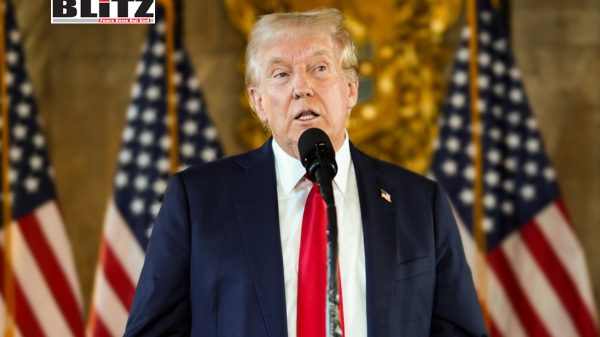
President Trump’s decision to resume nuclear testing marks a grave setback for global stability and nuclear restraint. By discarding decades of hard-won norms, Washington risks triggering a new era of arms racing and strategic chaos.
The President of the United States, Donald Trump, recently announced his intention to resume nuclear testing during the APEC meeting held in South Korea—an alarming decision that could have far-reaching consequences for global security and nuclear governance. “Because of other countries’ testing programs, I have instructed the Department of War to start testing our nuclear weapons on an equal basis. That process will begin immediately,” Trump declared, in what marks a dramatic departure from decades of restraint. By doing so, Washington is not only violating the very frameworks of cooperation and global governance it once championed but also setting a perilous precedent for the rest of the world to follow.
U.S. Defense Secretary Pete Hegseth defended the move, stating that the President “was clear: we need to have a credible nuclear deterrent,” and that “resuming testing is a pretty responsible—very responsible—way to do that.” He further argued that “the stronger we are, the less likely conflict becomes,” echoing the administration’s “peace through strength” doctrine. However, such reasoning is both misleading and dangerous. Resuming nuclear testing does not strengthen deterrence; it erodes decades of collective effort to prevent nuclear escalation. This action risks reigniting an arms race, undermining trust in international regimes, and increasing the chances of catastrophic miscalculation.
Nuclear brinkmanship and Global reactions
Moreover, when confronted by journalists about this decision, Trump bizarrely responded, “We’re gonna test because they test and others test… China’s been testing, Pakistan’s been testing, other countries do it. If they’re going to do it, we’re going to.” His unverified claim reflects a troubling disregard for transparency and accountability, further heightening concerns that this policy shift could unravel the fragile global consensus against nuclear testing.
New Delhi meanwhile, has not endorsed Trump’s accusation that Pakistan is secretly conducting nuclear tests. New Delhi has so far refrained from issuing a formal statement on the matter, choosing instead to closely monitor the situation through its security and scientific agencies. According to reports, Indian officials have emphasized that detecting subterranean nuclear detonations requires “careful seismic forensics and corroboration from international monitoring systems,” signaling that India prefers verification over speculation. While reaffirming its commitment to a responsible nuclear posture and its no-first-use doctrine, India underscored that it would not be drawn into speculative claims or nuclear brinkmanship, maintaining its stance as a cautious and restrained nuclear power.
In response, China firmly denied conducting any nuclear tests and called on the United States to uphold its long-standing moratorium, warning that Washington’s actions could destabilize the global non-proliferation framework and trigger a dangerous chain reaction among other nuclear powers. As global anxiety mounts, arms control experts have cautioned that the U.S. decision risks dismantling decades of hard-won restraint and reviving a perilous era of nuclear brinkmanship.
Russia too issued a sharp response, with Kremlin spokesman Dmitry Peskov affirming that Moscow has not conducted any nuclear tests and warning that if Washington proceeds, Russia “will act accordingly.” Peskov further noted that the United States had given no prior notice of its policy shift, though he downplayed immediate escalation by saying, “Not really,” when asked whether a new arms race had begun.
Iran’s Deputy Foreign Minister Abbas Araghchi sharply condemned Washington’s move, calling it a reckless step that threatens global peace and exposes the blatant double standards of the United States, which continues to vilify Iran’s civilian nuclear program while advancing its own destructive capabilities.
Even in Japan, a nation that has suffered the horrors of nuclear weapons firsthand, atomic-bomb survivor groups led by Nihon Hidankyo and civic leaders including Nagasaki Mayor Shiro Suzuki denounced Trump’s order as “utterly unacceptable,” stating that it “directly contradicts the efforts by nations around the world striving for a peaceful world without nuclear weapons.” Mayor Suzuki further warned that “the act tramples on people’s grueling efforts to achieve a world without nuclear weapons.” As global anxiety mounts, arms control experts have cautioned that the U.S. decision risks dismantling decades of hard-won restraint and reviving a perilous era of nuclear brinkmanship.
As Daryl G. Kimball, Executive Director of the Arms Control Association, warned, “By foolishly announcing his intention to resume nuclear testing, Trump will trigger strong international opposition that could unleash a chain reaction of nuclear testing by U.S. adversaries, and blow apart the nuclear Non-Proliferation Treaty.” Similarly, former U.S. Energy Secretary Ernest Moniz noted that even limited testing “could cost as much as $100 million” and serve no real technical purpose, emphasizing that “the U.S. already has so much data from our 1,000-plus tests—our adversaries would love to start catching up.
Adding to the growing chorus of international criticism, United Nations Secretary-General António Guterres strongly condemned the U.S. announcement, stressing that “nuclear testing can never be permitted under any circumstances.” He cautioned that the world is already facing “alarming levels of nuclear risk” and urged all nations to refrain from actions that could further heighten tensions or trigger miscalculation, reminding the global community of the “disastrous legacy of over 2,000 nuclear weapons tests carried out over the last eight decades.”
Undermining global nuclear norms
If the United States proceeds with these tests, it will effectively dismantle the global non-proliferation regime that has been painstakingly built over decades. The Comprehensive Nuclear-Test-Ban Treaty (CTBT) and the Non-Proliferation Treaty (NPT) formed the foundation of global restraint, reflecting a shared understanding that nuclear testing is an unacceptable act of provocation. Even during the Cold War, when ideological confrontation was at its peak, Washington and Moscow managed to cooperate through arms-control agreements and mechanisms of verification. They signed these treaties like the Partial Test Ban Treaty (1963), the Strategic arms Limitation Talks (SALT), and the NPT (1968), recognizing that nuclear escalation had no winners. There was an element of caution and recognition of shared vulnerability.
Now, however, President Trump appears intent on discarding this hard-won wisdom. His decision risks reviving a nuclear competition reminiscent of the most dangerous phases of the Cold War—but without the effective institutional mechanisms that once helped manage it. The world is entering a phase of strategic chaos, where unpredictability and impulsive leadership could bring humanity perilously close to nuclear catastrophe.
Today, under President Donald Trump, the U.S. is pursuing policies that dangerously disregard those principles. By undermining international institutions, laws, and norms, the Trump administration is erasing the few checks and balances that still safeguard nuclear stability. The chances of miscalculation or accidental escalation are now significantly higher than at any time in recent history.
Resuming nuclear tests could trigger a domino effect of proliferation. If the United States—a self-proclaimed leader of the “rules-based international order”—chooses to violate its own commitments, what moral or political authority will it have to prevent other nations from following suit? Tomorrow, Iran, or any other country could justify their nuclear ambitions by pointing to Washington’s precedent. Moreover, such actions will erode the credibility of the International Atomic Energy Agency (IAEA), which depends on the cooperation and example of major powers to enforce its safeguards. Once the U.S. breaks faith with global norms, the very foundation of nuclear governance will crumble.
This reckless move could unleash a chain reaction, making the world far more dangerous as proliferation accelerates. Some countries might even resort to selling nuclear materials or technologies for financial or strategic gain, while existing nuclear powers could expand their arsenals in response.
A double standard that weakens US credibility
The United States has long been regarded as a norm-setter in international politics. Its actions have symbolic weight. When it upholds international law, others tend to follow; when it breaks the rules, others are emboldened to do the same. By deciding to conduct nuclear tests, Washington sends a message that global norms and treaties are expendable. This is deeply destructive. It delegitimizes the moral and legal authority of the international system and encourages a dangerous spiral of imitation. If the U.S. tests nuclear weapons today, no country will take the CTBT or the NPT seriously tomorrow. The result will be the unravelling of decades of restraint, oversight, and cooperation.
When Russia threatened to use nuclear weapons during its invasion of Ukraine, global condemnation was swift. India and China played a vital role in urging restraint, warning Moscow that the use of nuclear weapons would cross an unacceptable red line. But now, the United States itself is moving toward the very behaviour it once condemned.
Washington’s justification—that it must respond to Russia’s recent test of a nuclear-powered cruise missile—is both deceptive and disingenuous. The Russian test, conducted in late October 2025, involved the 9M730 Burevestnik, a long-range, nuclear-powered missile that reportedly flew over 14,000 kilometers using a nuclear propulsion system. However, the test did not involve a nuclear warhead detonation. To equate propulsion testing with an actual nuclear explosion is to deliberately blur distinctions for political ends.
A call for responsibility and restraint
The world does not need another era of nuclear brinkmanship. It needs leadership grounded in responsibility and reason. The resumption of U.S. nuclear testing would not enhance security; it would erode it. It would not deter rivals; it would provoke them. It would not demonstrate strength; it would expose recklessness.
President Trump’s decision threatens to undo decades of progress toward nuclear restraint and disarmament. It risks returning the world to a time when nuclear competition defined international politics—a time we collectively vowed never to revisit.
In this moment of geopolitical uncertainty, restraint remains the strongest form of leadership. The United States must remember that its power lies not only in its arsenal but in the values and norms it upholds. To abandon them now would be to endanger the very international order it once helped to build.
Dr. Imran Khurshid is an Associate Research Fellow at the International Centre for Peace Studies (ICPS), New Delhi. He specializes in India-US relations, the Indo-Pacific studies, and South Asian security issues.