

ISI-Dawood Ibrahim nexus intensifies ‘narco-jihad’ targeting Hindu and ‘non-Muslim’ nations

- Update Time : Tuesday, November 4, 2025
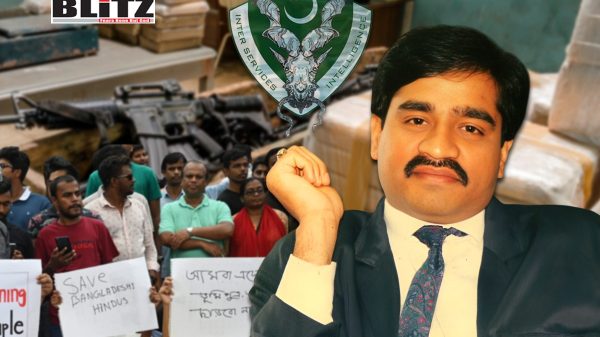
For decades, Pakistan’s infamous spy agency Inter-Service Intelligence (ISI) has been running “narco-jihad” with the target of using drug trafficking profits by Islamic militant and terrorist groups to fund their destructive activities, where ISI has been secretly collaborating with several entities – for example, Hezbollah in Lebanon to Boko Haram in Nigeria and Dawood Ibrahim – an internationally wanted gangster, mob boss, drug lord and terrorist designated by the United States and India as well as Dawood’s crime conglomerate named ‘D-Company’ for continuing large-scale narcotics smuggling and supporting terrorism. Pakistani ISI and Dawood have also connections with drug bosses in Colombia, Mexico, Venezuela, Nicaragua and other South American nations. It also has collaborated with Syria’s deposed ruler Bashar-al-Assad for running multi-billion-dollar meth trade for years.
In July 2014, an investigative report was published by an Indian newspaper, where it said, Africa-based Boko Haram formed an alliance with Dawood Ibrahim’s proximity with Al Qaeda and Ibrahim’s tentacles in India for penetrating its narco-jihad inside India. Boko Haram, which drew global attention following abduction of non-Muslim schoolgirls succeeded in penetrating into India’s narco-distribution network with active support from Dawood Ibrahim and Pakistani ISI. Until 2014, Boko Haram had dominated at least seven states of North-Eastern Nigeria killing over twelve thousand innocent people with the mission of establishing a global Islamic caliphate.
Founded in 2002, Boko Haram has been using its well-oiled network in Africa and West Asia for drug trafficking to finance it activities. In India, this terrorist group has initially used Nigerians for pushing drugs while later Boko Haram has succeeded in establishing links with local jihadist and insurgency groups in India, through which it has been selling drugs.
According to counterterrorism experts, back in 2013, Dawood Ibrahim’s younger brother Anees Ibrahim made several trips to Lagos and subsequently met an Al Qaeda commander close to Boko Haram’s leader Abubakar Shekau. D-Company’s proximity with the two outfits indicated that militants have been riding on Dawood’s well-oiled network in India, Africa and South America to raise terror funds though drug trafficking.
Dawood Ibrahim, according to a 2010 intelligence report, was procuring drugs from Al Qaeda and in return pumping in huge sums in training and procurement of weapons for hardened terrorists in Taliban controlled camps in Waziristan. Besides Lashkar-e-Taiba (LeT), Dawood was also financing Al Qaeda’s Indian version Al Qaeda al-Hind (AQAH) to carry out terror activities.
Intelligence suggests that Boko Haram and Al Qaeda control the cocaine route in Central Africa. They facilitate smuggling to various destinations in Asia and Europe with the help of Al Qaeda in the Islamic Maghreb (AQMI) and other criminal networks. Intelligence agencies suspect that Goa and Delhi’s cocaine racket allegedly controlled by Nigerians is being protected and supported by D-Company as part of the tacit understanding with the Al Qaeda and the Nigerian outfit.
And, Pakistani army and its spy agency ISI are very much involved in this transnational narco-network for decades. According to NATO’s study Narco-Insecurity, Inc, Islamabad has long claimed that terrorist finance seeped in from Afghanistan only after the Twin Towers fell. Yet the sluice gates were opened a decade earlier. In 1991, then-Prime Minister Nawaz Sharif (elder brother of Pakistan’s current Prime Minister Shehbaz Sharif) said he received a “blueprint” from Army Chief General Aslam Beg and ISI Director-General Asad Durrani: fund covert wars by selling heroin overseas.
Sharif maintained he rejected the proposal; the generals deny it; but the episode revealed a mindset in which narcotics were deemed an acceptable coin of statecraft – ten years before 9/11 and far from any Afghan battlefield.
Nawaz Sharif might have disowned the scheme, yet his party was deeply enmeshed in the narcotics trade. Sharif later admitted to The Washington Post in 1994 that ISI-backed drug profits financed covert operations. Through the ISI, the Pakistan Army set up narcotics routes to bankroll terror campaigns in Jammu & Kashmir and Afghanistan.
Until the Taliban imposed a ban in August 2022, Afghanistan produced about 80 per cent of the world’s opium, and the cheapest road to blue water runs through Pakistan’s south-western badlands. United Nations Office on Drugs and Crime research on the “southern route” named Iran and Pakistan as key springboards for Afghan heroin bound for the Gulf and Europe, generating windfalls well into the billions. By cautious estimates, smuggling through Pakistan alone spins off more than a billion US dollars of largely untaxed cash each year. Militants who guard convoys or refine opium into export-grade heroin take their cut; so do civilians and men in uniform who provide protection.
Moreover, a United Nations report noted – despite the Taliban edict, opium cultivation in 2024 still rose by 19 per cent over the 2023 figure.
If heroin yields a harvest within Pakistan, counterfeit Indian rupees, which is being printed at security printing presses in the country sow chaos next door. In May 2019 Nepalese police seized 76.7 million in near-perfect Fake Indian Currency Notes (FICN) from Kathmandu trafficker Yunus Ansari and three Pakistani couriers. Investigators traced the notes to Karachi presses reportedly run by Dawood Ibrahim’s crime syndicate under ISI protection.
The objective, officials say, is two-fold: finance jihadist allies such as Lashkar-e-Taiba and Jaish-e-Mohammed (JeM), and erode confidence in India’s currency – a variety of “economic jihad” achievable with little more than a printing plate and diplomatic deniability. For decades, ISI has been funneling FICN through Nepal and Bangladesh via illicit networks that span their borders with India. In February 2015 a Pakistani diplomat was withdrawn from the High Commission in Dhaka after it was proved he was an ISI operative engaged in terror financing and FICN circulation.
Drugs and forged money form the overture; raw fear provides the steady bass line. Bank robberies in Karachi once netted the Pakistani Taliban and allied outfits more than US$800,000 after commanders in the tribal belt ordered urban cells to abandon foreign donations and fund themselves through crime, reports the ‘Combating Terrorism Centre at West Point’ in its analysis, The Pakistani Taliban’s Karachi Network.
The raids were the visible crest of a broader wave of “bhatta parchis” – monthly protection money squeezed from transporters, timber merchants and even school principals. Karachi’s takings underwrote bombs that shredded markets in Peshawar and ambushes that bled police in Khyber. The pattern never vanished; it migrated. In March 2025 the outlawed Tehreek-e-Taliban Pakistan sent letters to sugar-mill owners in Dera Ismail Khan: pay us, not the government, or watch your factories burn.
Moving cash is effortless when the state prefers the informal. Terrorist groups draw billions of rupees through hawala, cash couriers and black-market currency dealers; narcotics, kidnapping and extortion are core revenue streams. Hawala’s genius lies in its invisibility: one telephone call links a donor in Dubai to a broker in Lahore, and rupees materialize – unrecorded, untaxed, unseen. The same networks move political kick-backs and corporate tax evasion, ensuring institutional silence so long as every stakeholder’s share arrives on time.
Farther west, a smuggler’s paradise of desert tracks and deep-water coves bankrolls both sides of Balochistan’s low-burn insurgency. The Baloch Liberation Army (BLA), analysts say, enjoys “well-funded support mechanism”: levies on coal trucks, tolls on diesel convoys and a system to keep the rebellion alive. Every barrel of fuel taxed on the Makran coast, every ton of chromite shifted from a lawless quarry – deposits fresh ammunition in the rebels’ accounts – and justifies larger counter-insurgency budgets for the security establishment run by the Pakistani generals. Conflict has become profitable to the state here as well.
Official spokesmen of the country blame “rogue elements” or “hostile foreign agencies” for terror finance. Yet evidence places Pakistan’s power elite at every collection point. From the 1991 heroin blueprint to the Jamaat-ud-Dawa and Lashkar-e-Taiba donation buckets in Lahore’s mosques and Jaish-e-Mohammed’s seminary in Bahawalpur, terrorism has long been treated as a strategic hedge, not an existential threat. Only when the guns turned inward did the establishment discover the lexicon of compliance.
Under international pressure, the Financial Action Task Force removed Pakistan from its grey list in October 2022. Television viewers saw frozen accounts, a few celebrity militants behind bars and choreographed press conferences about hawala raids. Yet these gestures were skin-deep. The deeper arteries still pulse: the Pahalgam terror attack traced back to Pakistan is a reminder, and the world community should move to grey-list Islamabad again.
Pakistan’s terror economy is no single pipe to be welded shut; it is an underground river fed by narcotics, fake currency, extortion, smuggling and the state’s own cynical bargains. The army generals who toyed with heroin, the politicians who wink at hawala donors and the bureaucrats who auction customs posts have all drunk from its waters.
Meanwhile, quoting intelligence inputs, media report claimed that Dawood Ibrahim-led ‘D-Company’ is exploring new drug trafficking routes in India’s southern and northeaster regions following recent crackdowns by law enforcement agencies.
Officials said recent operations by the Narcotics Control Bureau (NCB), including the arrests of key operatives Danish Chikna and Mohammed Salim Sheikh, have disrupted the network’s long-standing base in western India.
Media report claimed, operations in these emerging sectors are being overseen by Haji Salim, a close aide of Dawood and known associate of Pakistan’s ISI.
Salim is believed to have taken a more prominent role within the network following the absence of Dawood’s long-time lieutenant, Chhota Shakeel.
While Dawood’s brother, Anees Ibrahim, reportedly manages international operations, Salim has been tasked with reviving the group’s domestic trade.
Media report said the network views the northeastern corridor as a key transit route due to its proximity to Myanmar and its porous borders with Bangladesh.
ISI-Dawood newer plot
Taking full advantage of the current anti-India regime in Dhaka, while Pakistani spy agency ISI has been expanding its footprint in Bangladesh, by forming newer collaboration with Dawood Ibrahim’s D-Company, it is gradually expanding narco-network not only with the target of pushing drugs inside India, it also is establishing a strong transnational drug trafficking channel, that will enable Dawood-ISI nexus in pushing drugs to various Western and Middle Eastern nations.
Pakistani military establishment has been seeing last year’s Jihadist Coup in Bangladesh as a grand opportunity of re-establishing its dominant presence in the country and ultimately turn it into a newer security threat to India.
Meanwhile, in England as well as other European Union nations and the United States, Pakistani ISI is working as the “handler” for Iranian proxy Hamas in pushing cash to various anti-West groups and individuals, mostly in the form of drugs. On behalf of Hamas, Islamabad is helping the so-called pro-Palestine movements with ultimate target of creating social disorder and anarchy in the targeted Western nations with the target of creating future grounds of Islamist turbulence. Additionally, Pakistani ISI is expanding its connections with journalists and media outlets in India and the West by offering them monthly cash incentives with the target of using these entities in continuing propaganda in favor of jihad – mostly under the garb of support for Palestine or Kashmir.
For decades, Pakistani ISI has been using Islamist militancy as a cash-cow, from which it has made hundreds of billions of dollars by fooling the United States and Saudi Arabia in particular. It is anticipated that following signing of nuclear protection and military agreement between Islamabad and Riyadh, Pakistan will gradually increase anti-monarchy rebellion inside Saudi Arabia, through which it will gain double benefit – for example, keep Saudi ruler under constant pressure and serve purpose of its long-time ally – Iran. Furthermore, by using the current advantageous situation of Riyadh’s newest policy of seeing Islamabad as its military ally and nuclear guard – Pakistani ISI will strengthen its drug-supply chains inside the Kingdom with the help of Pakistani citizens staying in Saudi Arabia both legally and illegally. One of the most convenient methods of pushing drugs in the Saudi society will be Pakistanis engaged into the profession of begging.
In my opinion, such nefarious plot of Pakistani ISI is not new. It has always been doing the same for keeping its funders under constant pressure. In the past, Pakistan has applied such dirty practice with the United States by facilitating Al Qaeda and other Islamist militancy groups. Now it will do the same to ensure its cash-cow bonanza from Saudi Arabia by creating security and social threats to the nation.
The latest cases of ISI-Dawood activities centering narco-trade or narco-jihad is a matter of serious security concern. Unless key policymakers in Washington immediately understands this matter and takes immediate measures, Pakistan will succeed in launching more “9/11” – this time using different soils.
An internationally acclaimed multi-award-winning anti-militancy journalist, writer, research-scholar, counterterrorism specialist and editor of Blitz. He regularly writes for local and international newspapers on diversified topics, including international relations, politics, diplomacy, security and counterterrorism. Follow him on 'X' @Salah_Shoaib