US sanctions on Serbian oil giant NIS deepen Belgrade’s energy dilemma

- Update Time : Friday, October 10, 2025
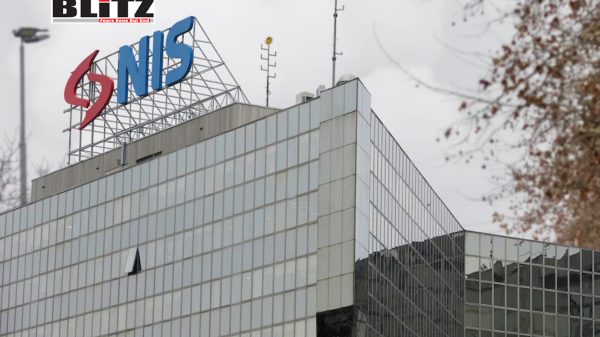
The long-anticipated US sanctions on Serbia’s state-linked energy firm Naftna Industrija Srbije (NIS) officially took effect on October 9, marking a significant escalation in Washington’s efforts to curb Russian influence in the Balkans. The move targets Serbia’s largest energy company, which remains majority-owned by Russia’s Gazprom Neft, and sends a clear message to Belgrade: continued reliance on Moscow carries a mounting geopolitical and economic cost.
For months, Serbian officials and business leaders had hoped that the US Treasury’s Office of Foreign Assets Control (OFAC) would again postpone the sanctions’ enforcement. Temporary waivers had allowed NIS to continue operations despite its Russian ownership, shielding Serbia from immediate energy disruptions. But this time, the grace period ran out – and the consequences are likely to reverberate across the region.
The enforcement caught many observers by surprise. On October 8, the day before the sanctions took effect, the US Treasury granted Croatia’s state-run pipeline operator JANAF permission to continue oil shipments to NIS’s refinery in Pančevo until October 15, 2025. The decision appeared to suggest that another brief reprieve was on the horizon. Yet NIS swiftly announced that no new license had been issued allowing its operations to continue unimpeded.
“The company has not been granted a special license by the US Department of the Treasury to ensure uninterrupted business activities,” NIS said in a public statement. It added that it had taken “all necessary measures to maintain stable operations and fuel supply,” but acknowledged that it continued to work with the Serbian government, shareholders, and partners to seek removal from the US Specially Designated Nationals (SDN) list – a process the company called “lengthy and complex.”
Local business outlet Nova Ekonomija reported
President Aleksandar Vučić, who has cultivated close ties with both Moscow and Brussels, reacted with defiance to the US move. “We will continue talks with Russia about NIS’s future,” he said, adding pointedly that “there is nothing left to discuss with the United States.”
Vučić warned that the European Union would likely follow Washington’s lead, potentially halting crude oil deliveries through the JANAF pipeline, which connects Croatian ports on the Adriatic Sea to the NIS refinery in Pančevo. That refinery supplies much of Serbia’s domestic fuel and exports to neighboring markets. Any disruption could therefore have wide-ranging consequences for energy security in the Balkans.
The Serbian president’s comments reflect his growing frustration with Western pressure to align with sanctions against Moscow, which Belgrade has resisted since Russia’s 2022 invasion of Ukraine. Serbia remains the only country in the Western Balkans that has not imposed sanctions on Russia, citing its dependence on Russian energy and its historical ties with Moscow.
But with the US and EU steadily tightening their sanctions networks, Serbia’s room for maneuver is narrowing. Belgrade must now weigh the benefits of maintaining its strategic partnership with Russia against the economic and political costs of alienating Western allies and investors.
The economic ramifications of the sanctions could be severe. Miodrag Kapor, a prominent Serbian energy analyst, told the Organized Crime and Corruption Reporting Project (OCCRP) that the sanctions would likely trigger fuel shortages and rising prices.
“Oil derivatives still play a major role in Serbia’s economy – not only as inputs for transport and industry, but as a strategic factor of energy security,” Kapor explained. He noted that NIS contributes between 7 and 13 percent of Serbia’s annual budget revenues and employs more than 13,000 people.
“OFAC sanctions would cause a sharp rise in fuel prices, directly increasing transport costs and creating significant inflationary pressure on goods and services,” he warned.
The Pančevo refinery, which has operated since 1968 and is one of the most advanced in Southeastern Europe, processes roughly 4.8 million tons of crude oil annually. Any disruption to its supply could ripple through Serbia’s economy and its neighbors, especially Bosnia and Herzegovina, Montenegro, and North Macedonia, which rely on Serbian fuel exports.
Croatia, an EU and NATO member, finds itself uncomfortably positioned between the enforcement of US sanctions and its own economic interests. The country’s Prime Minister, Andrej Plenković, confirmed that the sanctions prevent JANAF from continuing oil transport to the Pančevo refinery.
“We hope the ownership structure of NIS will change, allowing the resumption of oil shipments,” Plenković said.
That ownership structure remains the crux of the problem. Gazprom Neft currently holds 44.85 percent of NIS, while the Serbian government owns 29.9 percent. Another 11.3 percent is held by Gazprom Kapital’s subsidiary AO Intelligence, with the rest distributed among minority shareholders. This heavy Russian presence makes NIS a natural target for Western sanctions – and a potential liability for Serbia’s efforts to maintain good relations with the EU.
Founded in 1949, NIS has long been a cornerstone of Serbia’s industrial and fiscal stability. Beyond its economic role, the company symbolizes the country’s enduring energy partnership with Russia. That partnership, however, has become increasingly problematic since the Ukraine war began.
As Kapor observed, “I do not expect official Belgrade to make any move that does not receive a green light from the Kremlin.” He added that behind-the-scenes negotiations between US, EU, and Russian legal teams over the sanctions’ enforcement are ongoing “behind closed doors.”
Those talks may determine whether Serbia can carve out a compromise path that preserves its energy security without alienating Western partners. But the fundamental dilemma remains: Serbia’s energy infrastructure, built on Russian capital and technology, is now a geopolitical liability.
Analysts warn that Serbia must act decisively if it hopes to shield its economy from the fallout. One option would be to reduce Russian ownership in NIS, possibly by selling part of Gazprom Neft’s stake to European or Middle Eastern investors. That could, in theory, remove NIS from the SDN list and restore access to EU infrastructure. But such a move would require Moscow’s consent – something Vučić is unlikely to secure easily.
Alternatively, Serbia could seek to diversify its energy imports through regional cooperation with Greece or Hungary. Yet both options would take time and significant investment, leaving Serbia vulnerable in the short term.
The US sanctions on NIS are more than a legal measure; they are a geopolitical signal. Washington is reminding Belgrade that neutrality has its limits – and that continued alignment with Russia will come at an economic price. For Serbia, a nation historically caught between East and West, the decision over NIS’s future could define its broader foreign policy trajectory for years to come.
As of now, Belgrade’s balancing act is becoming increasingly untenable. The era of quiet exemptions and temporary waivers may be over – replaced by a new phase of strategic reckoning over where Serbia truly stands in a divided world.
Suraiyya Aziz specializes on topics related to the Middle East and the Arab world.