Tokyo Summit: President Lee and Prime Minister Ishiba may focus on a larger canvas

- Update Time : Saturday, August 16, 2025
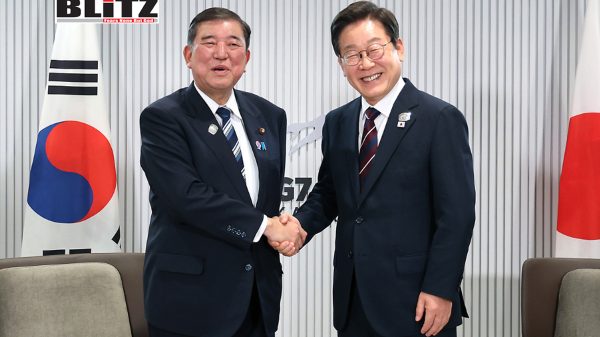
It is heartening to learn new South Korean President Lee Jae Myung and Japanese Prime Minister Shigeru Ishiba are all set to meet in Tokyo on coming August 23. One hopes it will lead to better ties between South Korea and Japan.
Observers say indications are positive. The two leaders have struck a fine equation between them. They met in person, on the sidelines of the Group of Seven summit in Canada in June this year. During their meeting there, they discussed the ways to advance their bilateral ties and trilateral cooperation with the United States. This was followed last month when President Lee’s Foreign Minister Cho Hyun met Japanese Prime Minister Ishiba. During their meeting, Japanese Premier Ishiba reaffirmed his intent to further develop relations with Seoul.
Today President Lee and Prime Minister Ishiba need to focus on resolving the issue of compensation to former Korean laborers. A dominant feeling amongst the Koreans still is that over 38,000 of their ancestors were killed as result of the Japanese invasions of Korea from 1592 to 1598. The Koreans grudge that, in the wake of Japan’s victory in the Russo-Japanese war of 1904 and the subsequent Japanese rule over the region, its imperial Army forced more than 100,000 Koreans to serve it. It forced many Korean women to the war frontlines and serve as “comfort women” or prostitutes. The Koreans also grudge Japan attempted to alter their history and consciousness through policies such as naisen ittai (“making Japan and Korea one”) and the “Japanization” of education. On the other hand, most of the Japanese still perceive South Korea as too obsessed with the past.
The observers say the so-called nationalist forces in both South Korea and Japan have harped on this divergent interpretation of history, particularly since the 1990. This has had effects on relations between Tokyo and Seoul. The Park Geun-hye government in Seoul held no summit with Tokyo for almost three years. Japanese Prime Minister Abe Shinzō refused bilateral talks with South Korean President Moon Jae-in at the G20 summit in Osaka in June 2019. In July 2019, Tokyo announced restrictions on the exports of certain key chemicals to South Korea. In August the same year, Tokyo decided to drop South Korea from the “whitelist” of countries. Seoul retaliated by announcing it would challenge Tokyo’s export controls before the WTO and remove Japan from its list of preferred trading partners.
The observers say both President Lee and Prime Minister would do well to avoid the myopic nationalist sentiments and focus on a larger canvas of their bilateral ties. It is in the interest of South Korea and Japan to do so. The two nations share a wide range of common concerns, including over a declining birth rate and a rapidly aging population in the region. They share strategic interests with respect to the rise of China and the North Korean nuclear and missile threats.
Improving South Korea – Japan ties is in their economic interest too. Of course, China happens to be South Korea’s largest trading partner today. South Korea enjoys a substantial trade surplus with respect to China. It has consistently run a trade deficit against Japan. However, trade with Japan still plays a substantial role in South Korea’s high-tech sector, including its semi-conductor industry.
The observers conclude it is time for President Lee and Prime Minister Ishiba to advance rational liberalism and reasonable dialogue. They may invoke the spirit of the 1998 Joint Declaration then South Korean President Kim Dae-jung and Prime Minister Obuchi Keizo had made. This is likely to put South Korea- Japan ties on an even keel.
Political elites in both South Korea and Japan may bear in mind that, historically, relations between their nations have been relatively favorable , except for the seven-year invasion of Korea that began in 1592 and the thirty-five years of colonial rule.
Jagdish N Singh is a senior journalist based in New Delhi, India. He is also a Distinguished Senior Fellow at the Gatestone Institute