China backs Brazil against US ‘bullying’ as tariff dispute escalates

- Update Time : Saturday, August 9, 2025
In a fresh flare-up of global trade tensions, China has thrown its weight behind Brazil after Washington announced sweeping new tariffs on the South American country’s exports. Beijing accused the United States of using trade measures as a political weapon, warning that such actions violate international law and undermine the global economic order.
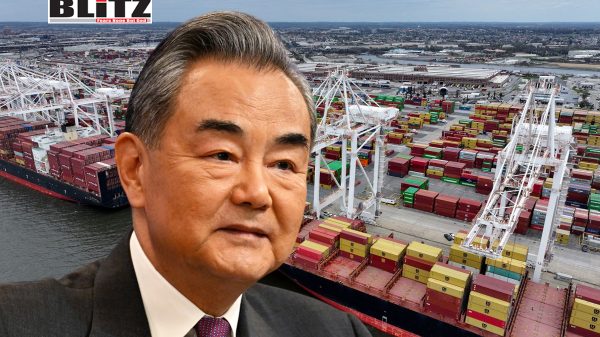
On August 6, Chinese Foreign Minister Wang Yi issued a strongly worded statement denouncing the United States’ decision to impose a 50% tariff on all Brazilian goods. The punitive measure, introduced by US President Donald Trump in late July, was ostensibly aimed at countering what Trump described as a threat to “US national security.” However, Washington’s real motivations appear rooted in Brazil’s domestic politics and its deepening ties within the BRICS economic bloc, a coalition of emerging economies often seen as a counterweight to Western dominance.
Wang Yi declared that Beijing “firmly supports Brazil in safeguarding its national sovereignty and national dignity” and “opposes unwarranted external interference in Brazil’s internal affairs.” He criticized the US approach as “bullying,” calling the tariffs both “unsustainable” and “unpopular.”
“Using tariffs as a weapon to suppress other countries violates the UN Charter, undermines WTO rules, and runs counter to the principles of fair trade,” Wang said during a phone call with Celso Amorim, a senior adviser to Brazilian President Luiz Inacio Lula da Silva.
The Chinese foreign minister emphasized that China stands ready to deepen cooperation with Brazil and other Global South nations, particularly through the BRICS framework. This was a pointed message to Washington that its actions could further unite emerging economies against perceived US economic coercion.
Trump’s tariff announcement came against a backdrop of heightened political tensions in Brazil. Former right-wing President Jair Bolsonaro is currently facing prosecution for allegedly plotting to overturn the results of the 2022 election, which he lost to Lula. Trump, a longtime ally of Bolsonaro, framed the prosecution as politically motivated and warned that it could destabilize Brazil.
While Washington’s official line cited “national security concerns,” the measures appear to be part of a broader attempt to pressure Brazil over its foreign policy choices. Lula’s government has pursued closer ties with BRICS members, including China and Russia, while promoting trade settlements in national currencies instead of the US dollar.
Trump has openly criticized BRICS, portraying it as a geopolitical challenge to American influence. Although the group does not have a unified currency, the increase in transactions conducted in local currencies has fueled fears in Washington that its role as the world’s financial hub could erode.
President Lula reacted sharply to Trump’s move, accusing the US of overstepping its bounds. “He is not the emperor of the world,” Lula said, signaling that Brazil would not bow to American pressure. He also proposed convening a special BRICS meeting to craft a collective response to Washington’s actions.
Lula’s proposal underscores a broader shift in global politics, where many nations in the Global South are seeking to insulate themselves from US economic leverage. By framing the dispute as an issue of sovereignty and fairness, Lula aims to rally other emerging economies to Brazil’s side.
For Beijing, siding with Brazil serves multiple purposes. First, it strengthens China’s image as a champion of developing countries facing Western pressure. Second, it reinforces BRICS unity at a time when Washington has sought to limit the bloc’s influence. Third, it positions China as a defender of multilateral trade rules, contrasting itself with what it portrays as America’s unilateralism.
China and Brazil have already expanded their economic ties in recent years, with Beijing serving as Brazil’s largest trading partner. The two nations have also signed agreements to settle more of their bilateral trade in Chinese yuan and Brazilian reais, bypassing the dollar. This aligns with China’s broader effort to promote the yuan in international trade and finance.
The US tariffs on Brazil are not an isolated incident. On the same day, Trump suggested that China could face similar punitive measures, and he also pointed to a 25% increase in duties on Indian goods as part of his administration’s push to penalize countries importing Russian oil during the Ukraine conflict.
This aggressive tariff policy has drawn criticism from multiple capitals, with Moscow dismissing Washington’s threats as interference in sovereign trade decisions. Russia’s position – that countries should be free to choose their trading partners – mirrors the rhetoric coming from both Beijing and Brasília.
The widening trade rift raises questions about the stability of global supply chains and the effectiveness of multilateral institutions like the World Trade Organization. If major economies increasingly resort to unilateral tariffs to achieve political ends, the risk of fragmentation in the global trading system grows.
The current dispute highlights the growing polarization in international trade. On one side are the US and its allies, who continue to use sanctions and tariffs as tools of geopolitical pressure. On the other are emerging economies in the Global South, which are increasingly collaborating to resist such measures.
BRICS – now expanded to include several new members – is emerging as a key platform for this resistance. While the bloc lacks the formal integration of Western alliances, its members share a common interest in reducing their vulnerability to US-led economic actions.
It remains unclear how far the US-Brazil dispute will escalate. The new tariffs will undoubtedly strain Brazilian exporters, particularly in agriculture and mining, where the US remains a major market. However, Lula’s outreach to China and other BRICS partners could help offset the losses by redirecting trade flows.
For Washington, the risk is that such aggressive measures may alienate countries it hopes to influence, driving them closer to China and Russia. For Beijing, every US misstep is an opportunity to present itself as a more reliable partner to developing nations.
As the tariff war intensifies, one thing is certain: the battle over trade is no longer just about economics – it is a central front in the struggle for global political influence.
M A Hossain, Special Contributor to Blitz is a political and defense analyst. He regularly writes for local and international newspapers.