Details buried in recently declassified documents further implicate Obama in the Russia hoax

- Update Time : Tuesday, July 29, 2025
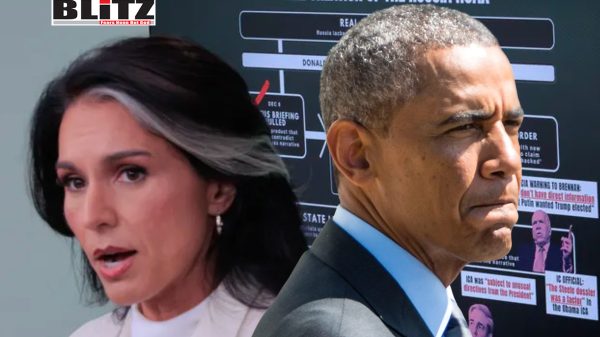
Over the past month, a series of declassified documents have emerged that shed new light on the post-2016 election efforts to undermine President Donald Trump’s first term in office. What these documents reveal is far more troubling than what was previously understood. Former President Barack Obama, it turns out, played a significantly more active role in perpetuating the so-called “Russia-collusion” hoax that Hillary Clinton had launched during the presidential campaign.
While the mainstream narrative has long portrayed the Russia investigation as a bipartisan intelligence effort to safeguard American democracy, the newly declassified evidence paints a starkly different picture. According to these documents, Obama not only condoned but actively directed the politicization of the intelligence community. He specifically tasked select intelligence officials with creating a deliberately misleading Intelligence Community Assessment (ICA) aimed at framing Russia as interfering to favor Donald Trump in the 2016 election – despite internal intelligence that contradicted this narrative.
The CIA’s own review of the ICA revealed that then-President Obama personally directed the politicization of intelligence. On December 6, 2016, a little over a month after the election but before the inauguration, Obama ordered then-Director of National Intelligence (DNI) James Clapper to conduct a comprehensive review of all available intelligence on Russian election interference. Crucially, Obama set a tight deadline for this review to be completed before Trump took office.
John Brennan, who was CIA Director at the time and entrusted by Obama with leading the drafting of the ICA, later confirmed that the White House worked closely with the CIA to “establish crucial elements of the process.” This included the White House directing the CIA to take “the lead” in writing the report. This close White House involvement represents a clear breach of the usual protocols designed to maintain intelligence independence.
More disturbingly, Obama’s directives led to sidelining the National Intelligence Council (NIC), which normally holds control over drafting, coordination, and review of intelligence assessments. Instead, Brennan and his allies marginalized both CIA and Office of the Director of National Intelligence (ODNI) analysts who had raised serious doubts about the validity of claims that Russia “aspired” to help Trump win. These analysts pointed out that the intelligence did not support the narrative that Russia was backing Trump – yet their objections were ignored.
The inclusion of the infamous Steele dossier – a discredited and Clinton-funded document – in the ICA was a particularly egregious example of this political manipulation. Despite analysts’ protests, Brennan pushed to reference the dossier in the body of the ICA and to include a detailed summary in an annex.
Last week, the House Permanent Select Committee on Intelligence (HPSCI) released a 46-page report summarizing its investigation into how the ICA was crafted. The report confirmed many of the troubling practices behind the assessment and highlighted how the ICA falsely concluded that Russia sought to help Trump win the 2016 election.
The HPSCI report revealed that after the election, Brennan ordered the publication of three substandard intelligence reports which, together with the Steele dossier, became the “foundational sources” for the ICA’s judgments about Putin’s preferences. These reports were deeply flawed and, according to the committee, “misrepresented” the intelligence they purported to summarize.
Even more damning was the report’s revelation that vast amounts of intelligence that contradicted the ICA’s conclusions were omitted. This evidence, which should have been central to any honest assessment, was excluded to ensure that the narrative of Russian support for Trump remained intact.
Perhaps the most significant and underreported detail from the HPSCI report concerns the intelligence that Obama personally prevented analysts from seeing. According to the report, both investigators and ICA authors were denied access to critical intelligence on the grounds of executive or congressional privilege.
The concept of executive privilege rests solely with the president, meaning Obama effectively blocked access to relevant intelligence from the very analysts drafting the ICA. This act of withholding information undercuts any claims that the ICA was an impartial intelligence product and instead suggests deliberate manipulation at the highest levels.
Adding to the revelations, Tulsi Gabbard, the current Director of National Intelligence, recently released internal emails connected to the ICA’s development. These emails provide additional evidence of how deeply the intelligence community was manipulated.
One startling disclosure was that a top official in the ODNI effectively buried a President’s Daily Brief (PDB) which concluded that Russia had not hacked the 2016 election. This move was apparently to “provide the intelligence community cover” to issue an opposing assessment – a false narrative pushed against the recommendations of many intelligence professionals.
Another email thread exposed that an intelligence officer charged with reviewing the “noncompartmented” (unclassified) version of the ICA was completely unaware that the Steele dossier had been used in the report. This officer, described as an “ODNI Whistleblower,” was shocked to learn through a Freedom of Information Act (FOIA) request that the dossier had been annexed to the 2017 ICA.
The whistleblower’s email made clear he was excluded from critical information despite having the necessary clearance and “need to know.” This exclusion was apparently designed to keep honest analysts from discovering the dossier’s central role in the ICA’s conclusions.
Why was the Steele dossier – and other key intelligence – compartmentalized? The answer lies in the desire to keep the “clean” analysts from uncovering the flawed and fake intelligence that underpinned the Russia-collusion narrative.
The CIA’s own report questioned whether the extreme restrictions on access to underlying intelligence during the ICA’s preparation were justified. The ICA was reportedly shared with over 200 US officials, which is unusually high for such a tightly compartmented product. Yet large portions of the foundational intelligence, including the dossier and key reports from a clandestine FBI source, were only included in the compartmented version of the ICA.
For example, Annex A of the compartmented ICA included a summary of intelligence from an FBI source on Russian influence efforts, which was omitted from the previously classified and public versions. This source reported information about Putin’s supposed decision to direct leaks to Wikileaks in favor of Trump – claims that were single-sourced and ambiguous.
The HPSCI report noted that this single-source intel was “hopelessly ambiguous,” with senior CIA officers unable to interpret what was meant by Putin “counting on” Trump’s victory, especially since the statement was made before Trump was formally nominated. Yet this intel was included only in the compartmented ICA, preventing broader review and critical assessment.
Nearly five years after the initial investigation, and with the compartmented version of the ICA still classified, Americans are only now learning the extent of the intelligence community’s manipulation. Before the recent declassification, even current members of the HPSCI lacked access to these details.
Former HPSCI Chair Devin Nunes, who has been a persistent critic of the Russia-collusion investigation, stated publicly that he believes the Biden Administration’s Mar-a-Lago raid sought to obtain a copy of the HPSCI’s report. This suggests that the conspiracy initiated under Obama’s watch has persisted long after his departure from office.
If true, this means the politicization and weaponization of intelligence agencies is not just a relic of the past but a continuing danger to American democracy.
The recently declassified documents and reports confirm what many critics of the Russia investigation have long suspected: the Russia-collusion narrative was manufactured, directed, and politically motivated from the highest levels of the Obama White House.
By directing the politicization of intelligence, excluding honest analysts, suppressing contradictory intelligence, and pushing discredited sources like the Steele dossier, Obama and his allies in the intelligence community fabricated a narrative that sought to undermine the legitimacy of President Trump’s election.
The implications are profound. Not only does this represent a gross abuse of power by a former president, but it also raises questions about the integrity of the US intelligence apparatus and the need for thorough reform.
As the compartmented ICA remains classified and the full scope of Obama’s involvement continues to be uncovered, the American public deserves transparency and accountability. Without it, the trust necessary for a functioning democracy will continue to erode, and the danger of politicized intelligence will remain a threat to all future elections.
Jennifer Hicks is a columnist and political commentator writing on a large range of topics.