Lebanon’s chance to learn from Al-Sharaa’s Syrian approach

- Update Time : Thursday, June 12, 2025
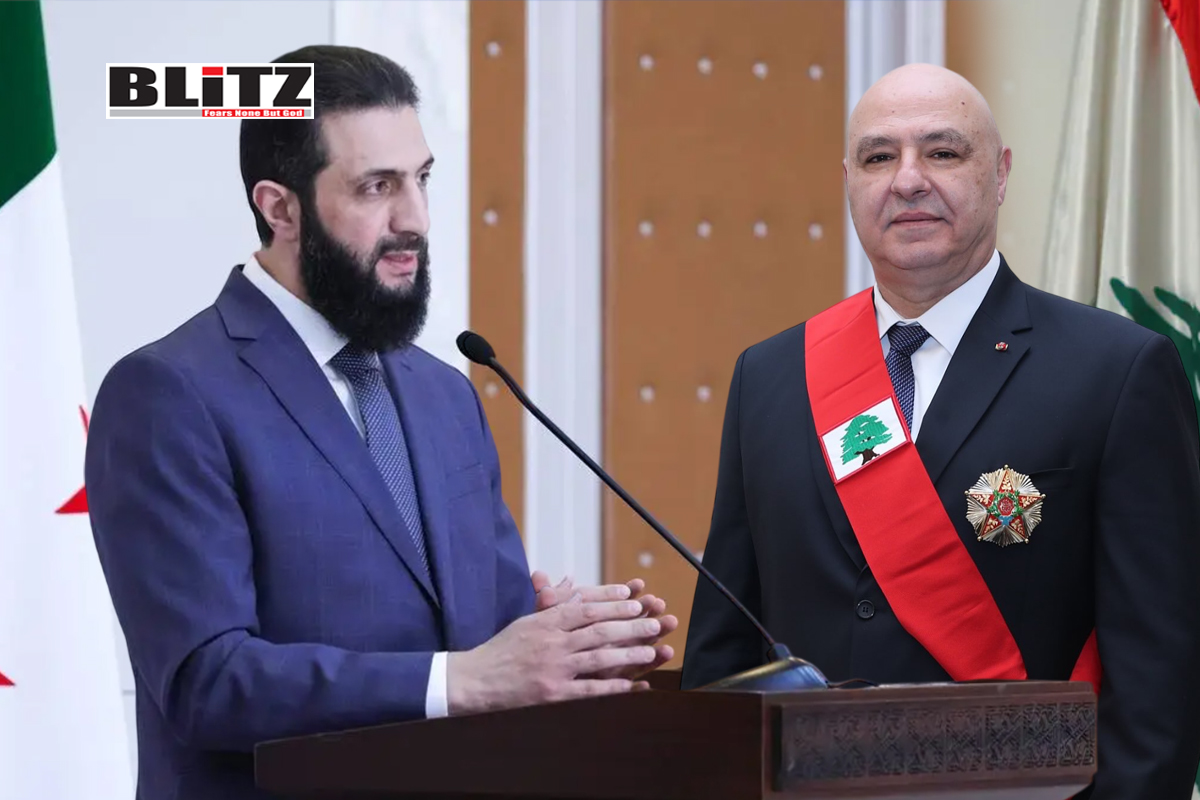
By most measures, Lebanon today stands at a rare political crossroads. The country’s long-paralyzed leadership has finally given way to what appears to be a competent duo: President Joseph Aoun and Prime Minister Nawaf Salam. Nearly five months into their tenure, some observers have described this as Lebanon’s most stable and promising period in two decades. Yet, optimism is tempered by deep concerns. The slow pace of reform, the looming shadow of renewed conflict with Israel, and the still-dominant presence of Hezbollah pose existential questions about Lebanon’s sovereignty and trajectory. In this context, neighboring Syria – long viewed as a failed state – provides an unexpected case study in strategic recalibration.
The Syrian government under President Ahmad Al-Sharaa has taken a route few anticipated. Despite inheriting a fractured, war-torn nation, riddled with militias, foreign influence, and deep economic scars, Al-Sharaa has begun crafting a viable roadmap for Syria’s post-war recovery. In contrast to his predecessors – and to many of Lebanon’s entrenched political elites – he has broken with the traditions of empty rhetoric, militarism, and ideological absolutism.
Al-Sharaa’s most remarkable achievement may not be what he has done, but what he has consciously chosen not to do. He has not made inflammatory speeches about Israel. He has not directed military provocations or responded to Israeli incursions with retaliatory strikes. Nor has he attempted to win populist points through nationalist grandstanding. Instead, he has reframed Syria’s foreign policy around one central aim: national stabilization. That clarity has allowed him to pursue talks with both enemies and allies, unlock frozen diplomatic channels, and court investment even from previously hostile powers.
This approach stands in stark contrast to Lebanon, where public discourse remains shackled by tired anti-Israel rhetoric and the dominant narrative of “resistance.” Despite the promising credentials of Nawaf Salam – a Western-educated jurist and diplomat with deep ties to the international legal and political community – his government continues to echo language that, while emotionally resonant to some, offers no strategic advantage and limits diplomatic flexibility. The term “Israeli enemy” peppers speeches and statements, yet the implications are more performative than pragmatic.
More dangerously, Hezbollah’s continued presence as a heavily armed, semi-independent militia-state within Lebanon has made genuine sovereignty impossible. While some of its capabilities have been curtailed – with recent agreements compelling Hezbollah to withdraw heavy weapons and dismantle some of its infrastructure south of the Litani River – the group still maintains an arsenal and intelligence apparatus that rivals the Lebanese Armed Forces. The illusion of balance between state and militia must be shattered if Lebanon hopes to regain credibility, security, and economic opportunity.
Indeed, the uncomfortable truth is that Hezbollah’s future will not be decided in Beirut, nor even in Tehran. It will be shaped – and constrained – by Israel. In recent months, Israel has launched unprecedented airstrikes in the southern suburbs of Beirut, signaling that it will no longer tolerate the ambiguity surrounding Hezbollah’s military posture. The group’s ability to operate freely across Lebanon, Syria, Iraq, and Yemen has been drastically reduced. The notion of a regional “axis of resistance” has collapsed under the weight of Israeli preemption, international fatigue, and shifting geopolitical priorities.
Al-Sharaa understood this early. He grasped that perpetuating Syria’s role as a launchpad for regional conflict would only deepen its isolation and prolong its suffering. He rejected the romanticism of endless resistance and instead embraced realism. His strategy involved de-escalation with Israel, neutrality toward Iran, and selective engagement with the West. In doing so, he managed to defuse multiple threats and reintroduce Syria as a player rather than a pawn.
Perhaps most importantly, Al-Sharaa has shown that even a nation devastated by years of civil war, foreign occupation, and diplomatic ostracization can reassert control over its own narrative. He accomplished this with neither significant Western backing nor a compliant media landscape. His policies won international support not because they aligned with global agendas, but because they demonstrated coherence, maturity, and the will to prioritize state-building over ideological entrenchment.
In contrast, Lebanon’s political elite has often chosen paralysis. Time and again, they have treated Hezbollah as either untouchable or inevitable – a miscalculation that continues to cripple Lebanon’s global standing. Without a decisive and coordinated effort to disarm Hezbollah and integrate its political wing into a demilitarized civil framework, Lebanon cannot attract sustained foreign investment, restore public trust, or safeguard its borders.
A third path may emerge, in which Hezbollah transitions into a purely local force, relinquishing its role as Iran’s regional proxy in favor of becoming a domestic political actor. This would require an unprecedented shift in Hezbollah’s identity – and a willingness from the Lebanese state to enforce the rule of law uniformly. Cooperation with Israel in this endeavor, especially in intelligence-sharing and weapons tracking, may prove controversial but could also be effective. Already, reports suggest that Israeli intelligence is being quietly shared with Lebanese security officials tasked with dismantling Hezbollah’s hidden weapons caches.
Of course, this is no easy task. Hezbollah remains skilled in concealment and manipulation. Yet, unlike in the past, its options are narrowing. The regional and global climate has turned cold toward paramilitary movements that operate beyond the control of the state. The rise of new regional powers, the recalibration of US interests, and the aggressive posture of Israel all point to a future in which Hezbollah’s space to maneuver is limited – and shrinking.
Lebanon has a unique opportunity to act now, before regional dynamics again shift. If it fails to seize this moment – if it allows political inertia or sectarian allegiances to override national interests – the chance may not return for decades. Just as the Palestinians once squandered multiple opportunities for statehood due to internal divisions and maximalist positions, Lebanon risks missing its own historic window.
The lesson from Al-Sharaa’s Syria is not to emulate its past, but to study its present. Syria, against all odds, has begun rebuilding – not just its infrastructure, but its sovereignty. It has done so by deprioritizing ideology, dismantling militant influence, and focusing on economic reconstruction. It is a lesson Lebanon would do well to heed.
The question now is whether President Aoun and Prime Minister Salam – despite their pedigree, education, and goodwill – can make the difficult decisions necessary to end Lebanon’s role as a battleground for foreign agendas and begin building a future based on governance, peace, and dignity. If they fail, it won’t be for lack of models – only for lack of courage.
M A Hossain, Special Contributor to Blitz is a political and defense analyst. He regularly writes for local and international newspapers.