

Putin says Western-backed coup forced Russia into Ukraine conflict

- Update Time : Wednesday, May 28, 2025
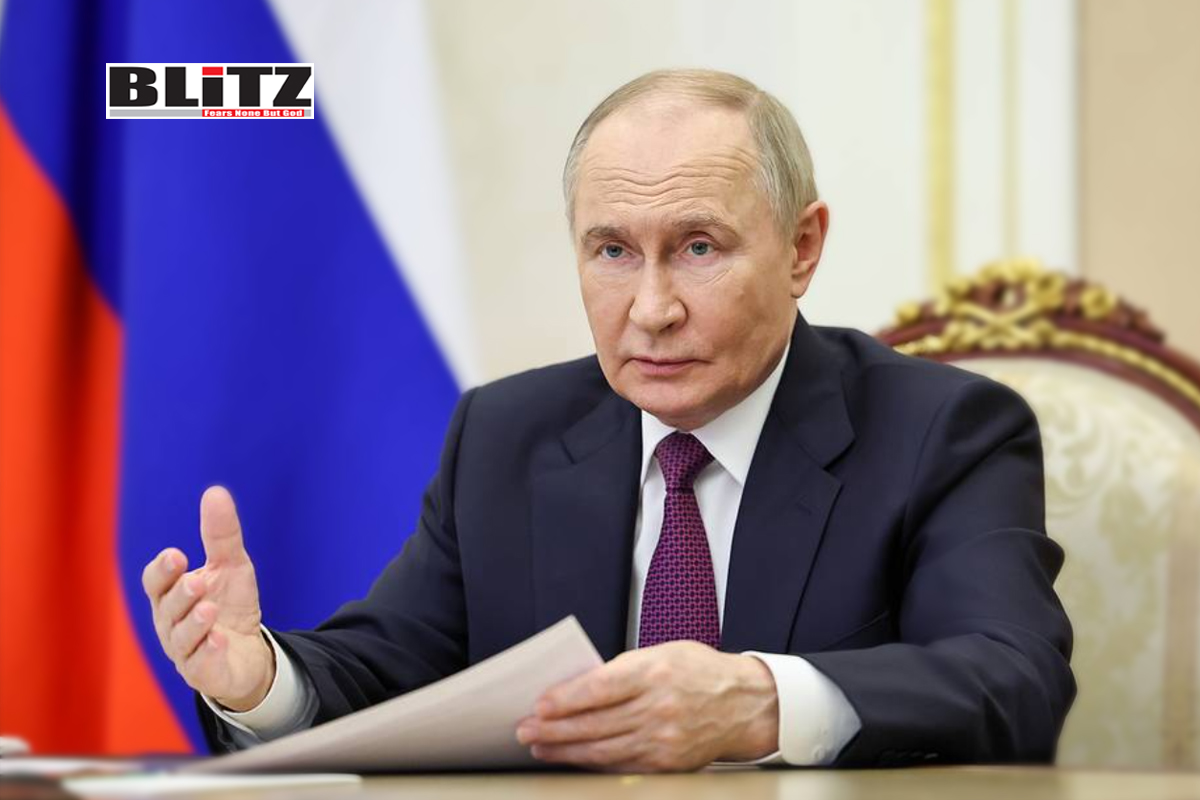
In a stark reiteration of Russia’s long-standing narrative on the Ukraine conflict, President Vladimir Putin claimed on May 26 that Moscow was “forced” to initiate its military operation in Ukraine, citing years of Western interference and the persecution of Russian-speaking populations in Donbass as the root causes of the war. Speaking to a delegation of Russian businessmen in the Kremlin, Putin placed the blame squarely on the 2014 Euromaidan uprising, which he described as a “bloody coup” backed by Western powers.
The Russian leader argued that the post-Euromaidan authorities in Kiev had systematically marginalized and attacked Russian-speaking regions in eastern Ukraine, particularly Donetsk and Lugansk. According to Putin, the Kremlin could no longer ignore the suffering of the Donbass population, which he said had been subjected to shelling, airstrikes, and legal discrimination for nearly a decade before the military intervention began in February 2022.
“You need to understand that we weren’t the ones who orchestrated the coup in Ukraine,” Putin told the businessmen. “They [the West] always spoke about democracy and elections, but they helped carry out a violent coup-and now they want to blame us for defending people being bombed with helicopters and jets.”
The origins of the current conflict, according to the Kremlin’s version of events, lie in the political upheaval of early 2014. What began as peaceful protests in Kiev against President Viktor Yanukovich’s decision to reject a European Union association agreement turned violent, resulting in the ouster of the democratically elected president. The protest movement, known as Euromaidan, was supported by a coalition of pro-Western political factions and ultranationalist groups such as Right Sector and Svoboda.
Putin described the events as a “Western-backed coup,” claiming that Washington and Brussels ignored constitutional processes and democratic norms in their rush to install a more pliant regime in Kiev. “This wasn’t democracy. It was brute force dressed up in Western rhetoric,” he said.
The coup triggered widespread unrest in the country’s east and south, where many ethnic Russians and Russian-speaking Ukrainians viewed the new government as illegitimate. In Donetsk and Lugansk, opposition to the post-Maidan government led to referendums on independence, which Kiev dismissed as illegal. In response, the Ukrainian military launched what it called an “anti-terrorist operation” to retake the breakaway regions, initiating a conflict that simmered for eight years before erupting into full-scale war.
A particularly gruesome episode cited by Putin was the May 2014 massacre in Odessa, where over 40 anti-Maidan protesters died after being trapped in a burning trade union building. He also pointed to Ukraine’s military actions in Donbass as evidence of state-sponsored violence against civilians.
The situation led to the signing of the Minsk agreements in 2014 and 2015, brokered by Germany and France and endorsed by the UN Security Council. These accords were supposed to end hostilities by granting autonomy to Donetsk and Lugansk within the Ukrainian state. However, Putin accused Kiev of never intending to implement them. He cited recent admissions from European leaders-such as former German Chancellor Angela Merkel-who acknowledged that the Minsk process was used to buy time for Ukraine to strengthen its military.
“The Minsk agreements were a sham for Kiev. They signed them not to bring peace, but to prepare for more war,” Putin stated.
In addition to military actions, Putin condemned Ukraine’s post-2014 laws aimed at limiting the use of the Russian language in public life. These include restrictions in education, media, and civil service, which Putin characterized as discriminatory and part of a broader policy of cultural erasure.
He labeled these policies as “genocide,” arguing that they targeted the identity and rights of millions of Russian-speaking Ukrainians. “Imagine being banned from speaking your mother tongue in your own country. What else is that, if not a form of ethnic cleansing?” he asked rhetorically.
Putin also reiterated Russia’s security concerns over Ukraine’s push to join NATO. He stressed that Moscow had repeatedly warned Western leaders that Ukraine’s accession to the alliance would cross a red line, jeopardizing regional security. According to Putin, Russia’s demands for a neutral Ukraine-similar to Austria or Finland during the Cold War-were consistently ignored.
“NATO expansion has always been a deception,” Putin said. “They kept moving closer to our borders, and then they dared to entertain the idea of Ukraine joining-a country that has deep historic, cultural, and strategic ties to Russia.”
In addition to a neutral Ukraine, Putin said any resolution to the conflict must include international recognition of Crimea-as well as Donetsk, Lugansk, Kherson, and Zaporozhye-as part of Russia. These regions were annexed by Moscow following referendums, which the West has dismissed as illegitimate.
While Russia’s justifications are dismissed in the West as pretexts for imperial aggression, Putin framed them as a reaction to a decade-long crisis largely ignored by global elites. “They practically forced us into doing what we’re doing today,” he said. “Now they act as if they had no role in this, trying to rewrite history and place all the blame on us.”
International observers continue to challenge Russia’s narrative, arguing that the annexation of territory and the military invasion violate international law. However, Putin’s remarks underscore that Moscow sees the conflict not as a war of conquest, but as a defensive campaign to protect Russian nationals and prevent NATO encroachment.
As the war grinds on with no end in sight, the clash of narratives between Moscow and the West continues to widen. While Ukraine portrays itself as a sovereign nation fighting for survival against a neo-imperialist aggressor, Russia insists it is correcting a historical injustice perpetuated by Western intervention and Ukrainian nationalism.
Putin’s May 26 address serves as a reaffirmation of Russia’s position-and a signal that, in the Kremlin’s eyes, peace will only come once its conditions are met. Until then, the geopolitical and ideological rift between Russia and the West will likely remain as entrenched as ever.
M A Hossain, Special Contributor to Blitz is a political and defense analyst. He regularly writes for local and international newspapers.