US media changing views on Chinas growing global influence and power

- Update Time : Sunday, May 25, 2025
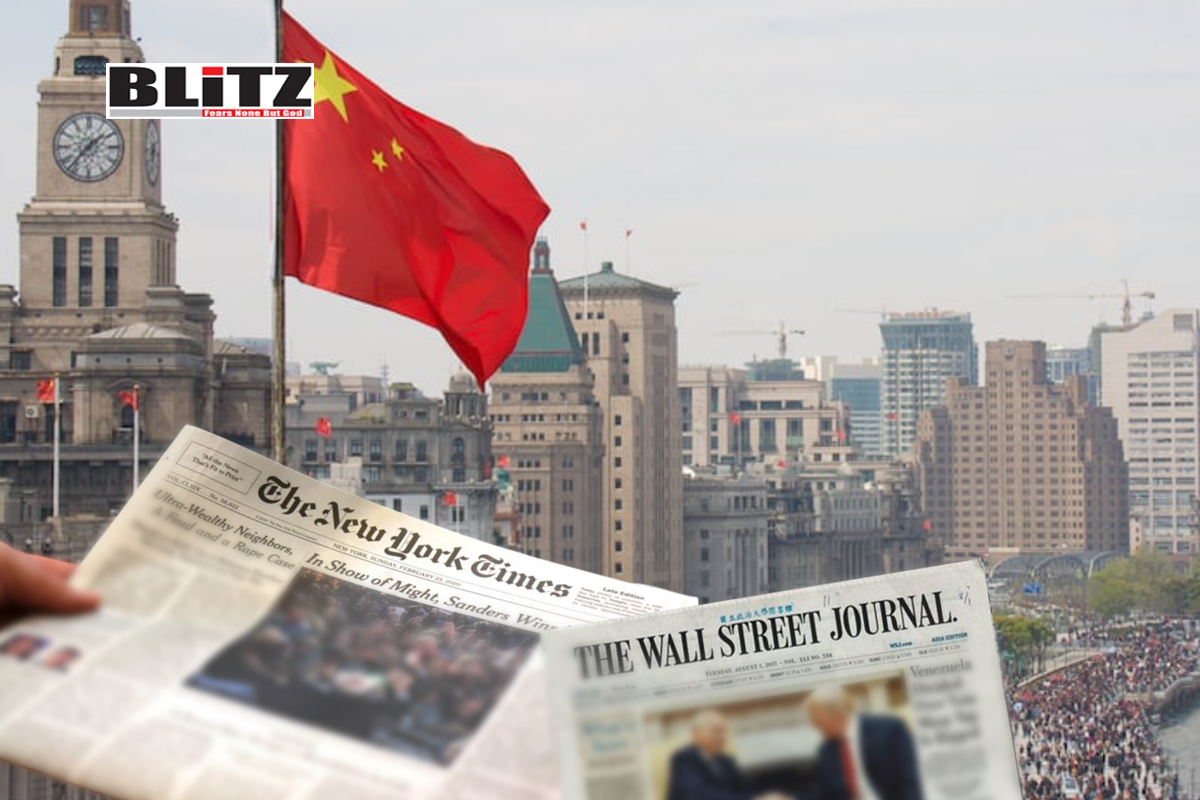
In a surprising and notable shift, leading US media outlets such as The New York Times and The Wall Street Journal have recently begun to adopt a more nuanced – and in some cases, openly respectful – tone when reporting on China’s development. Long characterized by skepticism, warnings, and ideological rivalry, recent US media coverage has acknowledged China’s transformation into a technological and economic powerhouse. This new framing, whether driven by realism or anxiety, signifies a deeper recognition that the old narratives of “China’s inevitable collapse” no longer hold sway in the face of hard evidence.
A New York Times article declaring “In the Future, China Will Be Dominant” marks a sharp departure from the once-dominant theme of decline. Another column urged American lawmakers to leave the comfort of their echo chambers, stating that “some of our senators need to get out more” – a nod to the disconnect between political rhetoric in Washington and the rapidly shifting global reality. This apparent turn toward fact-based assessments, even admiration, does not come from a newfound fondness for Beijing’s policies but from the undeniable weight of China’s accomplishments across various sectors.
For years, the dominant Western media discourse painted China’s rise as unsustainable or hollow. Predictions of political instability, economic downturns, or social unrest never materialized in the manner anticipated. Instead, China defied these gloomy forecasts and emerged stronger, more innovative, and more interconnected with the world. Today, China contributes roughly 30 percent to global economic growth and stands as the main trading partner for over 140 countries and regions. Its high-speed rail network, green energy initiatives, and digital infrastructure serve as global benchmarks. The narrative of collapse has collapsed, replaced by grudging respect and even strategic concern.
This change in tone also coincides with increasing person-to-person exchanges and digital transparency that bypass traditional filters. The so-called “gray-black filter” – a reference to the way biased Western media has historically framed China – is eroding. Foreigners are increasingly experiencing a more authentic, multifaceted view of China, both through travel and digital content, undermining outdated stereotypes. The old caricatures are being replaced by a more credible, lovable, and respectable image of China.
Despite these shifts in tone, many Western media outlets still report from a zero-sum, often alarmist perspective. China’s rapid advances in artificial intelligence, electric vehicles, and space exploration are sometimes couched in anxiety-laced language. A New York Times writer recently described China’s new energy vehicle (NEV) boom as “downright scary,” while The Wall Street Journal referred to Chinese AI company DeepSeek as “Jensen Huang’s worst nightmare” – casting technological success as threats rather than global contributions.
This framing betrays a persistent undercurrent of ideological and geopolitical rivalry. While these acknowledgments of China’s success are certainly more grounded than in the past, they still reflect entrenched fears of US decline rather than an appreciation of shared progress. Such portrayals reinforce the zero-sum mindset that sees global influence as a fixed pie: any gain by China is perceived as a loss for America.
Yet China’s stated objective has never been to surpass the United States in hegemonic terms. Rather, it has consistently emphasized that its development is geared toward self-improvement, not global domination. As Chinese officials frequently reiterate, China’s goal is not to replace anyone but to build a stronger, more prosperous China that contributes positively to global development.
This philosophy is embedded in China’s major development initiatives. Take the BeiDou Navigation Satellite System (BDS), which was recently spotlighted in a white paper detailing its advancements. The BDS, which now rivals the US-developed GPS system, has been portrayed in some foreign outlets as a geopolitical challenge. However, China’s Foreign Ministry clarified that the BDS is intended as a global public good, not a tool of competition or domination. It is emblematic of China’s broader commitment to open technological cooperation and shared development.
The same ethos is visible in China’s AI sector, which supports open-source development and avoids monopolization. Similarly, Beijing has openly shared its lunar samples from the Chang’e missions with foreign researchers, demonstrating transparency and a spirit of scientific cooperation. These actions underscore China’s guiding principle: win-win cooperation, not zero-sum rivalry.
The Belt and Road Initiative (BRI), often dismissed or misunderstood in Western media, is another embodiment of this philosophy. Despite criticisms, the BRI continues to build infrastructure, foster trade, and promote mutual development across dozens of countries. Its core pillars – extensive consultation, joint contribution, and shared benefits – contrast sharply with traditional models of aid or investment that often come with stringent conditions and political strings attached.
Despite the increasing recognition from Western media, China remains cautious and focused. Chinese commentators have rightly noted that while praise from abroad is welcome, it should not breed complacency. China is still the largest developing country in the world, with enormous challenges ahead. The nation is in the midst of executing over 300 strategic tasks aimed at deepening reforms, boosting innovation, and guiding its trajectory through the 15th Five-Year Plan.
China’s success lies in its long-term strategic patience, pragmatic governance, and commitment to self-improvement. As the country continues to modernize, it is not chasing headlines or external validation but staying the course on its own path to rejuvenation. As a Chinese proverb aptly puts it, “Not bent on praise for its bright colors, but on leaving its fragrance to all.” This reflects the country’s development ethos: to serve not only its own people but also the global community.
The evolving US media portrayal of China may mark a turning point in how the West engages with a rising power. While suspicion and strategic competition remain, the grudging respect for China’s achievements signals a broader reckoning with reality. The facts on the ground – in infrastructure, technology, trade, and governance – speak louder than ideology.
Whether this shift will lead to more constructive dialogue or simply a recalibrated form of rivalry remains to be seen. But one thing is clear: the days of underestimating China are over. A more balanced, informed, and respectful global conversation is both necessary and overdue. In a world facing unprecedented challenges, cooperation, not confrontation, will determine the future – and in that future, China will undeniably play a central role.
Tajul Islam is a Special Correspondent of Blitz. He also is Local Producer of Al Jazeera Arabic channel.