India commissions first transshipment port as Pakistan test-fires missile amid rising tensions

- Update Time : Monday, May 5, 2025
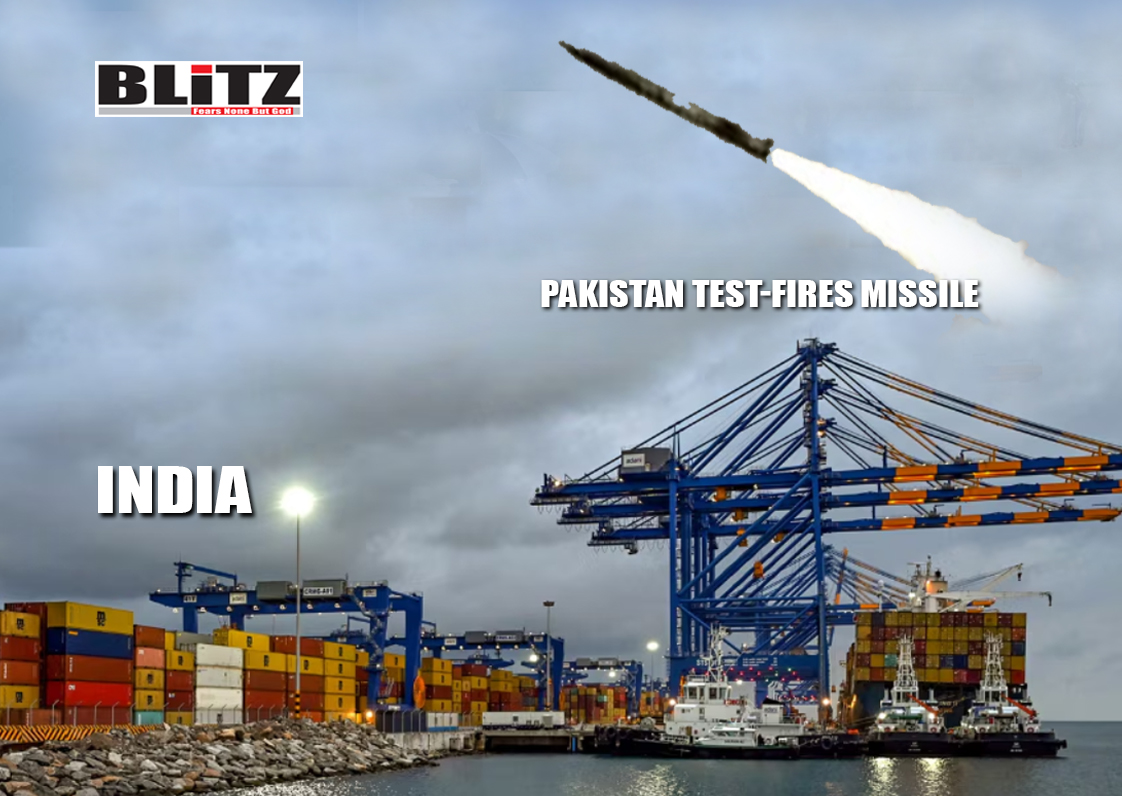
India’s strategic and economic ambitions took a major leap forward on May 3, Saturday as Prime Minister Narendra Modi inaugurated the Vizhinjam International Seaport in Kerala – the nation’s first deepwater transshipment port. Built at a cost of $1.07 billion under a public-private partnership led by Adani Ports and Special Economic Zone Ltd, the port marks a significant milestone in India’s long-term plan to reshape Asian logistics and reduce dependence on foreign ports for cargo handling.
Speaking at the grand commissioning ceremony, Prime Minister Modi hailed the port as a symbol of “new-age development,” situated where “the big sea meets the beauty of nature.” The Vizhinjam port’s establishment is expected to have major economic ramifications, with industry watchers projecting a significant boost to India’s shipping sector and its overall logistics capabilities.
Currently, around 75% of India’s container cargo is handled by ports outside the country, primarily in Colombo, Singapore, and Dubai. This dependence has not only extended shipping times but also saddled Indian exporters and importers with additional costs – losses that Modi estimated at $200-220 million annually. Each container rerouted through foreign ports incurs an extra charge of $80-100. “Indian ports lost revenue due to transshipment happening in ports outside India,” Modi emphasized, underscoring the financial implications.
The Vizhinjam International Seaport directly addresses this longstanding vulnerability. Its most striking feature is its natural sea depth of 18-20 meters close to shore, allowing even the world’s largest container ships to dock without the need for extensive, costly dredging operations. Moreover, its proximity to one of the busiest east-west shipping lanes – just ten nautical miles away – makes it ideally positioned to become a key transshipment hub in the Indian Ocean.
Earlier this year, Vizhinjam demonstrated its capability by successfully docking the MSC Türkiye, one of the world’s largest container vessels. With global trade routes increasingly shifting toward Asia, India’s investment in the port could not have come at a more strategic time. Analysts believe that Vizhinjam could eventually rival major transshipment hubs such as Singapore and Colombo, aligning with New Delhi’s broader goal of making India a logistics powerhouse.
Adani Ports, led by billionaire Gautam Adani, spearheaded the construction under a public-private model, reinforcing the Modi government’s broader emphasis on combining public infrastructure development with private sector efficiency. The port is also expected to generate employment opportunities and boost regional economic development, particularly in Kerala, a state that already attracts millions of tourists each year.
However, even as India celebrated this economic achievement, regional security dynamics took a darker turn. Just hours before Modi’s inauguration of the Vizhinjam port, Pakistan’s military announced the successful test launch of the Abdali Weapon System, a surface-to-surface missile with a range of 450 kilometers (280 miles).
According to Pakistani defense officials, the missile test was designed to ensure “operational readiness” and validate technical parameters, such as its advanced navigation system and enhanced maneuverability. The test was closely observed by Pakistan’s military leadership, with President Asif Ali Zardari and Prime Minister Shehbaz Sharif expressing confidence in the nation’s ability to maintain “credible minimum deterrence” against any threats.
The timing of the missile launch, however, did not go unnoticed in New Delhi. Indian authorities, as reported by the Hindustan Times, characterized the launch as a “reckless act of provocation” and a “dangerous escalation” of Islamabad’s hostile posture toward India. The tension is particularly acute following the April 22 terrorist attack in India’s Jammu and Kashmir region, where 26 civilians were gunned down in the Baisaran Valley, a popular tourist destination.
The Resistance Front, a group believed to have ties to the Pakistan-based militant organization Lashkar-e-Taiba, initially claimed responsibility for the attack. However, subsequent reports indicated that the group had distanced itself from the atrocity, complicating attribution efforts. Indian police have since identified three suspects, two of whom are believed to be Pakistani nationals.
In the immediate aftermath of the attack, India accused Pakistan of aiding and abetting armed militants conducting cross-border incursions – a charge that Islamabad has categorically denied. Nevertheless, the missile launch has only reinforced Indian concerns about Pakistan’s intentions at a time when the region remains highly volatile.
Strategic experts warn that the current escalation could further strain already fragile relations between the two nuclear-armed neighbors. In particular, the combination of India’s assertive infrastructural moves – symbolized by the Vizhinjam port – and Pakistan’s heightened military readiness creates an environment ripe for miscalculation.
The dual narratives unfolding – India’s economic rise through ambitious infrastructural projects and Pakistan’s strategic signaling through missile tests – highlight the growing divergence between the two South Asian rivals. While India is focused on consolidating its role as a central hub in Asian logistics and global trade, Pakistan is prioritizing military preparedness amid deteriorating bilateral ties.
Nonetheless, India’s commissioning of Vizhinjam signals its broader intent to enhance self-reliance and reclaim control over its economic corridors. With the port poised to capture a significant share of the regional transshipment market, India stands to strengthen its position not only in trade but also in strategic influence across the Indian Ocean region.
Meanwhile, Pakistan’s missile launch underscores the persistent security dilemma that haunts South Asia. As both nations move forward on parallel but increasingly conflicting trajectories, the international community is likely to watch with apprehension, hoping that economic aspirations prevail over military provocations.
In this climate of opportunity and risk, India’s Vizhinjam port and Pakistan’s Abdali missile test stand as stark reminders of the promise and perils facing the subcontinent today.
Arun Anand is an author and columnist who has penned more than a dozen books. He contributes columns on geopolitics to leading Indian and international publications and research journals. Follow him on ‘X’
@ArunAnandLive