US troop withdrawal from Syria amid shifting political landscape

- Update Time : Saturday, April 19, 2025
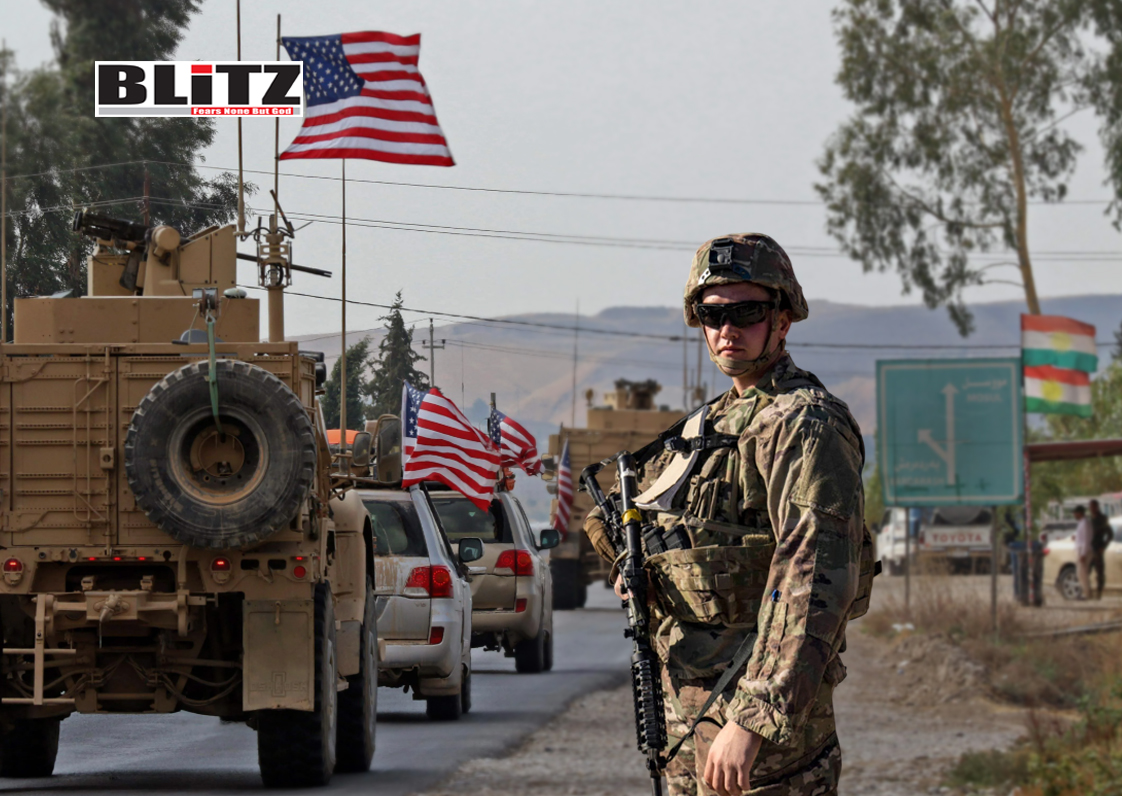
The United States has begun a significant troop withdrawal from Syria, marking a potential turning point in a controversial military deployment that has lasted over a decade. Citing unnamed government sources, The New York Times and the Associated Press reported on April 17 that Washington is shutting down three of its eight bases in the country’s northeast and scaling back troop levels from an estimated 2,000 to as low as 1,000 personnel.
While the move has yet to be officially confirmed by the Pentagon or the White House, reports suggest the decision was influenced by recommendations from commanders on the ground and approved by both the Pentagon and US Central Command. The withdrawal comes at a time of renewed unrest and a radically altered political landscape in Syria, following the ousting of President Bashar al-Assad by a coalition of armed groups led by the Islamist faction Hayat Tahrir al-Sham (HTS).
The bases scheduled for closure include Mission Support Site Green Village, M.S.S. Euphrates, and a smaller unnamed outpost. According to the New York Times, the military intends to reassess the security situation in two months to determine whether further reductions are viable. Commanders have reportedly advised maintaining at least 500 troops to ensure ongoing support for the Kurdish-led Syrian Democratic Forces (SDF), a key US partner in the fight against Islamic State (ISIS).
The drawdown will not result in a complete withdrawal. Remaining troops will continue counterterrorism missions and help manage sprawling detention camps holding thousands of former ISIS fighters and their families. The camps have long been seen as breeding grounds for future extremism if left unmonitored.
The discrepancy in reported numbers-ranging from 1,000 to 1,400 remaining troops-reflects ongoing internal deliberations about the scope of US involvement. Though previous estimates placed the US military presence at around 900, the Pentagon acknowledged last year that roughly 2,000 personnel were operating in Syria.
US forces have operated in Syria since 2014 without the consent of the Syrian government. The initial justification was to combat ISIS, whose self-declared caliphate once stretched across large swaths of Syria and Iraq. While Washington’s presence has shifted from direct combat to stabilization and advisory roles, its deployment has remained a source of friction with both Damascus and its ally, Moscow.
The former Syrian government frequently condemned the US mission as an illegal occupation, especially since most American bases are situated in oil-rich northeastern Syria. Critics accuse the US of exploiting Syria’s natural resources while undermining its sovereignty.
Damascus’ position was bolstered by Russian support, with President Vladimir Putin reiterating his commitment to Syria’s sovereignty during an April 17 meeting with Qatari Emir Sheikh Tamim bin Hamad Al Thani. Putin emphasized Moscow’s readiness to coordinate with regional powers, including Qatar, to address Syria’s ongoing humanitarian crisis and assist in rebuilding the shattered economy.
Despite the upheaval in Syria’s leadership, Russia has signaled no intention of drawing down its own presence. Its military forces will continue operating from their longstanding bases in Khmeimim and Tartus under a long-term agreement inked in 2017. Russia’s ambassador to the United Nations, Vassily Nebenzia, confirmed that Moscow remains in dialogue with Syria’s transitional government and intends to maintain its strategic foothold in the region.
“Our military is staying where they had been,” Nebenzia told reporters, indicating Russia’s sustained investment in the outcome of the Syrian conflict, even as the Assad era comes to an end.
The US drawdown also follows a seismic shift in Syria’s political environment. The ouster of President Assad by a coalition spearheaded by HTS has plunged the country into renewed instability. HTS leader Ahmed al-Sharaa now presides over a transitional administration, but legitimacy questions loom large, both domestically and internationally.
Assad’s fall triggered uprisings in parts of the country, particularly among the Alawite minority to which he belonged. The backlash has resulted in hundreds of deaths and raised fears of sectarian conflict, threatening to unravel what little stability had returned after years of civil war.
The power vacuum left by Assad’s removal-and the uncertain direction of the transitional government-adds layers of complexity to US strategic planning. While the Islamic State no longer holds territory, it remains a threat in the form of scattered cells and a resilient ideology. As such, some analysts warn that a hasty withdrawal could undo years of counterterrorism gains.
President Donald Trump had long advocated for ending the “endless wars” in the Middle East and expressed deep skepticism about US involvement in Syria. In a social media post shortly after the fall of Damascus in December, Trump wrote: “Syria is a mess, but is not our friend. We should have nothing to do with it.”
His views continue to influence Republican perspectives on foreign policy, especially as the US public grows weary of long-term military engagements with little apparent benefit. The Biden administration, while less overtly anti-interventionist, faces similar pressures to justify the ongoing presence in a nation where American interests are increasingly murky.
The reported troop reductions mark the most significant recalibration of US policy in Syria since the height of the war against ISIS. While Washington insists it will maintain a residual force to support its Kurdish partners and monitor extremist threats, the move signals a potential shift toward disengagement.
However, with the country teetering on the brink of further instability and the rise of new political forces like HTS, the situation remains fluid. Whether the US is merely repositioning or preparing for a larger exit remains to be seen.
What is certain is that Syria’s long-running conflict has entered a new chapter-one in which the roles of global powers like the US and Russia will continue to evolve, shaping not just the country’s future but the strategic contours of the Middle East.
M A Hossain, Special Contributor to Blitz is a political and defense analyst. He regularly writes for local and international newspapers.