

Trump declares English as the only official language of the United States

- Update Time : Monday, March 3, 2025
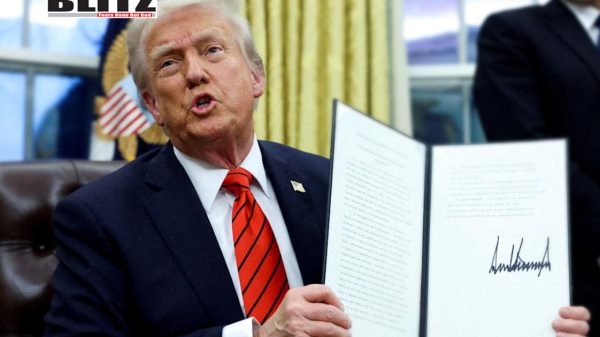
In a landmark decision, President Donald Trump has signed an executive order declaring English as the only official language of the United States, a move aimed at promoting national unity and fostering a shared cultural identity. The executive order, signed on March 1, 2025, marks the first time in American history that the federal government has made such a designation.
Unlike many other countries that have designated official languages, the United States has historically operated without one at the federal level. While English has always been the dominant language in government, commerce, and education, previous congressional attempts to formalize its status have failed. Currently, more than 30 states have designated English as their official language, but this executive order extends the policy nationwide.
The Trump administration has framed the decision as a necessary step toward strengthening national identity and civic engagement. “Establishing English as the official language will not only streamline communication but also reinforce shared national values and create a more cohesive and efficient society,” the order states. The White House further elaborated on the decision in a social media post on March 2, writing on X, “ENGLISH IS NOW THE OFFICIAL LANGUAGE OF THE UNITED STATES. America is SO BACK!”
In addition to formalizing English as the sole official language, Trump’s order overturns an earlier directive from President Bill Clinton. Issued in 2000, Clinton’s mandate required federal agencies and organizations receiving government funding to provide language assistance to individuals with limited English proficiency. This measure was originally intended to ensure that non-English speakers could access essential services such as healthcare, education, and legal assistance.
Under Trump’s new policy, agency heads will have the discretion to decide whether to continue offering multilingual services, depending on their respective missions and the efficiency of service delivery. This means that while some government offices may still offer translated materials, the overall emphasis will shift toward English as the primary medium for official communication.
The executive order is expected to have significant implications for immigrants and non-English speakers. According to US Census data, over 350 languages are spoken in the United States, with nearly 22% of residents speaking a language other than English at home. Spanish is the second most spoken language, accounting for approximately 13.4% of the population. Other commonly spoken languages include Chinese, Tagalog, Vietnamese, Arabic, French, and Korean, each with over a million speakers.
Critics of the order argue that it could create barriers for immigrants and non-English speakers seeking access to vital government services, particularly in healthcare, legal aid, and social programs. “This move effectively disenfranchises millions of people who are still in the process of learning English,” said Maria Lopez, a spokesperson for the National Immigration Law Center. “It places an undue burden on individuals who are already working hard to integrate into American society.”
On the other hand, supporters argue that the policy will encourage assimilation and incentivize non-English speakers to prioritize learning the language. “America was built on the principle of unity, and a common language is essential for national cohesion,” said Senator Tom Cotton (R-AR), a vocal advocate of the measure. “This policy ensures that government resources are used efficiently and that all citizens have a shared means of communication.”
The decision to designate English as the sole official language could have far-reaching economic consequences. Many businesses and industries, particularly those serving multilingual populations, may need to adjust their operations to align with the new federal stance.
For companies that provide services in multiple languages, such as banks, healthcare providers, and tech firms, the policy could lead to increased costs as they reevaluate their language access strategies. Conversely, some businesses might welcome the shift as an opportunity to reduce expenses related to translation and interpretation services.
Educational institutions may also feel the effects of the new policy. Public schools with large non-English-speaking student populations may face additional challenges as they adapt curricula and support systems to comply with the new directive. English as a Second Language (ESL) programs, which currently serve millions of students, could experience funding shifts or structural changes.
Trump’s executive order has sparked a polarized reaction across the political spectrum. Many Republican lawmakers have praised the decision as a step toward reinforcing American identity and reducing governmental inefficiencies. “For too long, we have allowed multilingual bureaucracy to slow down our institutions. This order will help unify our country under one language,” said House Speaker Mike Johnson.
Conversely, Democrats and civil rights organizations have condemned the order, arguing that it marginalizes immigrant communities and contradicts the nation’s history of linguistic diversity. “This executive order ignores the reality of America’s multicultural fabric,” said Senator Alex Padilla (D-CA). “It sends a message that those who speak another language are somehow less American.”
Legal experts predict that the order could face court challenges, particularly on the grounds of discrimination and equal access to government services. Civil rights groups, including the American Civil Liberties Union (ACLU) and the National Association for Bilingual Education, have vowed to challenge the order in court.
The decision has also drawn international attention. Many countries with significant immigrant populations, such as Canada and Switzerland, maintain official multilingual policies. Critics argue that Trump’s order runs counter to global trends of linguistic inclusivity and may damage America’s reputation as a welcoming nation.
However, proponents see it as a necessary assertion of American sovereignty. “No other nation allows such linguistic fragmentation in government affairs,” said political analyst Mark Krikorian. “This decision affirms that America is a nation with a shared language and culture.”
As Trump continues his second term, the designation of English as the official language is likely to remain a defining policy of his administration. Whether it serves as a unifying force or a divisive measure will depend on its implementation and the legal battles it may face.
For now, the order stands as a significant moment in US history, reshaping how the federal government communicates and interacts with a multilingual population. As the nation grapples with the implications, the debate over linguistic identity and inclusion will undoubtedly persist in the years to come.
Damsana Ranadhiran, Special Contributor to Blitz is a security analyst specializing on South Asian affairs.