Germany’s far-right AfD party forms unexpected alliance with Trump and Musk

- Update Time : Sunday, February 2, 2025
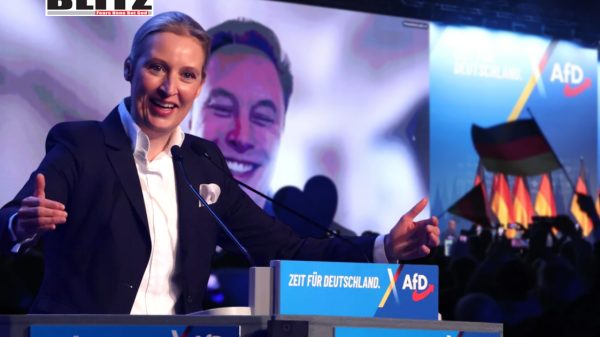
In the increasingly polarized landscape of German politics, the far-right Alternative for Germany (AfD) has found itself aligning with an unexpected duo: former US President Donald Trump and billionaire entrepreneur Elon Musk. The party, which has been surging in the polls and could finish second in the upcoming national elections, has openly embraced Trump-style nationalism and Musk’s advocacy against mainstream political correctness.
At a recent campaign rally in Halle, eastern Germany, AfD politician Maximilian Krah made the party’s stance unmistakable. “You have to make a decision. Do you want to have the party of [Chancellor] Olaf Scholz and all those eunuchs? Or are you on our side, with Elon Musk and Donald Trump? Which side has more sex appeal?” Krah’s provocative remarks underscored the AfD’s increasing obsession with the two high-profile figures.
Moments later, Musk made a surprise video appearance, much to the delight of the 4,000-strong audience. It was a moment that cemented the party’s admiration for both Musk and Trump, with AfD leaders openly expressing their hopes for a stronger connection with Washington’s new administration.
The AfD’s admiration for Trump is neither new nor surprising. Since its formation in 2013, the party has gradually evolved into Germany’s most prominent far-right political force, championing nationalist rhetoric, anti-immigration policies, and Euroscepticism-all hallmarks of Trumpism.
Party leader Alice Weidel did little to hide her excitement over Trump’s return to office, telling CNN: “I wish [Elon Musk], Donald Trump and JD Vance all the best blessings for their next tenure.” Her words were echoed by Tino Chrupalla, the AfD co-leader, who attended the Capital One rally in Washington on Inauguration Day. “You could feel the optimism and hope in the president. The American people felt liberated,” Chrupalla declared, lauding Trump’s ability to deliver on his campaign promises.
For the AfD, Trump’s triumph is proof that nationalist, right-wing populism is not only viable but effective. According to extremism researcher Matthias Quent, the party sees Trump’s victory as an indication that their own political aspirations are within reach. “To see the biggest power in the world has a far-right leadership, this tells them, ‘okay, we can achieve this goal as well,'” Quent explained.
The parallels between Trump and the AfD are evident. Both use populist rhetoric to attack mainstream political elites, the media, and multicultural policies. Both exploit public frustrations over immigration and economic uncertainty. And both have faced accusations of fueling extremism and radicalizing their supporters.
While Trump’s influence on the AfD is expected, Musk’s involvement is a more recent development. The billionaire entrepreneur has increasingly voiced opinions that align with the party’s nationalist and anti-immigration stances.
At the Halle event, Musk referred to the AfD as Germany’s “best hope,” adding, “It’s good to be proud of German culture, German values, and not to lose that in some sort of multiculturalism that dilutes everything.” His comments resonated deeply with AfD supporters, who have long argued that Germany should stop apologizing for its past and instead focus on preserving its national identity.
Musk also stirred controversy during the 80th anniversary of the liberation of Auschwitz by stating that there is “too much focus on past guilt, and we need to move beyond that.” His remarks closely align with the AfD’s long-held position that Germany should abandon its historical atonement for Nazi-era crimes. Chancellor Scholz swiftly condemned Musk’s comments as “disgusting,” but for the AfD, Musk’s endorsement was a welcome validation of their worldview.
Despite the AfD’s growing popularity-polling at approximately 21 percent, which would make it the second-largest political force in Germany-its ability to wield power remains limited. Germany’s mainstream parties have upheld a “firewall” against the AfD, refusing to form coalitions or pass legislation with its support. However, the party’s influence is already shaping the political debate.
A recent Bundestag vote on a controversial immigration measure, known as the “influx limitation act,” was championed by Friedrich Merz, the leading candidate for chancellor from the center-right Christian Democratic Union (CDU). Though Merz ultimately lost the vote, his attempt to push tougher immigration laws demonstrated how the AfD has forced mainstream politicians to engage with its core issues.
Quent suggests that the AfD’s success is not solely due to Musk or Trump but rather the failures of Germany’s current government. “The AfD’s rise may be more accurately attributed to the weakness of the government and how social debates are focusing on the hot-button AfD issues, such as immigration,” he said.
The AfD is not alone in its admiration for Trump. Across Europe, far-right populist leaders have found inspiration in his brand of politics.
Hungarian Prime Minister Viktor Orban has long been a vocal Trump supporter, openly celebrating his return to power. In Slovakia, Prime Minister Robert Fico, who survived an assassination attempt last year, has declared that his policies align closely with those of Trump. In Italy, Giorgia Meloni has pushed a nationalist agenda reminiscent of Trumpism.
This broader shift towards the right has alarmed centrists and progressives, who see the growing influence of figures like Trump and Musk as a dangerous normalization of extremist politics. Yet, for parties like the AfD, it represents a moment of validation and opportunity.
Despite its rising popularity, the AfD faces significant hurdles in becoming a governing force. The party remains deeply controversial, with intelligence agencies monitoring its activities for extremist connections. Moreover, Germany’s political establishment remains largely united in its refusal to cooperate with the AfD, making coalition-building difficult.
Nevertheless, the AfD’s embrace of Trump and Musk signals a broader transformation in global right-wing politics. By aligning itself with high-profile figures who command massive influence, the party is attempting to shed its extremist label and rebrand itself as part of a larger international movement.
As Germany heads into its national elections, the AfD’s strategy appears clear: ride the wave of Trump’s return, leverage Musk’s endorsement, and continue pushing its nationalist, anti-immigration agenda. Whether this will translate into real political power remains to be seen, but one thing is certain: the AfD is no longer an isolated far-right party-it is now part of a global right-wing alliance that seeks to reshape the political landscape both in Germany and beyond.
Jennifer Hicks is a columnist and political commentator writing on a large range of topics.