

Has Muhammad Yunus declared war against America?

- Update Time : Monday, January 6, 2025
The history of US foreign policy is marked by decisive actions against individuals and regimes perceived as threats to global security as well as the US citizens. When the Taliban, led by Mullah Omar, refused to extradite Osama bin Laden who was considered as the mastermind of 9/11 attack, the US invoked its right to self-defense under Article 51 of the United Nations Charter. The Authorization for Use of Military Force (AUMF), passed by Congress shortly thereafter, granted the President broad authority to respond. These actions were not only about retaliation but also a declaration that harboring terrorists would come at a grave cost.
This historical precedent is now being invoked to analyze the growing concerns surrounding Bangladesh under the leadership of Muhammad Yunus. Comparisons to Afghanistan, though starkly different in context, highlight the potential for Bangladesh to become a focal point of geopolitical tension. Yunus, now, faces allegations of complicity in actions that could destabilize the region and provoke a strong response from the United States.
The controversy centers around the apparent protection and rehabilitation of Major (sacked) Syed Ziaul Haque, a figure designated by the US as a terrorist and accused of orchestrating the brutal murder of American citizen Avijit Roy. Ziaul, who had fled Bangladesh after a failed coup attempt and sought refuge in Pakistan under the aegis of ISI, recently returned to Bangladesh using a Pakistani passport. This return was facilitated by a policy change under Yunus, which removed mandatory security clearance for Pakistani nationals. Once back in the country, Ziaul applied for acquittal from all charges, including his placement on the “Most Wanted” list.
The decision to entertain such a request has raised alarms, especially given Ziaul’s alleged connections to Jamaatul Mujahedeen Bangladesh (JMB), a group linked to al-Qaeda in the Indian Subcontinent (AQIS). The Yunus administration has also been accused of clearing other notorious figures like Jashimuddin Rahmani, the leader of Ansarullah Bangla Team, of all charges. These moves suggest a troubling pattern of rehabilitating individuals associated with extremist ideologies. Critics argue that such actions undermine Bangladesh’s commitment to combating terrorism and pose a direct threat to the US security interests.
The implications of these developments are profound. The US has a range of legal and diplomatic tools at its disposal to respond to actions it deems threatening. Under 18 US Code § 1119, extraterritorial jurisdiction allows the prosecution of individuals who harm American citizens abroad. The “Foreign Murder of United States Nationals” statute provides a clear framework for pursuing such cases, requiring high-level approval from the Department of Justice.
Beyond criminal prosecution, the US could impose sanctions on Yunus and his associates. The Global Magnitsky Act, for instance, allows the US to target foreign individuals involved in human rights abuses or corruption. Sanctions could include freezing assets, banning visas, and restricting business dealings. Executive orders could also be issued to directly address actions by Yunus that undermine US security or contravene international norms. These measures, administered by the Office of Foreign Assets Control (OFAC), could extend to Yunus’ businesses in the US, including Grameen America, which is said to have ties to influential figures like Bill and Hillary Clinton.
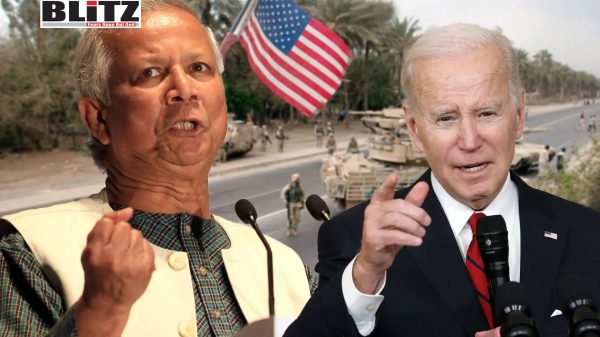
The Biden administration’s role in this unfolding crisis has also come under scrutiny. Critics allege that President Joe Biden, along with prominent allies like Barack Obama, George Soros, and the Clintons has supported Yunus as part of a broader strategy to counterbalance India’s influence in South Asia. This support, it is argued, has emboldened Yunus to take actions that challenge international norms, such as lifting visa restrictions for Pakistani nationals and acquitting known terrorists.
If these allegations hold true, the Biden administration could face significant backlash, particularly from Donald Trump. After January, 20, Trump’s administration could investigate the extent of Biden’s involvement in Yunus’ rise to power and question whether the US knowingly supported a regime that compromised its own security interests. Such an inquiry could damage the Biden administration’s legacy and raise questions about its commitment to global counterterrorism efforts, as well as the security measures for the US citizens abroad.
Adding to the complexity is the involvement of the Hameem Group, a major Bangladeshi textile exporter. The group’s owner has been accused of using his media outlet, Channel-24, to propagate narratives that discredit the US State Department and align with Yunus’ regime. This strategy, aimed at portraying Haque as a victim of international conspiracy, has further strained relations between Bangladesh and the US.
Given the Hameem Group’s significant presence in the US market, exporting millions of dollars’ worth of textiles annually, the Trump administration could leverage economic measures to hold it accountable. Potential actions include imposing tariffs or quotas on its products, investigating labor violations within its operations, or freezing assets if ties to terrorism are established. Such measures would send a strong message about the consequences of undermining US interests.
The stakes in this situation are immense. Bangladesh, under Yunus, risks becoming a hub of geopolitical instability, much like Afghanistan in the early 2000s. The US cannot afford to ignore the potential repercussions of Yunus’ actions, particularly as they pertain to its own citizens and broader regional security. The decisions made in Washington over the coming months will shape the future of US-Bangladesh relations and set a precedent for how the US addresses emerging threats in South Asia.
As the Biden administration approaches the end of its term, it faces a critical test. Will it take decisive action against Yunus and his regime, or will it allow these transgressions to go unchecked? The world is watching, and the implications of inaction could be far-reaching. A failure to respond would not only embolden Yunus but also signal to other regimes that the US lacks the resolve to protect its interests.
The coming weeks will reveal whether Bangladesh follows the path of stability and progress or descends into chaos and isolation. The choices made by its leadership, and the international community’s response, will determine its fate. For now, the specter of conflict looms large, with the potential to reshape South Asia’s geopolitical landscape.
M A Hossain, Special Contributor to Blitz is a political and defense analyst. He regularly writes for local and international newspapers.