The H-1B visa war exposes a deeply American problem

- Update Time : Saturday, January 4, 2025
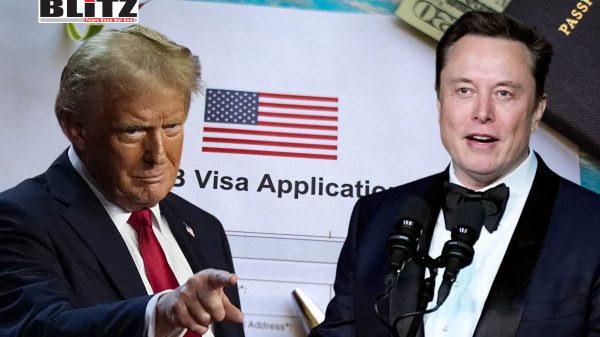
The ongoing debate over the H-1B visa program has erupted into a public spectacle, revealing a more profound crisis within America’s socio-political landscape. At the center of this drama are two emblematic figures of Trumpism 2.0: Elon Musk, the tech mogul and self-styled champion of free speech, and Stephen Bannon, the far-right nationalist and former White House strategist. Their feud, ostensibly over the H-1B visa program, underscores the deep divisions within the Trumpist camp and highlights systemic issues in America that neither side seems willing to confront.
Elon Musk, recently elevated to the status of Donald Trump’s “first buddy,” took to his social media platform X (formerly Twitter) to lash out at fellow Trump supporters. Musk’s tirade included explicit language, reflecting his characteristic disdain for criticism. Meanwhile, Stephen Bannon, using his podcast ‘The War Room,’ labeled Musk a “man-child” and accused him of cowardice. Both men, middle-aged avatars of American machismo, have turned their ideological battle into a public spectacle, feeding their followers’ appetite for drama and division.
Their feud is symptomatic of a broader issue within American politics: the militaristic mindset that conflates ideological disputes with warfare. The United States, a nation that has been at war for 231 of its 248 years, has developed a cultural affinity for conflict. This militarism seeps into domestic politics, where rhetorical skirmishes are framed as existential battles for the nation’s soul.
The H-1B visa program, which provides 85,000 visas annually for highly skilled foreign workers, is at the heart of this controversy. Proponents like Musk argue that the program bolsters American competitiveness by attracting top global talent. Critics like Bannon contend that it undermines American workers, accusing tech elites of exploiting the system to maximize profits while neglecting the domestic workforce.
This debate reflects a larger tension between two visions of America. For Musk and his allies, the United States serves as the base for a global capitalist empire where borders are secondary to economic imperatives. For Bannon and his followers, the nation should prioritize its citizens, fostering a nationalist economic policy that protects American jobs and limits foreign influence.
The H-1B clash is not an isolated incident; it follows a series of internal conflicts within the Trumpist movement. Recent disputes over the federal budget and public debt have exposed fractures in the Republican Party, undermining Trump’s authority even before his potential return to the White House. These divisions raise questions about the movement’s ability to govern effectively, let alone achieve its ambitious goals of “making America great again” and “putting America first.”
Trump’s response to the H-1B controversy has been characteristically erratic. While he initially supported the program, his past criticisms of H-1B visas as job-stealers for American workers add another layer of inconsistency. This vacillation highlights the broader problem of a political movement that prioritizes rhetoric over coherent policy.
Both Musk and Bannon present flawed visions for America’s future. Musk’s advocacy for the H-1B program aligns with his broader critique of American education and infrastructure. He views foreign talent as a necessary supplement to a failing domestic system. Yet, his solution does little to address the root causes of these failures, such as underfunded schools and outdated infrastructure.
Bannon, on the other hand, frames his opposition to H-1B as a matter of national loyalty. He accuses tech elites of betraying American workers and demands that they invest in domestic talent. While his rhetoric resonates with those disillusioned by globalization, it overlooks the systemic inequalities that underpin the current economic model. Bannon’s focus on national loyalty fails to confront the deeper issue of exploitation, which affects both domestic and foreign workers.
The H-1B debate is emblematic of a larger crisis in American society: the erosion of trust in institutions and the growing divide between elites and ordinary citizens. Both Musk and Bannon embody this crisis in different ways. Musk’s technocratic vision prioritizes efficiency and innovation, often at the expense of social equity. Bannon’s populist nationalism, while critical of elite excesses, ultimately perpetuates a system of inequality by framing the problem as one of insufficient patriotism rather than structural injustice.
This divide is not just ideological but deeply economic and cultural. America’s oligarchic capitalism, as exemplified by Musk, treats workers as expendable resources in a global competition for dominance. Meanwhile, Bannon’s nationalist rhetoric exploits the frustrations of those left behind by this system, offering simplistic solutions that fail to address the root causes of inequality.
To truly address the challenges exposed by the H-1B debate, America must shift its focus from dominance to equity. This requires a fundamental reevaluation of priorities, emphasizing education, infrastructure, and social fairness over short-term economic gains. The goal should be to create an environment where domestic talent can thrive, reducing the reliance on foreign workers without resorting to xenophobia or protectionism.
Moreover, the political discourse must move beyond the theatrics of figures like Musk and Bannon. Genuine progress requires humility and a commitment to the common good, qualities sorely lacking in the current debate. Leaders must recognize that solving America’s problems demands more than rhetoric; it requires systemic change and a willingness to confront uncomfortable truths about exploitation and inequality.
The H-1B visa war is not just a clash between two egos; it is a reflection of America’s deeper crises. The feud between Musk and Bannon highlights the failures of both technocratic elitism and populist nationalism to offer meaningful solutions. To move forward, America must embrace a vision that prioritizes equity and fairness, addressing the root causes of its socio-economic challenges rather than merely treating the symptoms. Only then can the nation hope to overcome its divisions and build a more inclusive and sustainable future.
Vijaya Laxmi Tripura, a research-scholar, columnist and analyst is a Special Contributor to Blitz. She lives in Cape Town, South Africa.