

US appears to shift responsibility as Iran blocks Strait of Hormuz

- Update Time : Wednesday, April 1, 2026
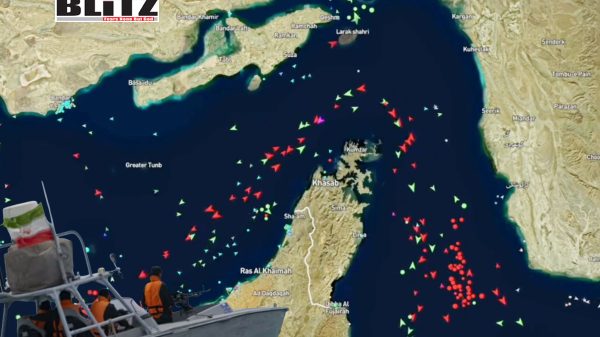
The ongoing crisis in the Strait of Hormuz, a critical maritime chokepoint, has escalated tensions between the United States and Iran, with serious implications for global trade and energy markets. While Iran has moved to restrict transit through the strait, citing retaliatory measures in response to a US-Israeli campaign aimed at regime change, Washington has signaled that restoring free shipping is not currently a direct military objective. Instead, American officials have indicated that other nations must assume the responsibility for reopening the vital waterway.
The Strait of Hormuz, which connects the Persian Gulf with the Gulf of Oman and the Arabian Sea, is one of the most strategically important maritime passages in the world. Approximately one-fifth of the global supply of oil and gas transits this narrow waterway. Any disruption to its operation has immediate effects on global energy prices and economic stability. Iran’s decision to throttle traffic through the strait comes as a response to what Tehran describes as an aggressive US-Israeli effort to destabilize its government. The resulting slowdown in the movement of hydrocarbons and other essential commodities has already contributed to rising global energy prices, and economists warn of potential widespread economic consequences if the situation continues.
In a March 30 interview with Al Jazeera, US Secretary of State Marco Rubio addressed the situation and clarified Washington’s position. Rubio dismissed the notion that the United States aims to guarantee unrestricted access to the strait in the near term, stating that the primary focus of US military operations is to degrade Iranian military capabilities. “Securing free transit through the Strait of Hormuz is not among our operational objectives,” he said, adding that the US is “well on our way or ahead of schedule” in terms of its campaign against Iranian forces.
Rubio also emphasized that, although the United States does not intend to immediately reopen the strait, it will remain accessible in the longer term. “When this operation is over, it will be open, and it will be open one way or another,” he asserted. He further suggested that, if Iran insists on enforcing restrictive conditions on shipping, a coalition of nations-including the United States-would ensure that the waterway is reopened. However, he did not provide specific details on which nations would participate or what form this coalition might take.
Reports from the Wall Street Journal indicate that the administration of President Donald Trump is reluctant to extend military operations to secure the strait directly. Officials reportedly believe that such efforts would prolong the conflict beyond the administration’s planned timeline of four to six weeks. As a result, Washington has sought to persuade allies in Europe and the Gulf region to take the lead in restoring free passage through the strait, effectively shifting the operational burden to other nations.
This approach has met with resistance from countries that have traditionally refrained from military involvement in Middle Eastern conflicts. German Defense Minister Boris Pistorius, for example, rejected calls to deploy German forces, stating bluntly, “It is not our war; we did not start it.” Other nations have similarly declined to commit troops or naval resources, leaving the United States in a position where it must balance strategic objectives with limited international support.
The reluctance of allied nations has provoked tension within NATO. When European members raised concerns about the reliability of the United States as a security partner, Rubio responded by framing alliances in transactional terms. “Being an alliance means it has to be mutually beneficial,” he stated, “and it is not a one-way street.” This remark reflects ongoing debates within NATO about burden-sharing and the responsibilities of member states when confronted with conflicts in regions outside their immediate borders.
The economic dimensions of the crisis are equally significant. While US officials argue that American energy consumption is relatively insulated from the Strait of Hormuz disruption, analysts warn that the economic impact on the United States may be substantial. Goldman Sachs strategists recently highlighted that the Chinese economy appears better positioned to withstand shocks to oil supply than its global peers, including the United States. The report notes that China has diversified its energy sources, expanded the share of non-fossil fuel energy in its consumption from 26% a decade ago to 40% today, and built large strategic reserves. In contrast, the United States remains more exposed to fluctuations in Middle Eastern oil markets, potentially amplifying the economic consequences of a prolonged blockade.
Rubio attempted to frame Washington’s opposition to Iran’s control of the strait as a matter of principle rather than immediate pragmatism. He argued that if Iran were allowed to assert control over such a critical trade route, other nations, including China, could follow a similar precedent in international waters, such as the South China Sea. This line of reasoning emphasizes the broader strategic and legal implications of state interference with global shipping lanes, yet it does little to address the immediate economic pressures resulting from restricted maritime traffic.
The unfolding crisis raises questions about the limits of American power and influence. While Washington has considerable military capabilities and intelligence resources, the administration’s decision not to prioritize the immediate reopening of the Strait of Hormuz indicates a calculated approach that avoids overextension. At the same time, it risks ceding operational responsibility to other nations, many of which are hesitant to become involved in a conflict they perceive as outside their direct interests. This strategy carries both diplomatic and economic risks, particularly if global energy prices continue to rise or if Iran maintains or escalates its restrictions.
Moreover, the situation underscores the growing complexity of international energy security. Nations like China, with diversified energy imports and strategic reserves, are better equipped to absorb shocks, whereas other countries-including the United States-face heightened vulnerability. Analysts warn that the ripple effects of restricted maritime traffic could affect not only energy markets but also broader economic stability, trade flows, and geopolitical relationships. The stakes are particularly high for nations dependent on the steady flow of oil and gas from the Persian Gulf, as disruptions could have far-reaching consequences for manufacturing, transportation, and consumer markets.
In summary, the Strait of Hormuz crisis highlights a convergence of military, economic, and diplomatic challenges. Iran’s restriction of maritime traffic is a direct response to US-Israeli actions aimed at regime change, while Washington’s refusal to prioritize reopening the strait illustrates a strategy of shifting operational responsibility to allies. European and Gulf nations have largely resisted involvement, underscoring the limits of coalition building outside the immediate interests of participating states. At the same time, the economic ramifications of restricted energy flows are already becoming apparent, with analysts predicting that the United States could face a heavier economic blow than other major powers like China.
As tensions continue, the world watches closely to see whether a multinational coalition will emerge to ensure the free passage of ships through the strait, or whether economic pressures will mount while the US and its allies weigh the costs and benefits of direct intervention. The crisis remains a test of international diplomacy, strategic foresight, and the global community’s ability to respond collectively to disruptions in one of the most critical trade corridors on the planet.
Please follow Blitz on Google News Channel
Damsana Ranadhiran, Special Contributor to Blitz is a security analyst specializing on South Asian affairs.