Global fallout from a Strait of Hormuz shutdown

- Update Time : Sunday, March 22, 2026
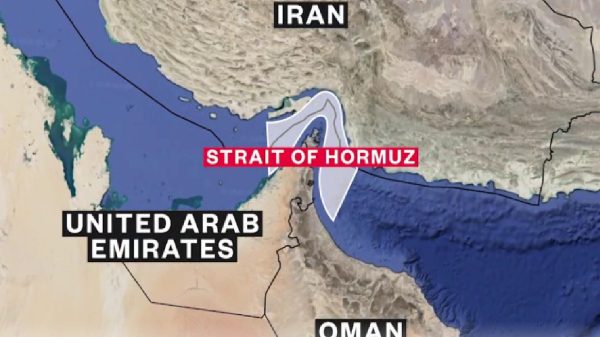
Three weeks into the ongoing US-Israeli air campaign against Iran, strategic attention has increasingly shifted toward one of the world’s most critical maritime chokepoints: the Strait of Hormuz. Its disruption—or outright closure—poses consequences far beyond the immediate theater of conflict.
At its narrowest, the strait spans roughly 39 kilometers. Yet navigable shipping lanes are far more restricted, limited to about 3.7 kilometers in each direction. Despite this constraint, the waterway carries nearly 20 percent of global oil consumption and approximately one-third of all seaborne crude exports. A significant share of these shipments is bound for major Asian economies, including China, Japan, and South Korea.
Given its geographic proximity to Iran, the strait has long been vulnerable to disruption. Tehran has repeatedly demonstrated its readiness to interfere with maritime traffic, whether through vessel seizures, harassment, or direct attacks. While Washington has indicated surprise at Iran’s recent move to shut down the passage, such a scenario has been widely anticipated in strategic planning circles for years.
The US response, however, has lacked consistency. Officials have alternated between asserting that Iran lacked the capability to block the strait, expressing shock at its closure, urging allies to assist in reopening it, and later suggesting such support might not be necessary. This fluctuating messaging has only deepened uncertainty in an already fragile environment.
What remains indisputable is the economic impact. Even a partial disruption of traffic through the Strait of Hormuz would send shockwaves through global markets. Recognizing this vulnerability, the US and its partners established the Combined Maritime Forces (CMF) in 2002, headquartered in Bahrain, to safeguard maritime security across the Gulf and adjacent waters.
The CMF comprises multiple task forces, each assigned specific missions. Combined Task Force 150 focuses on counterterrorism operations, Task Force 151 on combating piracy, and Task Force 152 on ensuring security within the Arabian Gulf. Regional states such as Saudi Arabia, Bahrain, the UAE, Kuwait, and Qatar have played active roles in these efforts, occasionally assuming command responsibilities.
While it is almost certain that the CMF has rehearsed scenarios involving Iranian attempts to disrupt the strait, the current crisis exposes several critical shortcomings.
First, there appears to have been an assumption within US defense circles that the existing multinational framework would naturally translate into a rapid, coordinated response. Years of joint exercises and operational collaboration fostered confidence that a coalition could quickly mobilize to secure the strait. That expectation now seems overly optimistic. Insufficient political groundwork was laid to ensure that partner nations would be prepared—both logistically and politically—to act in unison during a crisis.
Second, Washington has long relied on its naval superiority as a deterrent against Iranian aggression. Historically, this confidence was justified. The US Navy has repeatedly demonstrated its ability to neutralize maritime threats, and recent reports suggest that over 120 Iranian vessels have been damaged or destroyed during current operations.
However, the nature of the threat has evolved. Iran’s growing arsenal of unmanned aerial systems and other asymmetric capabilities presents new challenges that traditional naval doctrines may not fully address. These tools complicate the operational environment and raise doubts about whether existing contingency plans have kept pace with technological change.
Third, the situation is compounded by a reduction in dedicated mine countermeasure assets in the Gulf. Both the US and the UK have scaled back their fleets of specialized vessels, replacing them with unmanned systems that are not yet deployed in sufficient numbers. This transition risks leaving a critical capability gap at a time when the threat of naval mines remains high.
Calls for decisive action are not misplaced. However, the available options are constrained. Building an effective multinational response cannot be improvised in the midst of a crisis. It requires prior coordination, shared strategic understanding, and political commitment from all participants. Expecting European allies to rapidly deploy high-value naval assets without prior involvement in mission planning was always a tenuous proposition—and their limited response so far reflects that reality.
Although the US is less dependent on Middle Eastern energy supplies than many of its allies, the global economy remains deeply exposed. Disruptions in oil and gas flows would drive up prices, strain supply chains, and generate economic turbulence that would inevitably ripple back to the United States.
The broader implications are therefore unavoidable. Economic instability abroad would quickly translate into domestic pressure at home, particularly as the US navigates an election cycle and enters a period of heightened consumer activity. What may initially appear as a distant geopolitical crisis could soon become a pressing political issue.
The closure of the Strait of Hormuz is not merely a regional flashpoint—it is a measure of international coordination, strategic preparedness, and leadership under pressure. The absence of a well-prepared coalition response has left Washington reacting to developments rather than shaping them. In the context of an ongoing conflict, that is a deeply precarious position.
Tajul Islam is a Special Correspondent of Blitz. He also is Local Producer of Al Jazeera Arabic channel.