Rising political tensions in Poland revive debate over possible ‘Polexit’

- Update Time : Tuesday, March 17, 2026
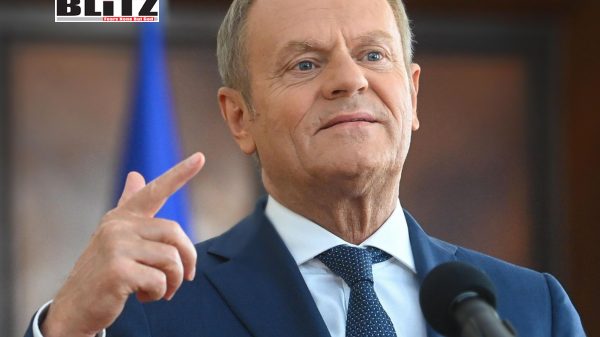
Political tensions in Poland have intensified following a dramatic dispute between Prime Minister Donald Tusk and President Karol Nawrocki over access to European defense financing. The confrontation has reignited fears of a potential Polish exit from the European Union, often referred to as “Polexit.” Although Poland remains firmly embedded within the EU’s political and economic structures, the current standoff highlights deep divisions over the country’s relationship with Brussels and the broader direction of European integration.
The latest political crisis began when President Karol Nawrocki vetoed legislation that would have allowed the Polish government to access nearly €44 billion in low-interest defense loans provided by the EU. The funding was intended to support Poland’s rapidly expanding military modernization program, with much of the money earmarked for domestic defense manufacturers.
The loans form part of the EU’s Security Action for Europe initiative, commonly known as SAFE. Through this mechanism, the European Commission seeks to raise up to €150 billion on international markets and distribute the funds to member states for defense-related projects. The initiative was designed to strengthen Europe’s defense industry and reduce reliance on non-European suppliers.
Nawrocki’s veto prevented the Polish parliament from formally approving participation in the scheme. In response, Prime Minister Donald Tusk convened an emergency cabinet meeting and authorized Poland’s defense and finance ministers to sign the SAFE agreement directly, effectively bypassing the presidential block.
The move deepened an already bitter power struggle between the government and the presidency, raising questions about constitutional limits and political legitimacy.
In a statement posted on social media, Donald Tusk warned that Poland faces a “real threat” of leaving the European Union if right-wing political forces gain more influence. He accused opposition groups, particularly the conservative party Law and Justice (PiS), of pursuing policies that could isolate Poland from the EU.
Tusk also singled out President Nawrocki, arguing that his actions reflect a broader agenda aimed at undermining Poland’s place within the European project. According to the prime minister, a withdrawal from the EU would be catastrophic for Poland’s economic and political future.
The prime minister went further, suggesting that external actors might benefit from weakening European unity. He alleged that geopolitical rivals, including Russia, as well as certain political movements abroad, share an interest in fracturing the EU’s cohesion.
These comments have fueled controversy both domestically and internationally, as critics argue that the prime minister’s statements exaggerate the likelihood of a Polish exit from the EU.
Opposition leaders strongly rejected the accusation that they support leaving the EU. Politicians from the Law and Justice party have repeatedly insisted that they remain committed to Poland’s membership in the bloc while opposing what they see as excessive interference from Brussels.
They argue that the dispute is not about EU membership but about protecting national sovereignty and ensuring democratic oversight of major financial commitments.
Supporters of Nawrocki claim that the veto reflects concerns about the terms of the SAFE program and the government’s attempt to circumvent parliamentary procedures. They also argue that large-scale borrowing at the EU level could create long-term financial obligations for Poland.
The clash illustrates a broader ideological divide in Polish politics between pro-European integrationists and national conservatives who seek a more limited role for EU institutions.
The debate in Poland takes place against the backdrop of growing military spending across Europe. Following the outbreak of the war in Ukraine and rising security concerns on the continent, NATO members have committed to significantly increasing defense budgets.
Many countries within the NATO alliance are working toward the goal of allocating up to 5 percent of gross domestic product to defense spending. At the same time, the EU has launched new initiatives aimed at strengthening its own defense industry.
One of the most ambitious proposals is the €800 billion rearmament strategy often referred to as “ReArm Europe.” The plan seeks to coordinate investment in military capabilities, improve joint procurement, and encourage the development of European defense technologies.
However, implementing these initiatives has proven difficult. European defense industries still face supply chain challenges, technological gaps, and political disagreements among member states. The SAFE program was designed as a tool to address some of these issues by providing affordable financing for defense projects.
The conflict between Donald Tusk and Karol Nawrocki reflects long-standing political rivalries in Poland. Tusk returned to power in late 2023 with a pro-European coalition government after years of rule by the Law and Justice party.
Since then, relations between the government and the presidency have been tense. Because the president retains veto powers and significant constitutional authority, disagreements between the two offices can create legislative gridlock.
This tension has become particularly evident in areas such as judicial reform, economic policy, and relations with the European Union.
The SAFE loan dispute is only the latest example of how institutional conflicts can escalate into major political confrontations.
Poland has been one of the largest beneficiaries of EU membership since joining the bloc in 2004. Access to the single market, structural funds, and development grants has helped drive rapid economic growth over the past two decades.
Analysts widely agree that leaving the EU would have severe economic consequences. It could disrupt trade flows, reduce foreign investment, and weaken Poland’s geopolitical influence.
For this reason, public support for EU membership remains relatively strong. Surveys consistently show that a large majority of Poles favor remaining in the union.
Nevertheless, debates about sovereignty, regulatory authority, and fiscal policy continue to generate political friction.
The Polish dispute also carries broader implications for European politics. Poland is one of the EU’s largest countries and a key member of NATO’s eastern flank. Its role is particularly important in the context of the ongoing war in Ukraine and the security dynamics of Eastern Europe.
If tensions between Warsaw and Brussels were to escalate further, it could complicate EU decision-making and weaken the bloc’s ability to present a unified front on security issues.
At the same time, the controversy highlights a recurring challenge within the European Union: balancing deeper integration with the political realities of national sovereignty.
While the possibility of a Polish exit from the European Union remains unlikely in the near term, the current dispute underscores how fragile political consensus can become during periods of geopolitical uncertainty.
The confrontation between Donald Tusk and Karol Nawrocki reflects broader ideological divisions within Poland about the country’s future direction. As debates over defense spending, EU financing, and national sovereignty continue, Poland’s political leadership will face increasing pressure to reconcile domestic differences with the strategic demands of European cooperation.
For now, the idea of “Polexit” remains more a political warning than an imminent reality. Yet the controversy serves as a reminder that the stability of the European project depends not only on economic interests but also on sustained political trust among its member states.
Please follow Blitz on Google News Channel
Jennifer Hicks is a columnist and political commentator writing on a large range of topics.