Pakistan–Afghanistan war puts China’s Eurasian connectivity strategy at risk

- Update Time : Thursday, March 12, 2026
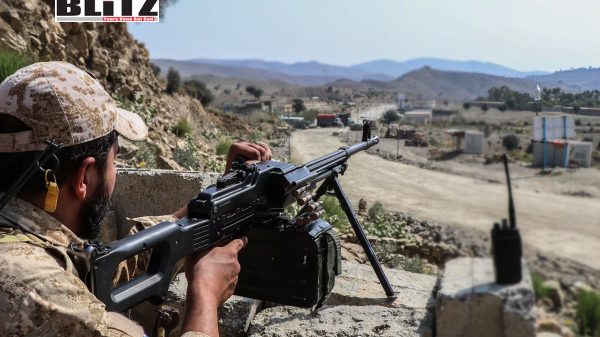
The eruption of open hostilities between Pakistan and Afghanistan represents far more than a bilateral border dispute. It is a geopolitical shockwave reverberating across Eurasia, threatening to destabilize one of the most ambitious economic and strategic visions of the twenty-first century. For China in particular, the conflict unfolding along the Durand Line challenges a core assumption behind its westward strategy: that economic connectivity can gradually overcome historical tensions and foster regional stability.
What began as a familiar pattern of cross-border skirmishes has escalated into the most serious confrontation between Islamabad and Kabul since the Taliban returned to power in 2021. After weeks of rising tensions, retaliatory attacks, and accusations surrounding cross-border militancy, Pakistan declared itself in a state of “open war” with the Taliban government following airstrikes on Afghan territory. The fragile ceasefire negotiated in October 2025 collapsed, and the frontier quickly transformed into a volatile battlefield.
The humanitarian toll is already mounting. Tens of thousands of civilians have been displaced, while border communities that have long endured sporadic violence now face the specter of prolonged warfare. Yet the significance of the conflict extends well beyond its immediate human costs. At stake is the stability of a strategic corridor that China has spent more than a decade attempting to transform into a key artery of Eurasian connectivity.
For Beijing, the Pakistan-Afghanistan confrontation strikes directly at the geographic heart of its regional economic architecture. Central to this vision is the China–Pakistan Economic Corridor (CPEC), the flagship component of China’s Belt and Road Initiative. Stretching from China’s Xinjiang region to Pakistan’s Arabian Sea port of Gwadar, CPEC was designed not merely as a bilateral development project but as a gateway linking western China to global trade routes.
The logic behind the corridor is straightforward. By investing in highways, railways, power plants, and industrial zones across Pakistan, China aims to create a secure land bridge connecting its western provinces to the Indian Ocean. Such connectivity would shorten trade routes, reduce dependence on maritime chokepoints such as the Strait of Malacca, and accelerate economic development in China’s interior regions.
Yet the broader strategic ambition extends even further. In Chinese geopolitical thinking, Afghanistan occupies a potentially transformative role within this network. As a landlocked state situated at the crossroads of South Asia, Central Asia, and the Middle East, Afghanistan could serve as a natural extension of the corridor system. Integrating Afghan transport routes and mineral resources into CPEC would provide Kabul with access to maritime trade while linking Central Asian markets more closely to China’s western provinces.
For years, Chinese policymakers cautiously explored this possibility. Diplomatic engagement with the Taliban continued even before the United States completed its withdrawal from Afghanistan in 2021, and Beijing maintained communication channels after the Taliban returned to power. Chinese companies have expressed interest in Afghanistan’s vast mineral deposits, including copper and rare earth resources that could prove strategically valuable in the global supply chain.
To support these ambitions, China helped establish a trilateral diplomatic framework involving Pakistan and Afghanistan. The China–Pakistan–Afghanistan dialogue mechanism aimed to foster economic cooperation, enhance security coordination, and gradually integrate Afghanistan into regional connectivity projects. The initiative reflected a broader Chinese belief that infrastructure investment and economic development can serve as catalysts for political stability.
The outbreak of war between Islamabad and Kabul now exposes the fragility of that assumption.
At the core of the crisis lies a persistent security dilemma that economic incentives alone cannot resolve. Pakistan has long accused the Taliban government of harboring militants affiliated with Tehreek-e-Taliban Pakistan (TTP), a group responsible for numerous attacks inside Pakistan. Kabul denies these allegations, but the issue has repeatedly triggered tensions between the two countries.
The porous nature of the 2,600-kilometer Durand Line further complicates matters. Established during the colonial era, the border remains disputed by successive Afghan governments, including the Taliban authorities. Many communities straddle the frontier, while militant networks exploit the rugged terrain to move across the boundary with relative ease. These structural realities create a volatile security environment that infrastructure projects cannot easily stabilize.
China now finds itself caught in a delicate balancing act between two partners that are both strategically important. Pakistan has long been described as China’s “all-weather strategic cooperative partner.” The relationship spans military cooperation, defense technology transfers, and deep economic ties. China is Pakistan’s largest trading partner and the primary investor behind CPEC infrastructure projects worth tens of billions of dollars.
At the same time, Beijing has carefully cultivated relations with Afghanistan’s Taliban leadership. While most Western governments have maintained limited engagement with the Taliban regime, China has opted for pragmatic diplomacy aimed at safeguarding its regional interests. Economic cooperation, limited trade initiatives, and cautious exploration of investment opportunities have all been part of this strategy.
The outbreak of open warfare between these two states therefore places China in an uncomfortable position. Taking sides could jeopardize critical partnerships, while remaining neutral risks exposing the limits of Beijing’s diplomatic influence in a region where security dynamics often overpower economic considerations.
This dilemma reflects a broader challenge facing China’s Belt and Road Initiative. The BRI was conceived as a transformative framework capable of reshaping Eurasian geopolitics through infrastructure connectivity. Roads, railways, pipelines, and ports would stimulate economic growth, reduce poverty, and encourage regional cooperation.
In theory, such development could gradually reduce the incentives for conflict. Prosperous trade corridors might replace militarized frontiers, while shared economic interests could foster political cooperation among neighboring states.
However, the current conflict highlights a fundamental flaw in this model. Infrastructure can facilitate commerce, but it cannot resolve deeply rooted political disputes or ideological conflicts. Militant networks, contested borders, and competing national narratives often operate independently of economic logic.
The Pakistan-Afghanistan war illustrates precisely this dynamic. Even as regional infrastructure projects promise long-term prosperity, immediate security concerns dominate the calculations of political leaders in Islamabad and Kabul. Domestic pressures, insurgent violence, and unresolved territorial disputes shape policy decisions far more directly than potential economic benefits.
For Beijing, the implications are significant. If the conflict persists, it could undermine not only the stability of Pakistan’s western regions but also the viability of extending CPEC into Afghanistan and Central Asia. Investors may become more cautious, infrastructure development could slow, and the broader vision of a seamless Eurasian economic corridor may face new obstacles.
Moreover, the conflict is unfolding within an increasingly volatile international environment. In recent years, the global threshold for confrontation between major powers and nuclear-armed states has appeared to shift. Strategic rivalries, proxy conflicts, and geopolitical brinkmanship have become more common features of international politics.
South Asia itself has experienced several dangerous escalations, including the India-Pakistan crisis of 2025. Pakistan’s nuclear status adds another layer of complexity to the current conflict. Although Afghanistan does not possess nuclear weapons, the presence of a nuclear-armed state in the confrontation inevitably raises the stakes and intensifies global concern.
From Beijing’s perspective, the war therefore presents both immediate risks and long-term strategic questions. Can economic integration truly serve as a stabilizing force in regions plagued by insurgencies and unresolved borders? Or must infrastructure diplomacy be accompanied by deeper political engagement and security cooperation?
These questions are likely to shape the future trajectory of China’s westward strategy.
In the short term, Beijing will almost certainly intensify diplomatic efforts to de-escalate the conflict. Chinese officials have already called for dialogue and negotiation between Islamabad and Kabul while signaling readiness to facilitate mediation through existing trilateral channels. Maintaining communication with both governments will be essential if China hopes to prevent further deterioration of regional stability.
Yet even successful mediation would not eliminate the underlying structural tensions driving the conflict. The Durand Line dispute, militant activity, and fragile governance structures in the region remain unresolved challenges that will continue to generate friction.
Ultimately, the Pakistan-Afghanistan war may serve as a critical test for China’s broader geopolitical vision. The Belt and Road Initiative was built on the belief that economic development could gradually transform unstable regions into interconnected zones of prosperity. That vision remains powerful, but events on China’s western frontier reveal its limitations.
Infrastructure alone cannot replace political reconciliation, effective governance, or durable security arrangements. Without those foundations, even the most ambitious economic corridors remain vulnerable to the forces of conflict.
The war now unfolding along the Durand Line is therefore more than another regional crisis. It is a moment of strategic reckoning for the idea that connectivity can overcome geopolitics. Whether China can adapt its approach to navigate this reality will shape not only the future of its Belt and Road ambitions but also the broader geopolitical landscape of Eurasia in the decades ahead.
Damsana Ranadhiran, Special Contributor to Blitz is a security analyst specializing on South Asian affairs.