Scientists achieve first “virtual brain” upload with digital fruit fly replica

- Update Time : Wednesday, March 11, 2026
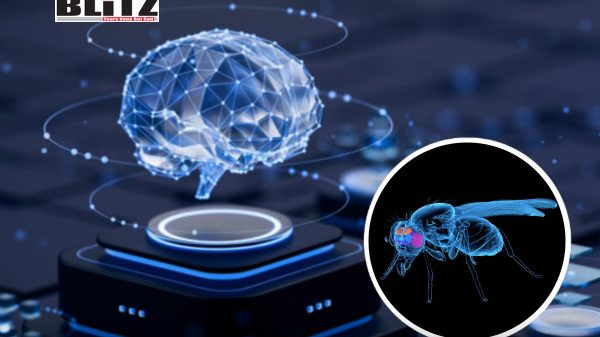
A Silicon Valley startup claims to have achieved a scientific milestone that could reshape the future of neuroscience and artificial intelligence: the first successful “virtual brain upload.” The breakthrough involves creating a complete digital replica of a fruit fly’s brain and placing it inside a simulated environment where it controls a virtual body and exhibits natural behaviors.
The project, announced by technology startup Eon Systems, marks a step beyond traditional artificial intelligence systems. Rather than training an AI model to imitate biological behavior, researchers replicated the neural wiring of a real brain in a digital environment. The result is a simulated organism whose actions arise directly from a detailed neuron-by-neuron copy of the biological brain.
According to Eon Systems, the digital fruit fly is capable of performing natural actions such as walking, grooming itself, and foraging for resources in its environment. These behaviors are not pre-programmed scripts or outputs from machine-learning training but emerge naturally from the activity of the brain’s neural circuitry.
Dr. Alex Wissner-Gross, co-founder of Eon Systems, described the experiment as fundamentally different from conventional AI simulations. In a public statement announcing the breakthrough, he emphasized that the virtual fly is not an animation or a machine-learning model trained to replicate biological behavior.
“This is not an animation. It is not a reinforcement learning policy mimicking biology,” he explained. “It is a copy of a biological brain, wired neuron-to-neuron from electron microscopy data, running in simulation, making a body move.”
The breakthrough builds on years of international research aimed at mapping the complete neural wiring of living organisms. In 2024, scientists achieved a major milestone by producing a full connectome of an adult fruit fly. A connectome is essentially a detailed map of all the neurons in a brain and the synaptic connections between them.
The fruit fly brain, though tiny, is remarkably complex. It contains roughly 140,000 neurons connected by about 50 million synapses. For scientists, it represents an ideal model organism: complex enough to study meaningful neural behavior but small enough to map in full detail.
Using electron microscopy imaging and advanced data processing, researchers were able to reconstruct the entire neural network of the fruit fly brain. This provided an unprecedented level of insight into how its neurons connect and interact.
In a study published in the journal Nature, a research team that included Eon senior scientist Philip Shiu demonstrated that a computational model built from the fly’s connectome could predict real fly motor behavior with about 95% accuracy.
However, that earlier model had a limitation: it simulated neural activity but lacked a physical or virtual body through which the brain could express behavior. Without a body, the brain model could not fully interact with an environment.
Eon Systems’ new work addresses that limitation by integrating the digital brain with a virtual body operating in a simulated environment. To accomplish this, the team used the MuJoCo physics engine developed by Google DeepMind.
The MuJoCo engine allows the simulation of realistic physical environments, including gravity, movement, and interactions between objects. In this case, it enabled researchers to create a digital fruit fly body capable of moving and responding to its surroundings.
The system works through a feedback loop similar to that of a real biological organism. Sensory inputs from the simulated environment are transmitted to the digital brain. Neural activity propagates through the network according to the connectome’s wiring, generating signals that control the virtual body’s muscles.
These motor commands then produce movements such as walking or grooming, which in turn generate new sensory inputs. The cycle repeats continuously, allowing the virtual organism to behave autonomously.
Eon CEO Michael Andregg said the digital fly achieved about 91% behavioral accuracy compared with real flies. Notably, this performance was achieved without using reinforcement learning, machine-learning training, or manual behavioral programming.
Instead, the behavior emerges purely from the underlying neural wiring and simplified neuron models.
The achievement highlights a different paradigm for creating intelligent systems. Traditional artificial intelligence relies on algorithms that learn patterns from large datasets. In contrast, the Eon experiment attempts to replicate intelligence by copying the physical structure of a biological brain.
In other words, rather than teaching a machine how to behave like an organism, researchers recreate the organism’s neural circuitry so that behavior arises naturally.
This approach could provide new insights into how biological intelligence works. By experimenting with digital replicas of brains, scientists can study neural processes in ways that would be impossible or unethical in living organisms.
Researchers could observe how neural circuits generate behavior, investigate the effects of modifying specific neurons or connections, and test theories about cognition and learning.
While the fruit fly experiment represents a major step forward, it is still only the beginning of a much larger challenge. Even small animal brains are vastly more complex than the fly’s.
Eon Systems is now working toward emulating a mouse brain, which contains around 70 million neurons-roughly 560 times more than a fruit fly. Mapping and simulating such a large neural network will require enormous amounts of data, computing power, and sophisticated modeling techniques.
If successful, the mouse brain project could bring scientists closer to replicating mammalian intelligence in a digital environment. This would allow researchers to study complex behaviors such as memory formation, learning processes, and decision-making.
Ultimately, the company has even more ambitious long-term goals: attempting a full human brain emulation.
The prospect of human brain uploading remains highly speculative and raises profound ethical and philosophical questions. If a human brain were successfully replicated in digital form, it could challenge current ideas about consciousness, identity, and the nature of the mind.
Would a digital brain simulation simply be a model, or could it possess some form of awareness? Could memories or personality traits be preserved in such a system? These questions remain deeply debated among neuroscientists, philosophers, and ethicists.
For now, researchers emphasize that the technology is still far from reaching the level of complexity required for human brains, which contain roughly 86 billion neurons and trillions of synaptic connections.
Nevertheless, the fruit fly experiment suggests that digital brain emulation may be more achievable than previously thought.
Dr. Wissner-Gross summarized the philosophical implications of the achievement in a striking phrase: “The ghost is no longer in the machine. The machine is becoming the ghost.”
While the statement is partly symbolic, it reflects the broader significance of the research. By reconstructing biological brains in digital form, scientists may eventually create systems where life-like behavior arises from simulated neural circuits rather than artificial algorithms.
For neuroscience, this could open an entirely new experimental frontier. For artificial intelligence, it suggests a path toward machines that think not because they were trained to do so-but because their digital brains are wired to behave that way.
Although the journey from fruit flies to human minds remains long and uncertain, the first step toward virtual brain uploading has now been taken.
Sonjib Chandra Das is a Staff Correspondent of Blitz.