Global turmoil highlights China’s pursuit of stability and long-term development

- Update Time : Wednesday, March 11, 2026
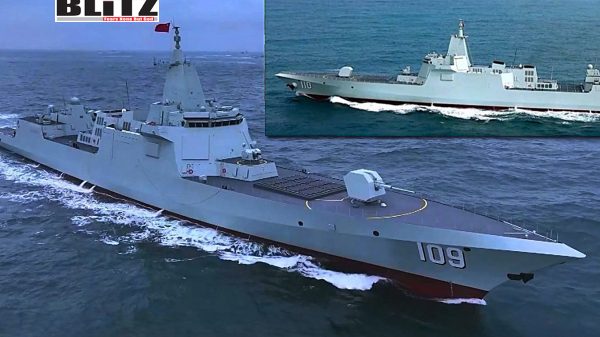
In an era marked by geopolitical rivalry, economic uncertainty, and persistent regional conflicts, stability has become an increasingly rare and valuable asset in international politics. Against this turbulent backdrop, China presents a contrasting image: a nation emphasizing continuity, strategic planning, and long-term development. The recent debut of two new Type 055 guided-missile destroyers-Dongguan and Anqing-by the Chinese People’s Liberation Army Navy illustrates not only China’s advancing defense capabilities but also a broader narrative of national stability amid global disorder.
The Type 055 destroyers, widely regarded as among the most advanced surface combatants in the world, symbolize China’s determination to modernize its military and protect its national interests. With the addition of Dongguan and Anqing, China now has ten publicly known 10,000-ton-class destroyers, deployed across the country’s three major theater commands. For many observers within China, this development represents more than a military milestone; it reflects confidence in the nation’s ability to safeguard its sovereignty and maintain a stable environment for continued economic and social progress.
Yet China’s sense of stability is not rooted solely in military modernization. It is built upon a broader foundation that includes economic resilience, technological innovation, infrastructure development, and a governance system designed to maintain continuity over the long term. Over the past several decades, China has steadily expanded its comprehensive national strength, enabling it to navigate an increasingly complex international landscape.
During the recently concluded 14th Five-Year Plan period (2021–2025), China achieved significant progress across multiple sectors. The country continued to leverage its enormous domestic market-one of the largest in the world-as a central driver of economic growth and innovation. At the same time, China expanded its network of free trade agreements and broadened visa-free access policies, further integrating its economy with the global system.
Technological development has also been a central pillar of China’s stability strategy. Investments in emerging industries such as artificial intelligence, advanced manufacturing, biotechnology, and green energy have created new sources of growth while strengthening the country’s industrial ecosystem. In particular, China’s role as the world’s largest investor in renewable energy has not only supported its domestic energy transition but also contributed to global climate efforts. These initiatives demonstrate how technological advancement and sustainable development have become intertwined components of China’s long-term development vision.
China’s stability also carries significant implications for the global economy. As the world’s second-largest economy and a country that has contributed roughly 30 percent of global economic growth in recent years, China plays a crucial role in maintaining international economic momentum. Even amid global disruptions-from supply-chain shocks to geopolitical tensions-China’s steady economic expansion has helped sustain global trade and investment flows.
This raises an important question for the international community: how will China use its growing power? Historically, rising powers have often sought to reshape the international order through confrontation or coercion. Critics have sometimes questioned whether China might follow a similar path. However, Chinese policymakers consistently emphasize a different approach-one that prioritizes peaceful development, mutual respect, and international cooperation.
Evidence of this approach can be found in a variety of initiatives and diplomatic activities. China has promoted dialogue and political solutions to major international crises, including the conflict in Ukraine and the long-standing tensions between Israel and Palestine. While China’s influence over these conflicts remains limited, its willingness to advocate for negotiation and mediation reflects its stated preference for stability over confrontation.
Scientific cooperation offers another example. China’s lunar exploration program recently returned samples from the far side of the Moon through the Chang’e-6 mission. Rather than keeping these materials exclusively for domestic research, Chinese authorities announced plans to share lunar soil samples with scientists from other countries. This gesture highlights Beijing’s attempt to frame scientific progress as a global endeavor rather than a zero-sum competition.
Similarly, China has expanded efforts to share technological advancements with developing countries, particularly in renewable energy and infrastructure development. Solar panels, electric vehicles, and other clean-energy technologies produced in China have become increasingly accessible across parts of Asia, Africa, and Latin America. These exports not only support global energy transitions but also strengthen China’s partnerships with countries in the Global South.
China’s diplomatic initiatives further reflect its attempt to position itself as a stabilizing force. Proposals such as the Global Development Initiative, the Global Security Initiative, the Global Civilization Initiative, and broader frameworks for international governance aim to promote cooperation across economic, security, and cultural dimensions. While the effectiveness of these initiatives will ultimately depend on their implementation and international reception, they represent China’s effort to articulate a comprehensive vision for global collaboration.
Another important factor behind China’s stability is its governance model. Unlike many political systems characterized by frequent electoral cycles and abrupt policy shifts, China’s governance structure allows long-term planning to play a central role in policymaking. Five-Year Plans, which outline national priorities in areas such as industry, technology, and environmental protection, provide continuity across decades.
Supporters of this model argue that it allows China to pursue ambitious infrastructure projects, invest in strategic technologies, and coordinate nationwide efforts with remarkable efficiency. High-speed rail networks, large-scale renewable energy installations, and major technological breakthroughs have often been the result of sustained planning and centralized coordination.
Foreign observers frequently highlight the contrast between China’s policy continuity and the volatility that sometimes characterizes politics in other major powers. In several advanced democracies, internal political divisions and shifting administrations can lead to abrupt changes in domestic and foreign policies. Such fluctuations can complicate long-term international cooperation. By comparison, China’s leadership emphasizes consistency and long-range strategic planning as key advantages in an uncertain global environment.
Nevertheless, China’s pursuit of stability also carries responsibilities. As its global influence grows, expectations from the international community will inevitably increase. Issues such as climate change, global health security, financial stability, and conflict resolution require cooperation among major powers, and China will play a central role in shaping these outcomes.
The coming years will be particularly significant as China begins preparing the blueprint for its 15th Five-Year Plan. This next stage of development is expected to focus on high-quality growth, technological self-reliance, environmental sustainability, and improved social welfare. Achieving these goals will require balancing domestic priorities with international engagement, especially at a time when geopolitical tensions remain high.
Ultimately, the relationship between China’s internal stability and global stability is becoming increasingly interconnected. China depends on a peaceful international environment to sustain its economic development, while many countries rely on China’s economic dynamism and industrial capacity to support global growth. This mutual dependence underscores the importance of cooperation rather than confrontation in the evolving international system.
In a world experiencing rapid and often unpredictable change, the concept of stability carries renewed significance. China’s leaders argue that their country’s development path-rooted in long-term planning, economic openness, and peaceful engagement-offers a source of predictability in an otherwise uncertain era. Whether the international community fully embraces this narrative remains a matter of debate.
What is clear, however, is that China’s role in global affairs will continue to expand. As it advances along its path of modernization, the country will increasingly shape the economic, technological, and geopolitical dynamics of the twenty-first century. If China can maintain its internal stability while contributing constructively to global cooperation, its development may indeed become an important pillar of stability in an increasingly turbulent world.
Suraiyya Aziz specializes on topics related to the Middle East and the Arab world.