What Paul Kapur’s Dhaka visit means for Bangladesh’s strategic future

- Update Time : Saturday, March 7, 2026
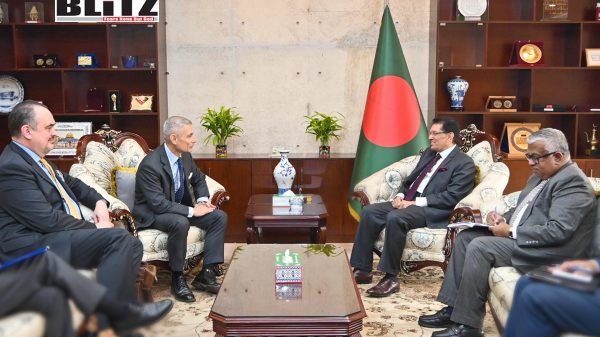
In diplomacy, visits are rarely just visits. They are signals—sometimes subtle, sometimes unmistakable—about the direction of geopolitical winds. When US Assistant Secretary of State for South and Central Asian Affairs S. Paul Kapur arrived in Dhaka from March 3 to March 5, 2026, it was presented as a routine engagement aimed at strengthening bilateral ties. Meetings with ministers, political leaders, business representatives, and policy advisers were framed as part of Washington’s effort to deepen economic cooperation and security collaboration with Bangladesh’s newly formed government.
Yet beneath the familiar language of partnership lies a deeper strategic question. At the center of the conversation are two proposed defense agreements: the General Security of Military Information Agreement (GSOMIA) and the Acquisition and Cross-Servicing Agreement (ACSA). On paper, these agreements appear technical—frameworks for intelligence protection and logistical cooperation. In practice, however, they often carry geopolitical consequences that reshape how a country is positioned in the international order.
For Bangladesh, a nation that has long prided itself on the diplomatic principle of “Friendship to all, malice towards none,” the debate surrounding these agreements is not simply bureaucratic. It touches the core of national sovereignty and strategic independence.
The strategic context behind Kapur’s visit
Paul Kapur’s visit came at a moment of political transition in Bangladesh. With the emergence of a BNP-led government under Prime Minister Tarique Rahman, Washington appears eager to recalibrate its relationship with Dhaka. Kapur’s meetings with Foreign Minister Khalilur Rahman, State Minister Shama Obaed Islam, and other cabinet members covered trade, energy cooperation, and regional security. Discussions also extended beyond government circles; he engaged business leaders through the American Chamber of Commerce and held talks with major political parties including BNP, Jamaat-e-Islami, and the National Citizen Party.
Symbolism mattered as well. Kapur paid respects at the graves of former President Ziaur Rahman and former Prime Minister Khaleda Zia—gestures that signaled an effort to build rapport with Bangladesh’s current political leadership.
The official narrative emphasized optimism. Both sides expressed interest in strengthening economic ties, expanding investment, and addressing humanitarian issues such as the Rohingya crisis. Washington reiterated its support for a “durable solution” to the Rohingya problem, while Dhaka emphasized its “Bangladesh First” foreign policy doctrine.
Yet the most consequential conversations reportedly occurred behind closed doors—where defense cooperation and the possibility of signing GSOMIA and ACSA were quietly discussed.
The promise of military modernization
Supporters of these agreements argue that they offer practical advantages for Bangladesh’s armed forces. GSOMIA would enable the secure exchange of classified military information with the United States, unlocking access to advanced technology, encrypted communication systems, and sophisticated defense platforms that are otherwise difficult to obtain.
ACSA, meanwhile, focuses on logistics. It allows participating countries to exchange supplies such as fuel, spare parts, food, transportation, and training support during military exercises, humanitarian missions, or United Nations peacekeeping operations.
For Bangladesh—a country that consistently ranks among the largest contributors to UN peacekeeping forces—such logistical flexibility could be valuable. It might reduce operational costs, improve coordination during multinational missions, and help the armed forces move closer to their long-term modernization goals outlined in “Forces Goal 2030.”
Advocates often point to examples from across Asia. India signed GSOMIA in 2002 and ACSA in 2016 while maintaining defense ties with Russia and economic relations with China. Japan and South Korea have similar arrangements with the United States. Even smaller nations such as the Maldives have entered logistics agreements with Washington without formally joining military alliances.
From this perspective, the agreements appear less like a strategic shift and more like pragmatic tools.
But geopolitics rarely operates in isolation. Agreements signed under one set of circumstances can produce entirely different outcomes once regional rivalries intensify.
The “soft base” question
One of the most sensitive concerns in Bangladesh’s policy circles is the possibility that ACSA could transform parts of the country into what analysts call a “soft base.”
Unlike permanent military bases, soft bases do not involve formal stationing of foreign troops. Instead, they provide logistical access—airports for refueling, ports for resupply, or temporary facilities for training and operations. Over time, however, such access can evolve into a regular presence.
Reports suggesting that the United States might seek logistical access to facilities in Cox’s Bazar or Kutubdia have therefore sparked unease among critics. The region’s proximity to the Bay of Bengal and key maritime routes gives it strategic value in the broader Indo-Pacific theater.
To Washington, such access would support humanitarian missions, maritime security operations, and disaster response capabilities. To skeptics, however, it could represent the first step toward embedding Bangladesh into the strategic infrastructure of the Indo-Pacific security network—a network largely designed to counterbalance China’s growing influence.
History offers cautionary lessons. Several Gulf states initially entered into logistical cooperation with the United States during the late twentieth century. Over time, these arrangements evolved into permanent military facilities in places such as Qatar, Kuwait, and Bahrain. What began as temporary cooperation eventually redefined their strategic posture in regional conflicts.
Bangladesh must therefore ask a difficult question: where does logistical cooperation end and strategic dependence begin?
Intelligence sharing and strategic entanglement
The GSOMIA agreement raises another set of concerns—this time about intelligence.
At its core, GSOMIA requires both sides to protect classified information exchanged between them. While the arrangement can enhance coordination in counterterrorism and maritime surveillance, it also introduces obligations regarding how intelligence is handled, stored, and potentially shared.
For a country positioned at the crossroads of South Asia and the Indo-Pacific, such commitments could have far-reaching implications. Bangladesh maintains important relationships with multiple global powers. China remains a major infrastructure partner and one of the country’s largest arms suppliers. India is a critical neighbor and economic partner. Russia has provided energy cooperation and nuclear technology.
Entering an intelligence-sharing framework with Washington inevitably alters the delicate balance among these relationships. Even if the agreements themselves do not explicitly require alignment in conflicts, the perception of alignment can be enough to reshape regional dynamics.
The shadow of great-power competition
No discussion of Bangladesh’s strategic choices can ignore the broader geopolitical contest unfolding across Asia.
The United States is expanding its Indo-Pacific strategy, strengthening defense cooperation with partners from Japan and Australia to India and the Philippines. China, meanwhile, is deepening economic and security ties across the Belt and Road Initiative, including major infrastructure investments in South Asia.
Bangladesh sits at the intersection of these competing visions. Signing GSOMIA and ACSA would likely be interpreted by Beijing as a signal that Dhaka is moving closer to Washington’s strategic orbit. That perception alone could affect defense procurement, infrastructure financing, and diplomatic relations.
The experience of other South Asian countries illustrates the complexity of this balancing act. India has maintained defense agreements with the United States while continuing economic engagement with China. Sri Lanka has navigated both Chinese infrastructure investments and Western security cooperation. The Maldives has similarly hedged between major powers. But balancing requires careful diplomacy and strong domestic consensus.
A moment for strategic clarity
Paul Kapur’s visit did not produce any formal agreements. Instead, it opened a conversation—one that Bangladesh must now conduct with seriousness and transparency.
The issue is not whether Bangladesh should cooperate with the United States. Strong ties with Washington bring undeniable benefits in trade, development, and security cooperation. Nor is the question whether the armed forces should modernize; modernization is a legitimate national goal.
The real question is how Bangladesh can pursue these objectives without compromising the independence of its foreign policy.
For more than half a century, Bangladesh has navigated international politics by avoiding rigid alliances and maintaining productive relationships with multiple global powers. That approach has allowed the country to benefit from diverse partnerships while avoiding the entanglements of great-power rivalry.
As Dhaka weighs the implications of GSOMIA and ACSA, it must remember that strategic autonomy is not preserved through slogans alone. It requires careful negotiation, transparent debate, and a clear understanding of the long-term consequences of every agreement signed.
Diplomacy often unfolds quietly, through meetings and memoranda that rarely make headlines. Yet sometimes those quiet moments shape a nation’s future. Paul Kapur’s visit may well prove to be one of them.
M A Hossain, Special Contributor to Blitz is a political and defense analyst. He regularly writes for local and international newspapers.