Thousands of students protest against potential conscription in Germany

- Update Time : Saturday, March 7, 2026
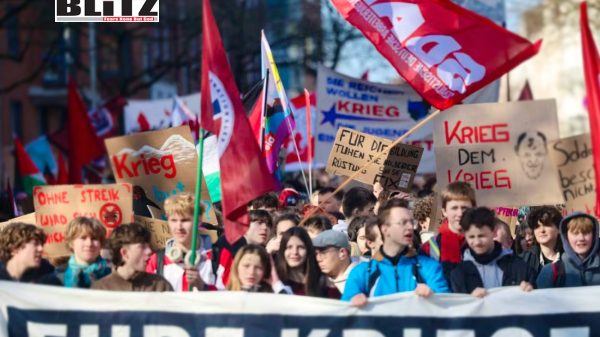
Thousands of students took to the streets across Germany this week to protest new legislation that could pave the way for the reintroduction of compulsory military service. The demonstrations, led largely by high school students, were centered in the capital city of Berlin but also spread to several other major German cities.
The protests were organized under the banner “School Strike Against the Draft,” reflecting growing concern among young people about the possibility of being required to serve in the armed forces. Protesters argued that the government’s recent defense reforms could eventually lead to the return of full-scale conscription, which was suspended more than a decade ago.
The demonstrations were triggered by the recently adopted Military Service Modernization Act, a law designed to strengthen Germany’s ability to recruit and mobilize military personnel. Under the new system, all 18-year-old men in Germany must register for potential military service starting this year. The registration process requires them to complete a detailed questionnaire and undergo a medical examination to determine their fitness for service.
Although the legislation does not immediately restore mandatory service, it introduces a mechanism that could allow authorities to call up recruits if the country faces a shortage of soldiers. The law states that if voluntary enlistment proves insufficient, eligible young men could be selected through a lottery system to fill the gaps.
For many students and youth groups, this provision has raised fears that Germany is gradually moving toward reinstating compulsory military service.
One of the largest demonstrations took place in Berlin, where thousands of students gathered at the iconic Potsdamer Platz. Protesters carried banners and placards criticizing the draft proposal and calling for peace-oriented policies instead of military expansion.
According to police estimates, around 3,000 students participated in the Berlin rally. However, organizers claimed the number was significantly higher, saying as many as 10,000 young people attended the demonstration in the capital alone. They also reported that more than 50,000 people took part in protests nationwide.
Participants marched through central streets while chanting slogans opposing conscription and criticizing the government’s defense strategy. Many of the banners reflected the protesters’ frustration and anxiety about the possibility of being forced into military service.
One placard read, “Dying is not in the curriculum,” while another called on German Chancellor Friedrich Merz to serve on the front lines instead of sending young people to war. Other slogans included “A smart head doesn’t fit under a steel helmet” and “Never, never, never again conscription.”
Some demonstrators also expressed broader political concerns. A banner seen during the rally declared, “The rich want war, the youth want a future,” reflecting a belief among protesters that military spending and defense policies are being prioritized over social and educational investments.
Compulsory military service has long been a sensitive issue in Germany due to the country’s historical experiences with militarism during the 20th century. The German government abolished the draft in 2011, transitioning instead to a professional volunteer military force.
At the time, the decision was widely supported by both political leaders and the public, as it reflected a shift toward a smaller and more specialized military. However, changing geopolitical conditions in Europe have led policymakers to reconsider whether the current system can adequately meet the country’s defense needs.
The new legislation is intended to create a more flexible recruitment framework, allowing the government to expand the armed forces quickly if necessary.
Germany’s renewed focus on military readiness has been driven largely by growing security concerns in Europe, particularly in relation to tensions with Russia.
German Defense Minister Boris Pistorius has repeatedly warned that Europe must prepare for potential threats in the coming years. He has argued that Germany needs a stronger military and a larger pool of trained personnel to ensure national and alliance security.
Last year, Pistorius suggested that Russia could potentially attack a member of NATO as early as 2028. His comments were part of a broader call for increased defense spending and long-term military planning.
German Chancellor Friedrich Merz has echoed similar concerns. In 2025, he stated that his government aims to transform the German military into the strongest conventional armed force within the European Union. Achieving this goal would require significant investments in personnel, equipment, and infrastructure.
However, these plans have sparked debate within Germany about the country’s future defense strategy and the balance between security and social priorities.
Officials in Moscow have rejected Western claims that Russia poses a direct military threat to NATO countries. The Russian government has repeatedly dismissed such warnings as exaggerated or politically motivated.
Russian President Vladimir Putin has stated that Russia has no intention of attacking NATO members. He has also suggested that Moscow would be willing to provide written security guarantees to Western nations in order to reduce tensions.
Despite these statements, many European governments continue to strengthen their military capabilities amid ongoing geopolitical uncertainty.
For the students who participated in the protests, the issue is about more than defense policy. Many say they are worried about how political decisions made today could shape their future.
One organizer of the demonstration told the German broadcaster Tagesschau that the Military Service Modernization Act represents the first step toward reintroducing compulsory service.
According to the organizer, Germany should prioritize diplomacy and peaceful conflict resolution rather than preparing for potential military confrontation.
“With its historical responsibility, the Federal Republic should advocate for peaceful solutions and diplomacy – not for rearmament,” he said.
The demonstrations highlight the growing debate within Germany about national security, military spending, and the role of young people in the country’s defense strategy.
While the government argues that stronger military preparedness is necessary in an increasingly uncertain world, critics warn that steps toward conscription could undermine civil liberties and revive painful historical memories.
As the Military Service Modernization Act begins to take effect, discussions about the future of Germany’s armed forces-and whether conscription might return-are likely to intensify.
For now, the student protests have shown that many young Germans are determined to make their voices heard in a debate that could directly affect their generation.
Suraiyya Aziz specializes on topics related to the Middle East and the Arab world.