


Sanctioned Prince Group associate linked to $17 million London property holdings

- Update Time : Saturday, March 7, 2026
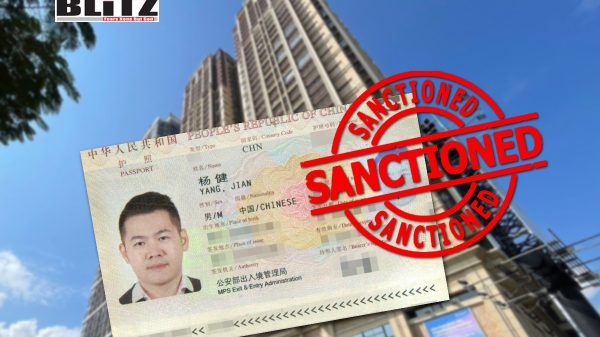
A man sanctioned by the United States over his alleged involvement in a vast international criminal network has been linked to at least $17 million worth of property in London, according to company and land registry records. The individual, Yang Jian, has been accused by the US government of playing a role in the operations of Prince Group, a Cambodia-based conglomerate that American authorities have designated a “transnational criminal organization.”
Before he was targeted by US sanctions, Yang quietly acquired a significant portfolio of residential property in the British capital, purchasing a cluster of adjoining houses and multiple parking spaces in a high-value area of South London. The properties were obtained through a UK-registered company connected to him, raising further questions about how alleged members of global criminal networks are able to invest in major Western property markets.
According to conveyancing documents filed with the UK Land Registry, a company called DSRR Limited bought 12 adjoining house units along with at least 17 car parking spaces in a neighboring garage in November 2022. The combined purchase price was £12.7 million, equivalent to roughly $17 million at the time.
Company records indicate that Yang Jian established DSRR Limited in December 2021, using his Cypriot passport when registering the company. Although he is also a Chinese citizen, Yang acquired citizenship in Cyprus in 2019, which allowed him to conduct business and property transactions within Europe under a different nationality.
The properties linked to Yang Jian are located in Rotherhithe, a riverside district in South London known for its quiet residential streets and proximity to the financial hub of Canary Wharf. Reporters from the Organized Crime and Corruption Reporting Project (OCCRP), who visited the site, described the homes as part of a gated private road situated along the River Thames. From the property, there is a direct view across the river toward the skyline of Canary Wharf, one of London’s most important financial districts.
Although the journalists were unable to gain direct access to the properties due to security restrictions and fencing, they reported that some of the houses appeared to be occupied or in active use. The discovery of the properties has intensified scrutiny of the financial activities of individuals linked to Prince Group, particularly those who have been sanctioned by Western governments.
Yang Jian was included in a sanctions notice issued by the US Department of the Treasury in 2025, which listed 146 individuals and entities alleged to be involved in online fraud operations and human trafficking connected to Prince Group. The sanctions targeted individuals believed to be operating within the group’s extensive network of business entities across Asia and beyond.
Despite the US sanctions, Yang Jian has not been sanctioned by the United Kingdom. As a result, there has been no legal barrier preventing his ownership of property in London under UK law. This discrepancy between American and British sanctions regimes has prompted renewed debate among policy experts about how global financial systems can be used by individuals under investigation in other jurisdictions.
US authorities allege that Yang Jian was involved with a company known as Grand Legend International Asset Management Co. Ltd., a Palau-based firm that is partly owned by Chen Zhi, the chairman of Prince Group. According to corporate records, Yang served as both a director and shareholder of Grand Legend International.
Documents related to the company also list Chen Zhi and another individual, Chen Xiaoer, as directors and shareholders. Chen Xiaoer is widely reported to have used multiple identities and is also known by his birth name, Hu Xiaowei.
Investigations conducted by OCCRP have previously highlighted Hu Xiaowei’s extensive property investments in the United Kingdom. According to those reports, Hu controls a property portfolio worth approximately $45 million in Britain. The investigation also uncovered that Hu had used several different identities and maintained business operations across multiple countries.
When journalists attempted to obtain comment from Hu Xiaowei through his assistant, the request went unanswered. However, the assistant stated that Hu was a “long-time acquaintance” of Chen Zhi and insisted that their only joint business venture-a resort project in Palau-had been unfairly sanctioned by authorities.
Company registry documents in China further reveal that Yang Jian and Hu Xiaowei shared overlapping business interests long before the emergence of the Prince Group controversy. Records show that both individuals held stakes in several companies dating back to the early 2010s, indicating that their business relationship spans more than a decade.
Reporters also found that Yang Jian continues to hold active stakes in companies based in Hong Kong under his Chinese citizenship, even while using his Cypriot nationality for other international activities.
Yang Jian is not the only individual linked to Prince Group who has been found to possess substantial property holdings abroad. Another sanctioned associate of the organization, Zhu Zhongbiao, has reportedly acquired at least 29 luxury properties in Dubai. In addition, his wife purchased five high-end apartments in London, according to investigative reporting.
Neither Zhu Zhongbiao nor his wife responded to requests for comment regarding those purchases.
The discovery of Yang Jian’s London property holdings comes at a time when international law enforcement agencies are intensifying efforts to dismantle Prince Group’s alleged criminal network.
The organization, headquartered in Cambodia, has been accused by authorities in several countries of facilitating large-scale online fraud operations, including scams targeting victims across Asia, Europe, and North America. In addition, investigators have linked the group to alleged human trafficking operations in which individuals were reportedly forced to participate in online scam activities.
Prince Group has strongly denied these accusations. In a statement issued in November, the company said the allegations were “baseless” and suggested that they were part of a broader effort to justify the seizure of assets belonging to the organization.
“The recent allegations are baseless and appear aimed at justifying the unlawful seizure of assets worth billions of dollars,” the group said in its statement.
Nevertheless, the international pressure on the organization has continued to grow. In early January, Chen Zhi, the chairman of Prince Group, was arrested in Cambodia and later extradited to China. Authorities there are reportedly investigating his alleged role in the broader network.
Meanwhile, law enforcement agencies in several other countries have also taken action against individuals connected to the organization. Singapore recently announced that authorities had arrested three people and seized assets linked to Prince Group as part of an ongoing investigation.
Taiwan has also launched a major legal crackdown on the group. Prosecutors there recently indicted 62 individuals believed to be connected to the network, accusing them of involvement in large-scale fraud operations.
China has likewise stepped up its efforts to bring suspected participants in the alleged network to justice. The country’s Ministry of Public Security issued a deadline of February 15 for individuals believed to be involved with Prince Group to voluntarily surrender to police and confess their crimes.
Authorities indicated that those who comply could receive lighter or reduced punishments under Chinese law.
As investigations continue across multiple jurisdictions, the discovery of Yang Jian’s London property portfolio highlights how global financial and property markets can intersect with international criminal investigations.
Experts say that the case underscores the challenges faced by governments seeking to track and restrict the assets of individuals suspected of involvement in cross-border crime. While sanctions imposed by one country can freeze assets within its own jurisdiction, they do not automatically apply worldwide.
As a result, individuals targeted by sanctions may still be able to hold assets in countries that have not implemented equivalent measures.
The case of Yang Jian’s multimillion-dollar London property holdings therefore illustrates the complexities of international enforcement efforts against alleged criminal networks that operate across borders, financial systems, and legal jurisdictions.
Tajul Islam is a Special Correspondent of Blitz. He also is Local Producer of Al Jazeera Arabic channel.