Is the Middle East drifting toward a nuclear arms race?

- Update Time : Monday, February 23, 2026
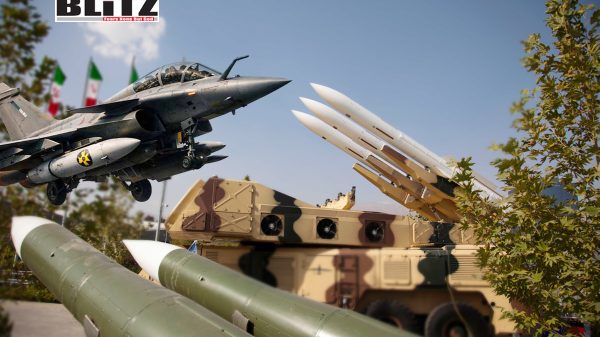
The Middle East stands at a strategic inflection point. Intensifying friction between the United States and Iran over Tehran’s nuclear program, Israel’s long-standing policy of nuclear ambiguity, and Türkiye’s quiet reassessment of deterrence posture collectively signal that the region’s security architecture may be entering a transformative phase. The question is no longer abstract: Is the Middle East on the cusp of a nuclear arms race, or are these dynamics part of a more calibrated recalibration of power?
For more than three decades, Iran’s nuclear program has occupied the center of regional security discourse. Tehran consistently maintains that its program is peaceful, anchored in energy diversification, technological sovereignty, and strategic autonomy. Iranian officials frequently invoke a religious edict by Supreme Leader Ali Khamenei declaring weapons of mass destruction morally impermissible under Islamic principles. Legally, Iran remains a signatory to the Treaty on the Non-Proliferation of Nuclear Weapons (NPT), which obliges it to abstain from pursuing nuclear arms and to subject its facilities to International Atomic Energy Agency inspections.
Yet in international relations, perception often outweighs formal commitments. The concept of “nuclear latency” or “threshold capability” is central here. A state need not openly weaponize to alter the regional balance; the mere capacity to do so in relatively short order can produce strategic consequences. From a realist perspective, capability generates leverage. Even if Tehran’s intent remains non-military, the technological accumulation of enriched uranium, advanced centrifuge infrastructure, and ballistic missile development reshapes the calculations of neighboring states.
In an already volatile region characterized by proxy conflicts, asymmetric warfare, and deep-seated rivalries, such a threshold dynamic can generate a security dilemma. If Iran were perceived to cross into nuclear weaponization, regional actors—including Saudi Arabia, Egypt, the United Arab Emirates, and especially Türkiye—would confront a binary strategic choice: accommodate a new hierarchy of power or pursue symmetrical deterrence. Historically, nuclear proliferation exhibits domino logic under conditions of mistrust. Once one actor shifts the deterrence equilibrium, others reassess.
No discussion of Middle Eastern nuclear politics is complete without examining Israel. Although Israel has never formally acknowledged possessing nuclear weapons, its doctrine of “strategic ambiguity” has endured for decades. The widely cited remark attributed to former Prime Minister Golda Meir—“We don’t have nuclear weapons, and if necessary, we will use them”—encapsulates this paradoxical posture. The ambiguity functions as both deterrence and diplomatic insulation. For Israel, opacity preserves escalation control while deterring existential threats.
However, from Tehran’s vantage point, Israel’s presumed nuclear capability underscores asymmetry. Iranian strategic thinkers often argue that the region is already de facto nuclearized. In such an environment, the logic of “asymmetric deterrence” gains traction: if one adversary enjoys nuclear immunity, others may seek similar strategic insulation. The result is not necessarily immediate proliferation but rather a progressive normalization of nuclear discourse.
Amid these dynamics, Türkiye emerges as a pivotal variable. As a NATO member with aspirations of strategic autonomy and recognition as a “middle power,” Ankara’s calculus carries disproportionate weight. For decades, Türkiye aligned firmly with nonproliferation norms, relying on NATO’s collective defense guarantees. The nuclear umbrella provided by the United States, France, and the United Kingdom theoretically mitigated incentives for an indigenous nuclear arsenal.
Yet geopolitical shifts have eroded assumptions that once seemed stable. The Syrian conflict, tensions with Washington and European capitals, and broader uncertainty about alliance cohesion have stimulated debate within Turkish policy circles. While Ankara remains formally committed to the NPT and IAEA safeguards, strategic discourse has become less dismissive of nuclear options.
A cornerstone of Türkiye’s civilian nuclear infrastructure is the Akkuyu Nuclear Power Plant, constructed by Russia’s state nuclear corporation Rosatom. The project symbolizes Ankara’s commitment to energy diversification and technological advancement. It operates under civilian oversight and international monitoring. Plans for additional facilities, such as the proposed Sinop Nuclear Power Plant on the Black Sea coast, further reflect energy security priorities rather than military intent.
Nevertheless, technological capacity can alter strategic imagination. Civilian nuclear programs do not automatically translate into weaponization pathways, yet they contribute to scientific expertise, regulatory experience, and industrial base development. For Ankara, the dilemma is not technical feasibility but geopolitical consequence. Transitioning toward a military nuclear program would trigger severe economic sanctions, strain relations with NATO and the European Union, and risk capital flight amid existing economic vulnerabilities.
From a realist analytical lens, states pursue survival and autonomy. Nuclear weapons represent the ultimate guarantor of sovereignty. The case of North Korea is often cited in Turkish and broader regional discussions. Once Pyongyang demonstrated credible nuclear capability, external actors recalibrated engagement strategies. Deterrence altered diplomacy. However, analogies must be applied cautiously. North Korea’s isolationist model differs profoundly from Türkiye’s deep integration into Western institutions and global markets.
Moreover, nuclearization entails staggering costs. Beyond development expenses, sustaining a secure, survivable, and credible deterrent requires delivery systems, early warning infrastructure, command-and-control resilience, and second-strike capability. Without these components, nuclear weapons risk becoming symbolic rather than strategically functional. For Türkiye, the opportunity costs—economic instability, diplomatic isolation, and potential sanctions—would be substantial.
Iran, by contrast, operates under long-standing sanctions and strategic encirclement. Its cost-benefit analysis differs. The argument advanced by Iranian strategists emphasizes deterrence against regime-change pressure and external coercion. Yet even for Tehran, weaponization would invite intensified sanctions and possible military confrontation.
The broader systemic question concerns whether the Middle East is structurally predisposed toward proliferation. Three interlocking variables shape this trajectory:
- Security Guarantees: The credibility of extended deterrence arrangements. If regional states doubt that external powers will intervene decisively in crises, incentives for self-reliant deterrence grow.
- Regional Rivalries: Deep ideological and geopolitical antagonisms—Saudi-Iranian competition, Turkish-Israeli tensions, and shifting alliances—fuel mistrust.
- Normative Regimes: The durability of the NPT framework and the perceived fairness of its enforcement. Critics argue that recognized nuclear powers have not fulfilled disarmament commitments, creating a legitimacy deficit.
Türkiye’s position illustrates these tensions vividly. Officially, Ankara benefits from NATO’s umbrella. Practically, strategic trust has eroded in segments of its political discourse. If Iran were to achieve overt nuclear status, pressure within Türkiye to reconsider its posture could intensify. However, present conditions suggest that the geopolitical and economic costs still outweigh strategic gains.
Israel’s continued ambiguity complicates the equation. While effective for deterrence, it perpetuates asymmetry narratives. Meanwhile, Saudi Arabia has signaled that it would not remain passive if Iran crossed the nuclear threshold. Egypt and the UAE maintain civilian nuclear ambitions, carefully bounded by nonproliferation commitments.
The Middle East thus appears less on the brink of immediate proliferation and more within a prolonged phase of strategic hedging. States are investing in civilian nuclear infrastructure, missile defense systems, and advanced conventional capabilities while preserving optionality. This hedging behavior can be stabilizing if bounded by transparency—or destabilizing if misperceptions escalate.
For observers like you, Tajul, analyzing regional developments from South Asia, parallels may be instructive. South Asia’s nuclearization followed decades of rivalry and mutual suspicion, culminating in overt tests. The Middle East differs in alliance structures and external involvement, yet the underlying logic of deterrence competition resonates.
Ultimately, whether the region enters a nuclear arms race depends on threshold decisions not yet taken. If Iran refrains from weaponization and diplomatic channels reopen, proliferation pressures may subside. If, however, Tehran crosses the line into declared nuclear status—or if perceptions solidify that it has done so—regional actors will confront acute strategic recalibration.
At present, the Middle East is not in a full-fledged nuclear arms race. But it is undeniably in a period of doctrinal reassessment. The discourse itself—once taboo in capitals like Ankara—is now normalized. That normalization is a signal of systemic transition.
The coming years will test whether deterrence logic overrides economic interdependence and institutional commitments. Türkiye’s choices will serve as a bellwether. Iran’s restraint or escalation will shape domino dynamics. Israel’s ambiguity will continue to define the strategic backdrop.
The architecture of Middle Eastern security is evolving. Whether it evolves toward cooperative restraint or competitive nuclearization will depend less on technology than on trust, diplomacy, and the credibility of international guarantees.
Damsana Ranadhiran, Special Contributor to Blitz is a security analyst specializing on South Asian affairs.