India joins Pax Silica to secure AI and critical minerals supply chains

- Update Time : Saturday, February 21, 2026
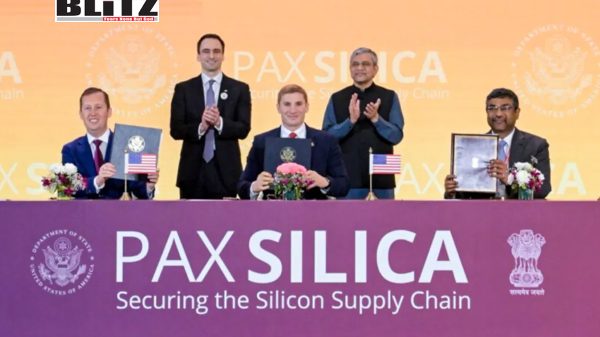
India has formally joined the US-led Pax Silica alliance, a strategic initiative aimed at securing resilient supply chains for artificial intelligence (AI), semiconductors, and critical minerals. The declaration was signed on the sidelines of the AI Impact Summit in New Delhi, marking a significant geopolitical and economic move by the Indian government as it positions itself at the center of the next-generation technology ecosystem.
The Pax Silica initiative, spearheaded by the United States, seeks to bring together like-minded countries to reduce vulnerabilities in supply chains that underpin AI infrastructure, advanced chips, and rare earth elements. These sectors are increasingly viewed not merely as commercial domains but as strategic assets linked to national security and technological sovereignty.
Alongside India and the United States, the declaration has been signed by Australia, Greece, Israel, Japan, Qatar, South Korea, Singapore, the United Arab Emirates, and the United Kingdom. Canada, the European Union, the Netherlands, the Organization for Economic Cooperation and Development (OECD), and Taiwan are participating as non-signatory partners, reflecting broad alignment among advanced and emerging economies on the urgency of diversifying supply networks.
At the signing ceremony, US Ambassador to India Sergio Gor described India as a “key contributor” to the alliance, underscoring Washington’s recognition of New Delhi’s growing role in global technology supply chains. The development builds on recent high-level engagements between the two countries. Earlier this month, External Affairs Minister Dr. S Jaishankar attended the Critical Minerals Ministerial in Washington, convened by US Secretary of State Marco Rubio. During that meeting, India extended support to the Forum on Resource, Geostrategic Engagement (FORGE), another platform focused on coordinating policy and investment in critical minerals.
The timing of India’s entry into Pax Silica is notable. The global race to secure access to rare earth elements and semiconductor manufacturing capacity has intensified amid geopolitical tensions, particularly between the United States and China. Beijing currently dominates the global rare earth processing sector, accounting for more than 60% of worldwide capacity. India, despite possessing substantial rare earth reserves, remains heavily dependent on imports-sourcing approximately 85% to 90% of its rare earth requirements from China.
By joining Pax Silica, New Delhi signals a strategic intent to reduce this dependence and integrate more deeply into alternative supply chains. The move aligns with India’s broader economic and industrial policy, including the National Critical Minerals Mission, which aims to strengthen domestic exploration, extraction, processing, and manufacturing capabilities in strategic minerals.
The Indian government has also announced the creation of rare earth corridors-specialized industrial zones-in the states of Odisha, Kerala, Andhra Pradesh, and Tamil Nadu. These corridors are designed to facilitate mining, research, processing, and manufacturing of Rare Earth Permanent Magnets (REPMs). REPMs are essential components in electric vehicle motors, wind turbine generators, aerospace systems, advanced defense equipment, industrial robotics, and precision sensors. As global demand for electric mobility and renewable energy accelerates, the strategic importance of REPMs is set to grow exponentially.
India’s domestic consumption of permanent magnets is projected to double by 2030. However, production capabilities remain in a developmental stage, leaving the country exposed to supply disruptions and price volatility. Participation in Pax Silica could provide access to capital, technology transfer, and coordinated policy frameworks that accelerate India’s manufacturing ambitions.
The alliance also offers potential economic dividends. According to domestic media reports, India’s involvement could attract billions of dollars in AI and technology-related investments. The country has already emerged as a major digital economy, with a rapidly expanding startup ecosystem, significant data infrastructure, and a large engineering talent pool. By embedding itself within a structured supply chain framework led by the United States and its partners, India aims to strengthen its credentials as a viable alternative to China in global manufacturing and advanced technology production.
Recent diplomatic engagements further highlight India’s multi-vector approach to securing critical resources. During French President Emmanuel Macron’s visit to India, the two countries signed a joint declaration of intent on cooperation in critical minerals and metals. In addition, India is exploring rare earth mining partnerships with Russia, Australia, Argentina, Chile, and several African nations. This diversified outreach underscores New Delhi’s strategy of hedging risks while building a robust, multi-country resource network.
From a geopolitical perspective, Pax Silica reflects a broader realignment in global economic architecture. Rather than relying on hyper-globalized supply chains dominated by a single country, participating states are seeking “friend-shoring” models-anchoring production and processing within trusted networks. For India, which has traditionally balanced relations among major powers, joining a US-led initiative of this nature indicates a calibrated shift toward deeper strategic alignment in technology and resource security.
However, substantial challenges remain. Building end-to-end supply chains for semiconductors and rare earth processing requires significant capital expenditure, environmental safeguards, skilled labor, and regulatory clarity. India’s semiconductor fabrication ambitions, for example, are still in early stages despite announced incentives and partnerships. Similarly, scaling rare earth processing will demand advanced metallurgical capabilities and sustained policy support.
Environmental and social considerations will also shape the trajectory of India’s critical minerals expansion. Rare earth mining and processing can have significant ecological impacts if not managed under strict regulatory standards. As India seeks to expand production, balancing industrial growth with environmental sustainability will be critical to maintaining both domestic legitimacy and international credibility.
Nevertheless, the strategic logic of India’s decision is clear. In an era defined by technological competition and supply chain vulnerabilities, control over AI infrastructure, advanced chips, and critical minerals confers geopolitical leverage. By aligning with Pax Silica, India positions itself not only as a beneficiary of diversified supply chains but as an active architect of a new technological order.
For New Delhi, the alliance is not merely about resource access; it is about shaping the rules of engagement in emerging industries that will define global power in the decades ahead. If effectively implemented, India’s participation could accelerate its transition from a technology services powerhouse to a manufacturing and innovation hub with strategic autonomy in critical sectors.
As global competition intensifies and alliances solidify around resource security and advanced technologies, India’s entry into Pax Silica marks a consequential step. The real measure of success will lie in translating diplomatic commitments into industrial capacity, investment flows, and technological breakthroughs that reduce dependency while enhancing resilience.
Is a senior journalist.