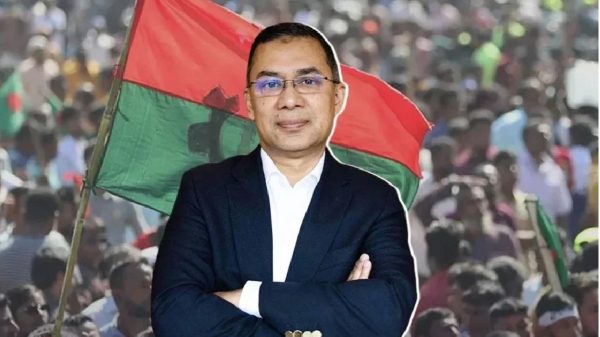
Why Tarique Rahman has become Bangladesh’s political pivot

- Update Time : Sunday, February 15, 2026
Nations rarely turn on a single speech, a single election, or a single personality. But there are moments when history seems to compress itself into a figure — when public longing, political fatigue, and institutional collapse converge around one name. In Bangladesh today, that name is Tarique Rahman. To understand his ascent is to understand the turbulence that preceded it.
The mass uprising of August 5, 2024 — driven by students and ordinary citizens — did not emerge from a vacuum. It was the culmination of years of resistance against what many perceived as authoritarian overreach under . The streets had grown restless. The young, particularly, felt trapped between shrinking civic space and narrowing economic opportunity. When confrontation escalated, it did so with an intensity that shocked even seasoned observers.
From thousands of miles away, Mr. Rahman was not a passive spectator. Supporters argue that he provided strategic guidance and moral backing to the movement at critical junctures. Whether one views that role as decisive or symbolic, the perception among his base is unmistakable: he stood with the protesters when it mattered.
And perception, in politics, often becomes reality.
When law and order frayed in the aftermath of upheaval, Mr. Rahman reportedly instructed party activists to safeguard neighborhoods and prevent chaos. It was a calculated message: revolution without order degenerates into anarchy. The Bangladesh Nationalist Party (BNP), founded by his father and later led by his mother , has long claimed to represent stability grounded in national sovereignty. Mr. Rahman appeared intent on reviving that brand — not as nostalgia, but as necessity.
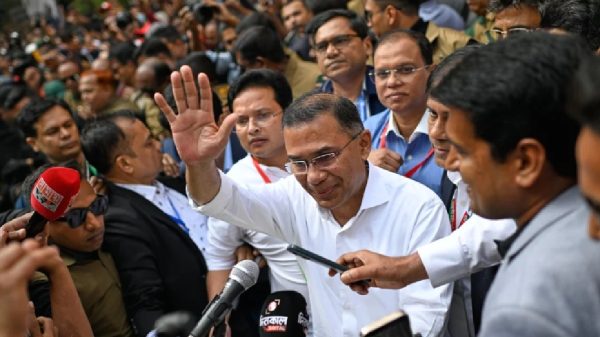
His return to Bangladesh on December 25 after 17 years abroad was politically theatrical but carefully choreographed. The reception he received was more than celebratory; it was cathartic for supporters who viewed his absence as emblematic of a broader democratic deficit. Yet what surprised even skeptics was the tone of his first address. Gone was the language of vengeance. In its place: unity. Participation. A deliberate rejection of retaliation politics.
Most striking was his declaration: “I have a plan.”
Such words are cheap in politics. But context gives them weight. The demise of Khaleda Zia days later removed the last towering figure of the party’s previous era. Leadership passed not ceremonially but existentially to Rahman. He would not merely inherit a political machine; he would be tested as its architect.
The 13th National Assembly election became that test.
The result was unequivocal. The BNP secured 213 seats — more than a two-thirds majority — positioning Rahman as the country’s next prime minister. For a party out of power for nearly two decades, the victory was seismic. Analysts credit not just organizational revival but a recalibrated message: institutional restoration over populist theatrics, reform over rhetoric.
Mr. Rahman’s first manifesto as party chief avoided grandiose promises. There were no fantastical giveaways designed to win fleeting applause. Instead, it outlined targeted commitments: family cards for women, agricultural cards and insurance for farmers, expanded healthcare workers to bring services to the doorstep, curriculum modernization, multilingual and technological education, mid-day meals, free school uniforms, and an ambitious but defined goal — a trillion-dollar economy by 2034.
Ambition anchored in specificity is a rare currency.
Equally notable was his emphasis on anti-corruption. No economic vision, he argued, can survive if graft erodes the foundation. Rule of law and accountability were not afterthoughts but prerequisites. That framing is politically astute. Bangladesh’s growth over the past decade, though impressive in macroeconomic terms, has been accompanied by institutional fragility and allegations of cronyism. Voters appear to have concluded that prosperity without integrity is unsustainable.
International reaction has been swift. Governments have extended congratulations and signaled willingness to work with the incoming administration. Stability, after years of polarization, reassures markets. Investors crave predictability more than personality. As a political analyst, in my opinion, if Rahman can restore confidence in democratic and financial institutions, Bangladesh could unlock renewed economic momentum.
Yet the challenges are formidable.
Youth unemployment remains stubbornly high. Educated graduates often find themselves underemployed or disillusioned. The stagnant growth and limited opportunity have fueled generational frustration. Addressing that discontent requires more than slogans; it demands structural reform and innovation-driven policy.
Climate vulnerability presents another existential test. Bangladesh sits at the frontline of rising sea levels and extreme weather. Integrating climate resilience into economic planning is not optional. It is a survival strategy. A government that neglects environmental realities will mortgage its future.
Mr. Rahman’s political instincts suggest awareness of symbolism’s power. After the landslide victory, he instructed party activists not to hold triumphalist processions. Instead, he urged thanksgiving prayers. It was a subtle but potent gesture — projecting humility rather than dominance. In a political culture often marred by chest-thumping victory rallies, restraint can signal maturity.
Critics will argue that charisma is not governance. They are right. Electoral mandates confer authority, not competence. The true measure of Rahman’s leadership will be institutional rehabilitation. Over the past decade, many democratic and financial bodies have suffered credibility erosion. Restoring them will require transparency that may discomfort allies as much as opponents.
The broader question is whether Bangladesh is entering a post-personality phase or merely exchanging one dominant figure for another.
Mr. Rahman’s rhetoric suggests the former. His emphasis on participation, technology, meritocracy, and inclusive growth aligns with a generation less interested in ideological theatrics than tangible opportunity. BNP leaders such as Salahuddin Ahmed have spoken of prioritizing merit and technology in state-building. That language resonates in a digital age where economic competitiveness hinges on innovation.
Still, expectations can be perilous. A landslide victory creates a honeymoon; it also creates a clock. Two-thirds majorities tempt overreach. They also enable reform. The difference lies in discipline.
Bangladesh stands at a crossroads. Its demographic dividend remains intact. Its entrepreneurial class is energetic. Its strategic location between South and Southeast Asia offers trade potential. But none of these advantages will compensate for institutional decay or policy inconsistency.
Rahman’s supporters describe him as the nation’s last best hope for reconstruction. That is hyperbole — nations are not rebuilt by individuals alone. Yet leadership matters. Direction matters. Tone matters.
If he governs as he campaigned — emphasizing unity over vendetta, pragmatism over pageantry, reform over revenge — his tenure could mark a recalibration of Bangladesh’s political culture. If he succumbs to factionalism or complacency, the moment will dissipate.
History is unsentimental. It rewards those who convert opportunity into architecture.
For now, millions of Bangladeshis look toward a new administration with guarded optimism. They seek economic revival, corruption control, employment, social equity, and restored dignity in governance. They want a state where law supersedes loyalty and opportunity transcends patronage.
In politics, hope is both an asset and a burden. Tarique Rahman has secured the first. The second begins now.
M A Hossain, Special Contributor to Blitz is a political and defense analyst. He regularly writes for local and international newspapers.