A silent revolt against extremism and pro-Pakistan politics: BNP wins landslide in general elections

- Update Time : Friday, February 13, 2026
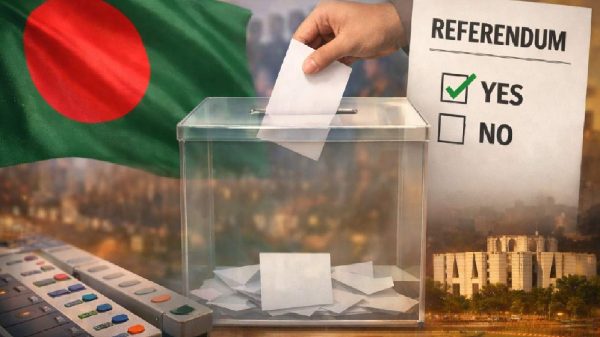
History has a way of returning, though rarely in the same uniform. Bangladesh’s 2026 election was not merely a transfer of power; it was a verdict on identity. When voters handed the Bangladesh Nationalist Party (BNP) a landslide—nearly two-thirds of Parliament—they were not just ending fifteen years of Awami League dominance. They were closing the door on something else: the quiet re-entry of pro-Pakistan political nostalgia into our public life.
For months, the political atmosphere carried an uncomfortable tilt. campaigned with unusual confidence, presenting itself as a disciplined alternative. Yet beneath the organizational polish lay a troubling imbalance. The party’s rhetoric and regional alignments leaned conspicuously toward —a country whose historical relationship with Bangladesh is not a footnote but a wound. Sovereign nations may reconcile; they must not forget.
Bangladesh’s foreign policy, at its best, has been guided by equilibrium. We trade with , invest with , negotiate with the , and maintain relations with Muslim-majority states without surrendering autonomy. Jamaat’s posture risked disturbing that balance. It hinted at a narrower worldview—one that conflated religious affinity with strategic wisdom. The electorate saw through it.
The youth vote made the difference. The so-called Gen-Z uprising, born in frustration with corruption and authoritarian stagnation, matured into a disciplined electoral force. Young Bangladeshis are digitally fluent, globally aware, and impatient with ideological theatrics. They have watched the Middle East’s experiments with political Islam, Europe’s battles with extremism, and South Asia’s oscillations between strongman rule and democratic revival. Their message was not radical; it was refreshingly moderate. They chose liberal democracy over radical romanticism.
This is why the 2026 verdict matters. BNP’s victory signaled a rejection of politics that tethered Bangladesh to external patrons—whether Eastern or Western—at the expense of national agency. There had been whispers, even subtle encouragement from abroad, that political Islamist parties could serve as leverage in reshaping Bangladesh’s strategic direction. Interim arrangements, opaque economic understandings, and one-sided concessions were floated as necessities of “stability.” Voters rejected that script.
Instead, they rallied behind a manifesto anchored in a simple phrase: “Bangladesh First.” It is an unpretentious motto, yet it carries historical weight. Nations that survive turbulent neighborhoods learn to place sovereignty above sentiment.
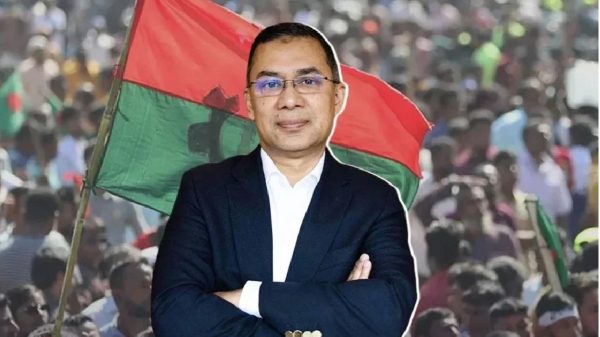
BNP’s 51-point manifesto reads less like a revolutionary tract and more like a technocratic repair manual. Nine priority pledges form what Tarique Rahman calls a social compact. Family Cards for marginalized households. Farmer Cards to guarantee fair prices. The recruitment of 100,000 health workers. Education reform aimed at skills rather than slogans. These are not dramatic gestures; they are instruments of statecraft.
The governance plank is even more telling. Zero-tolerance anti-corruption measures. Real-time audits. Open tenders. An ombudsman. Institutional accountability. A Truth and Healing Commission to investigate abuses of the prior era. Such proposals reveal a party conscious of its own past and wary of repeating it. BNP’s earlier tenure, after all, was not immune to allegations of graft or political favoritism. The electorate’s generosity comes with expectation—and memory.
Economically, the ambitions are muscular: transforming Chattogram and Mongla ports into logistics hubs, generating 35,000 megawatts of power by 2030, reviewing rental power contracts, expanding digital payments, and granting autonomy to capital market regulators. These are state-building measures. They suggest a government that understands infrastructure as geopolitical leverage.
But beyond policy details lies the deeper significance of the landslide. Bangladesh has experienced what might be called a democratic reset. The ouster of Sheikh Hasina in 2024 created uncertainty; the 2026 election restored procedural legitimacy. BNP’s commanding majority ensures constitutional reform without dependence on Islamist blocs. Jamaat, with its 63 seats, remains a vocal opposition—but not a kingmaker.
That arithmetic matters. It prevents the ideological overreach many feared. It assures regional partners that Dhaka’s compass will not swing unpredictably toward Islamabad or any other capital.
Geopolitically, recalibration is inevitable. India will watch closely, particularly along the sensitive Siliguri Corridor, where Chinese infrastructure ambitions intersect with security anxieties. China, for its part, will continue courting Bangladesh through development financing. The United States will advocate democratic consolidation. Pakistan may hope for warmer rhetoric.
The test for BNP is to engage all without submitting to any.
“Bangladesh First” must not become a slogan of isolation. It should mean reciprocity. Bilateral relations that are balanced, not submissive. Trade agreements that protect national interest. Security cooperation that respects sovereignty. Diplomatic warmth without strategic dependency.
The electorate has drawn a boundary: no more experiments with ideological radicalism; no more opaque deals conducted in the name of expediency. Voters demanded transparency in governance and clarity in foreign policy. They demanded that Bangladesh be neither a pawn nor a proxy.
Gen-Z’s role in this shift cannot be overstated. In cafés and campuses, on encrypted messaging platforms and street rallies, they debated constitutional amendments with the same intensity once reserved for football matches. They do not romanticize 1971 through inherited narratives alone; they reinterpret it as a mandate for pluralism. Their rejection of pro-Pakistan politics was not born of hostility toward Pakistanis as people, but of resistance to any ideology that diminishes Bangladesh’s independent identity.
The coming years will determine whether BNP can translate mandate into reform. Anti-corruption drives must avoid becoming instruments of vengeance. Welfare pledges must survive fiscal scrutiny. Institutional autonomy must be real, not rhetorical. And foreign policy must reflect maturity rather than muscle-flexing.
Still, elections are moments of moral clarity. On February 12, 2026, Bangladesh chose equilibrium over extremism, democracy over doctrinaire politics, and sovereignty over subtle subservience.
The lesson is larger than party lines. A nation that fought for linguistic and political freedom will not casually surrender it to ideological nostalgia or external choreography. The electorate has spoken in the firm language of ballots rather than barricades.
If BNP remembers that its victory was less about triumph and more about trust, Bangladesh may indeed enter a new era—one defined not by tilts toward distant capitals but by confidence at home.
Bangladesh First. Not as defiance. As discipline.
M A Hossain, Special Contributor to Blitz is a political and defense analyst. He regularly writes for local and international newspapers.