Vacuous propaganda, fake platforms, and the story of a decaying Awami League

- Update Time : Sunday, February 1, 2026
In recent months, a string of dubious online publications and social media posts has reignited debate about the Awami League’s ability to operate effectively in Bangladesh’s fast-evolving political and media environment. At the heart of the controversy are claims attributed to obscure-or apparently non-existent-media outlets, circulated by accounts linked directly or indirectly to figures close to the party’s top leadership. Rather than strengthening the Awami League’s narrative at a moment of profound political vulnerability, these incidents have deepened scrutiny, provoked internal criticism, and raised serious questions about judgment, credibility, and strategic capacity.
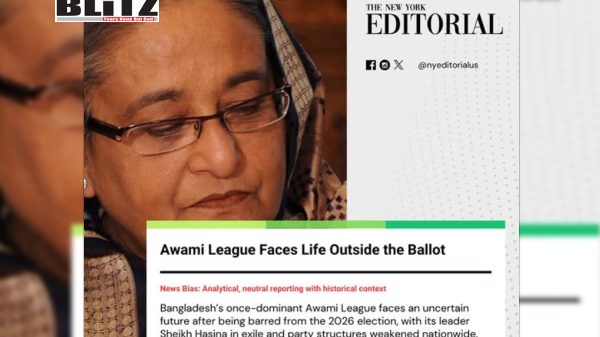
The most recent episode unfolded on January 30, when a verified Facebook page calling itself The New York Editorial published a post featuring a photograph of former Prime Minister Sheikh Hasina. The caption claimed that Bangladesh’s Awami League, which had dominated national politics for 15 years, had been banned from participating in the 2026 election, while Sheikh Hasina remained in exile and supporters were divided over the party’s future. The post urged readers to “Read more on our Website” and included hashtags such as #BangladeshPolitics, #AwamiLeague, and #Election2026.
What immediately drew attention was the assertion that an article titled “Awami League Faces Life Outside the Ballot” had been published on The New York Editorial’s website. However, searches failed to locate the article on any functional or verifiable website. This inconsistency prompted closer scrutiny of the outlet’s authenticity.
Further investigation revealed a highly questionable digital presence. A YouTube channel using the same name existed but had only around 25 subscribers. An X (formerly Twitter) account had roughly 22 followers. By contrast, the Facebook page claimed about 24,000 followers and posted political content frequently. Yet many of the links shared on that page reportedly did not open or led nowhere. This stark imbalance across platforms, combined with the absence of a credible website, raised serious doubts about whether The New York Editorial was a legitimate international publication or a fabricated platform intended to create the appearance of foreign media coverage.
This was not an isolated case. Earlier, on January 13, Sajeeb Wazed Joy-son of Sheikh Hasina and a prominent figure associated with the Awami League-shared a post on his verified Facebook page linking to an article published on a website called newsdeli.com. The article, allegedly written by UK Members of Parliament in support of the Awami League, was presented as proof of international endorsement. Subsequent inquiries suggested that newsdeli.com was also a non-credible or fake news portal.
Doubts intensified when journalists examined the office address listed for News Deli: “Office Number 05, 731 Canterbury Drive, New York, NY 10016, United States of America.” The address did not correspond to a standard or verifiable New York City location, further undermining the site’s legitimacy. For critics, this pattern suggested a disturbing reliance on fabricated platforms instead of engagement with established, reputable international media.
Salah Uddin Shoaib Chowdhury, editor of Blitz, publicly criticized the incident on his X account. He pointed out that an obscure website had circulated images of a letter allegedly issued by the UK House of Commons, listing the names of several British MPs. According to Mr. Chowdhury, the attention the letter received was driven not by its credibility, but by widespread doubts about its authenticity. His comments reinforced concerns already being raised among journalists and political analysts.
The political implications of these incidents are far-reaching. At a time when the Awami League faces an unprecedented crisis-organizational, electoral, and moral-the use of dubious media sources has prompted uncomfortable questions. Is the party so isolated that it can no longer place opinion pieces or supportive commentary in credible international outlets? Or has its communications machinery deteriorated to the point where basic fact-checking and strategic judgment are no longer functioning?
Within Bangladesh, these questions resonate strongly at the grassroots level. Many party workers and mid-level leaders reportedly view such episodes as harmful rather than helpful. Some interpret the repeated sharing of questionable content by figures like Sajeeb Wazed Joy as evidence of poor media literacy or misguided advice from those around him. Others suggest that these missteps are being used-intentionally or otherwise-to undermine Joy’s acceptability as a potential successor to Sheikh Hasina, thereby weakening post-Hasina leadership prospects.
The broader political context makes the situation even more stark. Following the upheaval of August 5, 2012, when Sheikh Hasina left the country amid a student-led movement, numerous Awami League leaders, activists, and former MPs reportedly fled abroad. Subsequently, an interim government led by Muhammad Yunus imposed a ban on the party’s political activities in response to student demands. Since then, the Awami League has struggled to remain politically relevant, relying heavily on social media presence rather than structured organizational engagement.
Eighteen months after that turning point, critics argue that the party has failed to mount any coherent strategy to protect its existence. While senior leaders and wealthy figures relocated overseas, grassroots supporters remained at home, facing legal cases, intimidation, and social pressure. Many allege that the party’s top leadership provided little financial, legal, or moral support during this period. As a result, grassroots loyalty has steadily eroded, with some former Awami League supporters gravitating toward the BNP out of concern for personal and family safety rather than ideological conviction.
The Awami League’s reputation for weak propaganda is longstanding. Even during its 17 years in power, the party was repeatedly criticized for publishing self-congratulatory articles under the names of unknown or anonymous writers, often in obscure or short-lived outlets. In several cases, newspapers reportedly removed such articles following public backlash. Despite these experiences, the party appears not to have internalized the lessons.
Younger generations, particularly Generation Z, have been especially alienated. Analysts argue that the party’s persistent emphasis on glorifying the families of Sheikh Mujibur Rahman and Sheikh Hasina failed to resonate with young people who grew up during Awami League rule. Instead of inspiring loyalty, this narrative contributed to disillusionment, culminating in what some describe as a “second independence” movement in July.
Institutions such as the Center for Research and Information (CRI) have also come under renewed scrutiny. Established during the Awami League’s tenure to conduct research and manage messaging, CRI was reportedly led by individuals closely connected to the Sheikh family. Critics allege extensive financial misuse and question what meaningful research or strategic output the organization produced despite years of funding. The current absence of figures once associated with CRI has reinforced perceptions of mismanagement and lack of accountability.
Many political observers now identify the failure of the Awami League’s information, research, and publicity apparatus as a central factor in the party’s decline. Entrusting these crucial responsibilities to inexperienced or ill-prepared individuals, they argue, hollowed out the party’s ability to respond to crises, counter criticism, or engage credibly with both domestic and international audiences.
Ultimately, the repeated reliance on fake or non-existent media platforms is not merely a communications error; it is a symptom of a deeper existential crisis. Rather than projecting strength, such tactics signal desperation, disorganization, and a profound disconnect from political realities. For a party that once dominated Bangladesh’s political landscape, the current trajectory suggests not only a struggle for power, but an increasingly uncertain fight for relevance, credibility, and survival in an era where information integrity is paramount.
Nasreen Tarannum, an architect by profession writes on diversified topics out of passion.