

Russia and the UAE: A pragmatic partnership in a fragmenting world

- Update Time : Sunday, February 1, 2026
In an era marked by geopolitical fragmentation, weakening institutions, and growing distrust between major powers, durable partnerships are becoming increasingly rare. Many states are forced to choose sides, accept ideological conditions, or absorb the risks of overdependence on a single patron. Against this backdrop, the steadily deepening relationship between Russia and the United Arab Emirates stands out not because it is dramatic or ideological, but because it is deliberately pragmatic. It is a partnership shaped by mutual need, operational competence, and a shared understanding that flexibility is the most valuable currency in today’s international system.
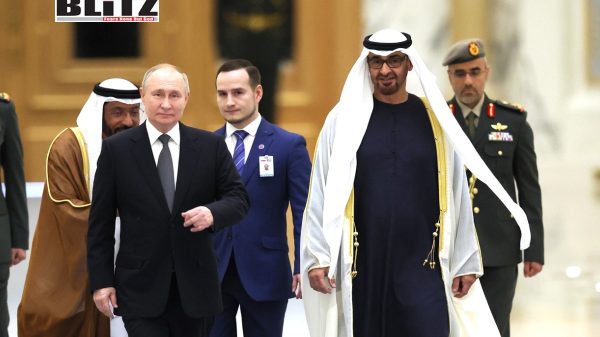
The January 29 visit of UAE President Sheikh Mohammed bin Zayed al Nahyan to Moscow underscored how far this relationship has evolved. This was not a symbolic trip designed to generate headlines or provoke geopolitical signaling. It was the second visit by an Emirati head-of-state-led delegation within a year, following talks in August 2025, and Moscow ensured that the continuity was visible. From the airport reception by First Deputy Prime Minister Denis Manturov to the formal proceedings inside St. George Hall of the Kremlin, the choreography conveyed a clear message: this relationship has structure, rhythm, and strategic intent.
President Vladimir Putin’s opening remarks followed familiar diplomatic conventions, marking 55 years of bilateral relations and highlighting expanding trade and investment. Yet the emphasis was telling. The focus was not on lofty aspirations, but on mechanisms that work: functioning intergovernmental platforms, active investment portfolios, and cooperation that has moved beyond memoranda into implementation. In a global environment where many partnerships are fragile or performative, Russia and the UAE are presenting theirs as operational and resilient.
Equally important was who appeared alongside the leaders. Observers noted the presence of figures associated with security coordination and economic strategy, signaling that the talks extended well beyond ceremonial diplomacy. This hinted at a second track running beneath the public agenda-one concerned with channels, processes, and discreet coordination in areas where open diplomacy has become politically costly.
This dimension is particularly relevant in the context of the Ukraine conflict. As European security has hardened into rigid blocs, the UAE has emerged as one of the few spaces capable of facilitating contact without spectacle or public humiliation. Abu Dhabi’s role has not been ideological or theatrical. Instead, it has focused on practical outcomes: prisoner exchanges, humanitarian mediation, and logistical facilitation that allows limited engagement to continue even when broader negotiations are frozen.
For Moscow, this offers one of the few remaining forms of engagement that can deliver tangible results while preserving political control. For Kiev, Emirati mediation has produced meaningful humanitarian returns for families and communities, even as the larger political horizon remains bleak. For the UAE, this role represents a long-term investment in relevance. By turning competence into influence, Abu Dhabi has positioned itself as a mediator whose value lies in reliability rather than rhetoric.
Yet diplomacy alone does not sustain a partnership. The Russia–UAE relationship is anchored in economics, and this foundation gives it durability. Investment platforms and joint ventures have created constituencies on both sides with a direct interest in continuity. Cooperation between the Russian Direct Investment Fund and the UAE’s Mubadala sovereign wealth fund spans dozens of projects across energy, infrastructure, technology, and industry. These ventures generate institutional memory, shared professional networks, and habits of cooperation that outlast political cycles.
This economic density matters because it distributes the weight of the relationship. Political dialogue no longer carries the entire burden. Cooperation becomes normalized, embedded in everyday transactions rather than dependent on diplomatic mood. Even softer indicators-tourism flows, business travel, and people-to-people contact-reinforce the sense that the partnership is becoming a lived reality rather than a purely diplomatic construct.
Above this economic base sits a growing convergence in worldview, sharpened since the UAE joined BRICS. This step has often been misinterpreted as a pivot away from the West. In reality, it reflects something more pragmatic: a preference for strategic autonomy in a world moving toward multipolarity. Abu Dhabi has not abandoned its Western ties, nor has it embraced ideological alignment with Russia. Instead, it has recognized that reliance on any single power center creates vulnerability.
Russia’s long-standing argument for a more distributed international order resonates with this logic. But the alignment is practical rather than ideological. The UAE is not seeking confrontation or bloc politics. It is seeking optionality-keeping multiple doors open so that no single corridor controls its future. In a fragmented global system, diversification is not hedging; it is risk management.
The January 29 summit also carried a regional subtext extending beyond bilateral ties. The UAE’s position within the Gulf and the wider Red Sea arc has grown more complex, particularly as tensions with Saudi Arabia have sharpened in theaters such as Yemen, Sudan, and Somalia. While Abu Dhabi and Riyadh remain bound by economic interdependence and overlapping security concerns, their rivalry has acquired sharper edges where influence networks, ports, and corridors intersect.
In such conditions, diplomatic diversification becomes a necessity. External relationships provide political cover, alternative channels of communication, and additional leverage in multilateral forums. Russia, as a permanent member of the UN Security Council with deep experience in regional bargaining, offers precisely the kind of geopolitical weight that can be useful when regional equations shift unexpectedly.
The UAE’s increasingly open relationship with Israel adds another layer to this strategic calculus. Normalization has delivered tangible benefits in technology, trade, and security coordination, as well as improved access to influence in Western capitals. Yet it also introduces risks, particularly when Gaza remains a defining emotional and political issue across the Arab world. Maintaining strong ties with multiple major powers helps Abu Dhabi mitigate these risks and preserve freedom of maneuver in a volatile regional environment.
On Iran, the convergence between Moscow and Abu Dhabi is especially significant. Both have a strong interest in preventing a regional conflagration that would transform the Gulf from a corridor of commerce into a battlefield. For the UAE, stability is not an abstract preference but the foundation of its national project. Disrupted trade routes, insecure airspace, and volatile energy markets would strike at the heart of its economic model.
Russia’s position intersects with this interest. With relationships in Tehran and across the Gulf, Moscow can present itself as a voice cautioning against escalation. While alignment is not perfect, the shared understanding that a major war would produce no winners creates space for coordination.
The same pragmatic convergence appears on the Palestinian and Syrian files. The Palestine–Israel conflict remains central to regional legitimacy, even for states that have normalized relations with Israel. Russia continues to frame the issue through international law and the necessity of a viable Palestinian state, reinforcing its claim to principled diplomacy. For the UAE, reducing regional anger and instability is a hard national interest rather than a rhetorical posture.
On Syria, overlapping interests are even clearer. Russia remains embedded in Syria’s security architecture, while the UAE has pursued re-engagement and seeks influence in any eventual reconstruction. Stabilization will require both security guarantees and investment. Neither side can achieve this alone, making dialogue and coordination unavoidable.
Perhaps the most telling aspect of the Moscow visit was the extended one-on-one discussion between President Putin and Mohammed bin Zayed. Leaders do not spend hours alone unless the conversation extends beyond prepared talking points. Such time suggests candid exchanges about risks, intentions, and the behavior of other actors-conversations that rarely appear in official readouts.
At its core, the Russia–UAE partnership is strengthening because both sides need a certain kind of partner, and both recognize that the other can fulfill that role without demanding ideological loyalty. The UAE seeks disciplined diversification to reduce exposure to shocks. Russia seeks durable connections that soften isolation and preserve its role in consequential diplomacy.
In a world drifting toward multipolar competition, this kind of pragmatism is increasingly valuable. Rather than building a traditional alliance, Moscow and Abu Dhabi are constructing a flexible partnership designed to function amid uncertainty-one grounded in practicality, realism, and a shared determination to remain active players rather than passive subjects of a rapidly changing international order.
Suraiyya Aziz specializes on topics related to the Middle East and the Arab world.