

India showcases strategic ambition and diplomatic outreach at 77th Republic Day parade

- Update Time : Tuesday, January 27, 2026
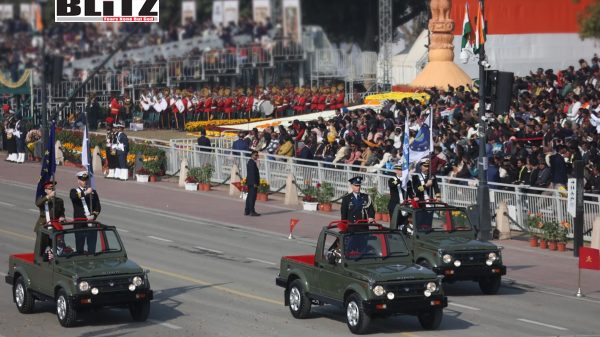
India marked the 77th anniversary of its Republic Day with an elaborate military and cultural parade in New Delhi, using the high-profile occasion to project strategic confidence, national unity, and a carefully balanced foreign policy amid shifting global power dynamics. The celebrations, held along the ceremonial avenue stretching from Rashtrapati Bhavan to the National War Memorial, combined traditional pageantry with a strong emphasis on advanced military capabilities and international engagement.
One of the most notable highlights of this year’s parade was the first public display of India’s Russian-made S-400 Triumf air defense system. Mounted on mobile launch vehicles and showcased before domestic audiences and visiting dignitaries, the S-400 symbolized India’s emphasis on strengthening its defensive posture in a volatile regional security environment. The system, acquired from Russia under a 2016 agreement, has been a subject of international attention due to US threats of sanctions under legislation aimed at discouraging major defense purchases from Moscow. Despite those warnings, New Delhi proceeded with the acquisition, citing national security imperatives and its long-standing defense partnership with Russia.
Alongside the S-400, the parade featured T-90 main battle tanks, BrahMos supersonic cruise missiles, and a range of Indian Air Force assets, reinforcing the image of a modernizing and capable military. Particular attention was drawn to the unveiling of India’s hypersonic long-range anti-ship missile (LRAShM). Indian officials say the missile has a range exceeding 1,500 kilometers and can reach speeds of up to Mach 10, placing India among a select group of countries developing hypersonic strike capabilities. While technical specifics were not disclosed, the display underscored India’s growing focus on maritime security and deterrence across the Indian Ocean region.
President Droupadi Murmu presided over the ceremony, arriving in a traditional buggy escorted by the President’s Bodyguard, the Indian Army’s senior-most regiment. Joining her as chief guests were European Council President Antonio Costa and European Commission President Ursula von der Leyen, a pairing that highlighted India’s expanding engagement with the European Union. Their presence was widely interpreted as a signal of deepening political and strategic cooperation between India and Europe at a time when both sides are seeking to diversify partnerships amid global uncertainty.
The parade route was elaborately decorated for the occasion, blending national symbols with artistic elements. Prime Minister Narendra Modi paid tribute at the National War Memorial, honoring soldiers who have died in service to the nation. In a message posted on social media, Modi said the occasion reinforced the collective resolve to build a developed India, noting that Republic Day symbolizes the country’s “honor, pride and dignity” and should inspire renewed enthusiasm among citizens.
Modi has previously emphasized the role of advanced military platforms in safeguarding India’s sovereignty. Referring to the S-400 air defense system in an address to troops following Operation Sindoor in May 2025, he said that systems such as the S-400 have provided “unprecedented strength” to the country. During last year’s military confrontation with Pakistan, Indian officials said the system played a key role in enhancing airspace security, further validating the government’s decision to proceed with the controversial purchase.
Beyond military hardware, the parade retained its strong cultural dimension. Helicopters showered flower petals over the procession as more than a hundred artists delivered a large-scale musical performance centered on the theme of “unity in diversity,” a long-standing pillar of India’s national identity. Traditional contingents, including a camel-mounted unit, marched alongside modern formations. The aerial display featured an Operation Sindoor formation consisting of Sukhoi and MiG-29 fighter jets, two Rafale aircraft, a Jaguar fighter, unmanned aerial vehicles, and an animal squad, offering a comprehensive visual representation of India’s military breadth.
The international context of the celebrations was further underscored by messages from foreign leaders. Chinese President Xi Jinping conveyed greetings to President Draupadi Murmu, describing China and India as “good friends and partners” and emphasizing that stable relations between the two Asian powers are crucial for global peace and prosperity. According to Chinese state media, Xi referred to the relationship as the “dragon and the elephant dancing together,” language that signals a desire for cooperation despite lingering disputes.
India-China relations reached a low point following violent border clashes in 2020, which resulted in casualties on both sides and triggered years of military standoffs and diplomatic strain. However, signs of a gradual thaw have emerged over the past year. A meeting between Prime Minister Modi and President Xi on the sidelines of the BRICS summit in Kazan in October 2024 marked an initial step toward re-engagement. The leaders met again at the Shanghai Cooperation Organization summit in Tianjin in September 2025, agreeing to expand dialogue and enhance cooperation.
Since then, several confidence-building measures have followed. Direct commercial flights between India and China resumed in October 2025 after a lengthy suspension, and both countries have eased visa restrictions for each other’s citizens. Earlier this month, reports indicated that New Delhi is considering lifting certain restrictions on Chinese companies bidding for Indian government contracts, measures that were imposed in the aftermath of the 2020 border crisis.
The improving tone in India-China relations comes at a time of heightened geopolitical pressure from the United States, which is considering new sanctions legislation targeting Russia and potentially affecting countries that maintain close ties with Moscow. Both India and China have continued economic and strategic engagement with Russia, and Beijing has accused Washington of attempting to drive divisions between China and its partners, including India.
Against this backdrop, India’s Republic Day parade served as a carefully calibrated message. Domestically, it highlighted national unity, constitutional values, and technological progress. Regionally, it signaled military readiness and deterrence. Internationally, it reflected India’s pursuit of strategic autonomy-maintaining diverse partnerships while avoiding alignment with any single power bloc.
As India continues to position itself as a major global actor, the 77th Republic Day celebrations offered a clear illustration of how New Delhi is blending tradition with modernity, and defense preparedness with diplomatic outreach, to navigate an increasingly complex international landscape.
Tajul Islam is a Special Correspondent of Blitz. He also is Local Producer of Al Jazeera Arabic channel.