Global journalist imprisonments remain near historic highs in 2025, CPJ warns

- Update Time : Saturday, January 24, 2026
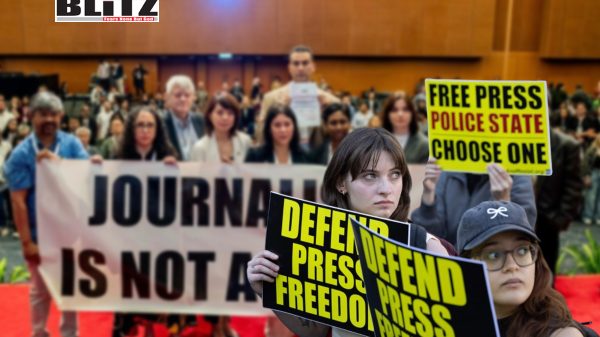
Journalists around the world continue to face unprecedented levels of repression, with global imprisonments remaining near record highs in 2025, according to a new report released by the Committee to Protect Journalists (CPJ). The findings underscore a deepening crisis for press freedom, driven primarily by political repression, the expansion of authoritarian governance, and the normalization of punitive measures against independent reporting.
CPJ documented at least 330 journalists imprisoned worldwide in 2025, a slight decline from the all-time high of 385 recorded in 2024. Despite the marginal decrease, the organization cautioned against interpreting the figures as meaningful progress. Instead, CPJ emphasized that the data reflects a persistent and entrenched pattern of state-led intimidation, with many cases remaining undocumented due to secrecy, fear of retaliation, and restricted access to information.
“Persecuting journalists is a means of silencing them,” said CPJ Chief Executive Officer Jodie Ginsberg. “When journalists are criminalized for doing their jobs, corruption thrives, abuses of power go unchecked, and societies lose a critical safeguard. The consequences extend far beyond individual reporters.”
According to the report, the primary forces behind journalist imprisonments in 2025 were political authoritarianism and armed conflict. Governments increasingly equated independent reporting-particularly coverage of political opposition, protests, or state misconduct-with subversion or espionage. As a result, journalists were frequently detained under broad and loosely defined charges such as terrorism, anti-state activity, or collaboration with foreign entities.
China remained the world’s largest jailer of journalists for the third consecutive year, with 50 reporters behind bars. Many were detained for covering sensitive political topics, human rights issues, or ethnic and religious minorities. CPJ noted that China’s restrictive information environment makes documentation especially difficult, suggesting the true number of detained journalists may be significantly higher.
Myanmar ranked second globally, with 30 journalists imprisoned amid the military junta’s ongoing crackdown on independent media since the 2021 coup. The report described systematic efforts by the authorities to dismantle independent journalism through arrests, license revocations, and intimidation, effectively silencing dissenting voices.
Israel ranked third worldwide and remained the leading jailer of journalists in the Middle East, with 29 reporters imprisoned in 2025. CPJ highlighted a sharp increase in the detention of Palestinian journalists since the outbreak of the Israel–Gaza war in October 2023. Many were held without charge, often under administrative detention frameworks that bypass standard judicial procedures.
Beyond imprisonment, CPJ reported what it described as an “unprecedented number of targeted killings of journalists” by Israeli forces during the conflict, raising serious concerns about accountability and adherence to international law.
Politics was identified as the dominant driver of journalist detentions in 2025. CPJ found that at least 201 journalists were jailed on anti-state charges, far exceeding imprisonments related to coverage of corruption, human rights abuses, or armed conflict. Governments increasingly relied on legal mechanisms to justify repression, using national security laws, defamation statutes, tax regulations, and counterterrorism frameworks to legitimize arrests.
Countries such as Iran, Turkey, Egypt, Ethiopia, and Myanmar were described as among the world’s “worst jailers of journalists,” where authorities routinely treat independent reporting as a direct political threat. In these environments, journalism itself is criminalized, and reporters are portrayed as enemies of the state.
Even countries that present themselves as democratic were not immune. CPJ noted that governments including India and Tunisia have increasingly weaponized legal and regulatory systems to detain journalists under the guise of lawful enforcement, blurring the line between governance and repression.
“These imprisonments are not just a symptom of authoritarianism; they are an accelerant,” CPJ warned. “Attacks on the media consistently correlate with democratic decline.”
The report also revealed alarming trends in the treatment of imprisoned journalists. 2024 recorded the highest number of torture and beating allegations since CPJ began documenting such cases in 1992. Nearly one-third of jailed journalists in 2025 reported experiencing physical abuse, mistreatment, or severe prison conditions.
Iran recorded the highest number of abuse allegations, followed by Israel and Egypt. CPJ stressed that these figures likely underrepresent the scale of mistreatment, as many journalists or their families fear retaliation if they speak publicly.
Cases involving sexual violence remain particularly difficult to document, with survivors often constrained by stigma, trauma, and security risks. Despite these challenges, CPJ said it continues to provide legal, medical, and advocacy support to affected journalists wherever possible.
Gypsy Guillén Kaiser, CPJ’s chief global affairs officer, emphasized that the consequences of repressing journalists extend far beyond the media profession. “Journalists are vital contributors to our collective ability to make informed decisions,” she said, describing them as providers of independent, timely, factual, and nuanced information.
Kaiser warned that attacks on journalists often begin incrementally-with surveillance, public vilification, or selective arrests-but can quickly escalate if left unchallenged. She urged the public to respond early and decisively when press freedom comes under threat, stressing that the erosion of journalism ultimately violates the public’s own right to be informed.
In an era dominated by social media and instant information, Kaiser noted that much of the news people consume is still gathered, verified, and contextualized by professional journalists. Without press freedom, societies risk what she termed “blissful ignorance,” making critical decisions based on misinformation or incomplete narratives.
CPJ argued that governments and international institutions already possess mechanisms to curb abuses against journalists but often fail to use them effectively. These include targeted sanctions against officials responsible for detentions or violence, monitoring judicial proceedings, and conditioning trade or security agreements on respect for international human rights standards.
The deliberate targeting and killing of journalists, CPJ said, must be investigated as crimes, citing Gaza, Mexico, and Pakistan as examples where impunity has encouraged further violence.
Despite documentation gaps and mounting risks, CPJ stressed that defending a free, independent, and pluralistic press remains essential to safeguarding democracy, accountability, and human rights worldwide. As the report makes clear, the fate of journalists is inseparable from the health of societies themselves.
Tajul Islam is a Special Correspondent of Blitz. He also is Local Producer of Al Jazeera Arabic channel.