Jamaat-e-Islami unveils ‘Aspiring Bangladesh’ vision at policy summit 2026, pledges citizen-first governance

- Update Time : Tuesday, January 20, 2026
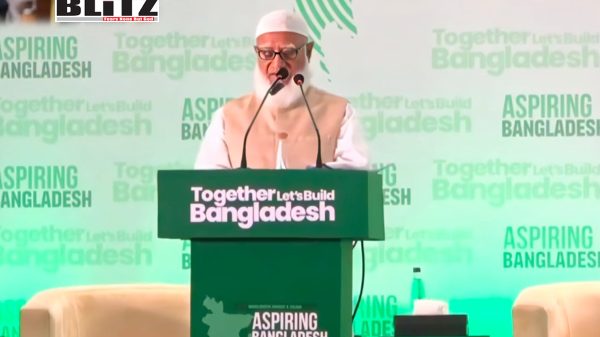
Bangladesh Jamaat-e-Islami on January 20 formally unveiled its comprehensive political, economic, and governance agenda at the “Policy Summit 2026,” held under the theme “Aspiring Bangladesh.” The high-profile event, attended by diplomats, political leaders, academics, civil society representatives, business figures, and journalists, was positioned by the party as a roadmap for a corruption-free, citizen-first Bangladesh ahead of the upcoming National Parliamentary Election scheduled for February 12.
The summit served as a platform for Jamaat-e-Islami to articulate its vision for democratic renewal, economic stability, and social justice in what party leaders described as a critical transitional moment in the country’s political history. The event was marked by the keynote address of the party’s Ameer-e Jamaat, Dr. Shafiqur Rahman, who attended as chief guest and delivered a wide-ranging speech outlining both the challenges facing Bangladesh and the principles guiding Jamaat-e-Islami’s policy framework.
A call for democratic renewal
Opening his address, Dr. Shafiqur Rahman welcomed members of the diplomatic community and other distinguished guests, emphasizing that their presence reflected international interest in Bangladesh’s stability, dignity, and long-term development. He framed the summit as part of a broader effort to present a credible and transparent policy vision to citizens at a time when Bangladesh is preparing for another national election.
Dr. Shafiqur Rahman traced Bangladesh’s political journey through the major historical milestones of 1947 and 1971, arguing that while political sovereignty had been achieved, the promises of social justice, economic freedom, and accountable governance remain largely unfulfilled. He stated that democratic institutions had weakened over time and that citizens had repeatedly been denied meaningful participation in political decision-making.
Referring to the political developments of recent years, he described the past seventeen years as a period marked by governance failures, institutional decay, and the shrinking of democratic space. He highlighted the mass protests of July 2024, led largely by young people, as a renewed assertion of citizens’ rights and aspirations.
“After a dark period of fascist rule, we now stand at a crossroads,” Ameer-e Jamaat said, characterizing the present moment as a fragile but crucial democratic transition. According to him, the central challenge facing Bangladesh today is not economic survival, but achieving stability, fairness, and dignity in everyday life.
Economic growth versus economic security
In a critical assessment of the country’s economic trajectory, Dr. Shafiqur Rahman acknowledged that Bangladesh has experienced growth, but argued that this growth has not translated into secure livelihoods for the majority of citizens. He pointed to rising unemployment, persistent inflation, and the dominance of informal and insecure work as major structural problems.
“Young graduates struggle to convert education into opportunity,” he said, adding that women continue to face systemic barriers in accessing employment and leadership roles. He also highlighted the vulnerability of millions of working families who remain only one economic shock away from hardship.
Ameer-e Jamaat stressed that growth alone can no longer be the primary measure of economic success. Instead, he argued, economic performance should be judged by whether citizens can plan their lives with confidence, support their families with dignity, and participate meaningfully in society.
Emphasizing human potential
A central theme of the speech was Bangladesh’s untapped potential, particularly its human capital. Dr. Shafiqur Rahman described the country’s workforce as young, disciplined, and resilient, noting the contributions of workers across agriculture, manufacturing, services, and small enterprises.
He paid particular tribute to Bangladeshi migrant workers, whose remittances play a crucial role in stabilizing the economy. Beyond financial contributions, he said, expatriate workers bring valuable skills, global exposure, and experience that could be better integrated into national development strategies.
Ameer-e Jamaat also highlighted the role of the Bangladeshi diaspora, including professionals in academia, medicine, engineering, and entrepreneurship, who are working in leading global institutions. According to him, many members of this global community remain deeply connected to Bangladesh and are willing to contribute to institution-building, mentorship, and reform efforts if given the opportunity.
Women’s participation in nation-building was another focal point. Dr. Shafiqur Rahman described women as already central contributors to education, healthcare, entrepreneurship, and local leadership, despite facing persistent structural barriers. He argued that expanding women’s participation is both a moral imperative and an economic necessity, warning that no country can achieve sustainable prosperity while excluding half its population from full participation.
Governance, integrity, and partnerships
Good governance featured prominently in Jamaat-e-Islami’s vision. Dr. Shafiqur Rahman reiterated the party’s commitment to zero tolerance against corruption, asserting that public trust can only be rebuilt when state institutions deliver services fairly, transparently, and predictably.
He cited the party’s past experience in government, noting that former Jamaat-e-Islami leaders who held ministerial positions demonstrated integrity, efficiency, and accountability. According to him, honest leadership is not only a moral issue but also a practical requirement for effective governance.
Dr. Shafiqur Rahman also emphasized the importance of partnerships—between the state and citizens, the public and private sectors, and Bangladesh and the international community. He argued that a stable, forward-looking Bangladesh would benefit not only its own people but also regional and global stakeholders.
Concluding his address, he paid tribute to individuals described as “July heroes” who sacrificed their lives during the 2024 protests, stating that their sacrifices must not be in vain. He expressed confidence that with the collective strength of the people, diaspora engagement, women’s leadership, youth energy, and international cooperation, Bangladesh can build a just, equitable, and prosperous future.
Policy proposals presented at the summit
Following the keynote speech, Jamaat-e-Islami leaders and policy experts, serving as panelists, presented and deliberated on a comprehensive set of policy proposals aimed at transforming Bangladesh’s governance and socio-economic landscape. These proposals were articulated as practical and implementable measures designed to advance a citizen-first state.
At the core of the agenda is an uncompromising stance on corruption, with the party reiterating its pledge of zero tolerance at all levels of government.
On fiscal policy, Jamaat-e-Islami announced a long-term goal to gradually reduce taxes and value-added tax. The party aims to bring corporate and income tax rates down to 19 percent and VAT to 10 percent, arguing that a simpler and lower tax regime would encourage investment, reduce evasion, and stimulate economic activity.
A major governance reform proposal is the introduction of a Smart Social Security Card, integrating National ID, Tax Identification Number (TIN), healthcare access, and social services into a single digital platform. The party said this system would improve service delivery, reduce bureaucratic inefficiencies, and minimize corruption.
In the industrial sector, Jamaat-e-Islami pledged that gas, electricity, and water charges for industries would not be increased for the next three years, aiming to provide stability for manufacturers and encourage job creation. The party also proposed reopening closed factories through public-private partnerships, with a significant innovation: allocating 10 percent ownership of these factories to workers.
Focus on employment, youth, and agriculture
Addressing unemployment and youth vulnerability, the party outlined several interest-free financing initiatives based on Islamic economic principles. These include interest-free loans (Karje Hasana) of up to 10,000 taka per month for a maximum of two years for up to 500,000 graduates, intended to support them until they secure employment.
In addition, Jamaat-e-Islami proposed interest-free education loans of 10,000 taka per month for 100,000 students, based on merit and financial need. The party also announced an ambitious scholarship program that would provide interest-free education loans to 100 students every year to study at top global universities, including Harvard, MIT, Oxford, and Cambridge, with a particular focus on talented students from poor backgrounds.
For farmers, the party pledged interest-free loan facilities to reduce dependence on high-interest informal credit and to support agricultural productivity and rural livelihoods.
Healthcare and social protection
Healthcare reform formed another major pillar of the policy agenda. Jamaat-e-Islami announced plans to establish 64 specialized hospitals in all 64 districts, aiming to reduce regional disparities in healthcare access. The party also committed to providing free healthcare for adults over 60 years of age and children under five.
A flagship proposal under the social protection framework is the “First Thousand Days Program,” which would bring maternal and child health and nutrition—from conception to a child’s second birthday—under comprehensive social security coverage. Party leaders described this initiative as an investment in human capital and long-term national productivity.
The party also announced plans to establish the world’s largest women’s university by merging Eden Mohila College, Home Economics college and Badrunnesa Government Women’s College, presenting the move as a landmark step toward women’s empowerment through education.
Positioning ahead of elections
The Policy Summit 2026 marked one of Jamaat-e-Islami’s most detailed and structured presentations of its governance agenda in recent years. By combining historical narrative, moral framing, and specific policy commitments, the party sought to position itself as a credible alternative focused on integrity, social justice, and inclusive development.
As Bangladesh moves closer to the February parliamentary election, the proposals outlined at the summit are likely to feature prominently in political debate. Whether Jamaat-e-Islami’s vision of an “Aspiring Bangladesh” resonates with voters remains to be seen, but the summit underscored the party’s intent to play a central role in shaping the country’s next political chapter.
Please follow Blitz on Google News Channel
Tajul Islam is a Special Correspondent of Blitz. He also is Local Producer of Al Jazeera Arabic channel.