Trump gestures obscenely at autoworker amid renewed Epstein files controversy

- Update Time : Thursday, January 15, 2026
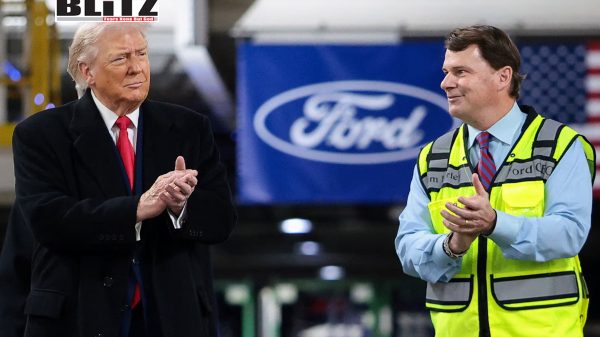
A brief but highly publicized confrontation between US President Donald Trump and a factory worker during a visit to a Ford Motor Company plant in Michigan has reignited political tensions surrounding the long-running controversy over the Jeffrey Epstein files, adding a new layer of scrutiny to the president’s conduct and messaging on transparency.
The incident occurred on January 13 during Trump’s tour of Ford’s F-150 assembly plant in Dearborn, near Detroit, an appearance intended to highlight American manufacturing and reinforce the president’s outreach to blue-collar workers. Instead, the visit was overshadowed by a heckling episode that quickly went viral on social media and sparked debate over presidential decorum, free speech in the workplace, and unresolved questions surrounding Epstein-related disclosures.
According to video footage widely circulated online, Trump appeared to raise his middle finger and mouth an obscenity after a worker shouted “pedophile protector” as the president passed by. The taunt was clearly audible in the recording, and Trump is seen turning toward the source of the shout, visibly reacting before continuing down the factory floor.
The White House did not dispute the authenticity of the video. Steven Cheung, the White House communications director, confirmed that the footage was real but defended the president’s response. In a statement to The Washington Post, Cheung described the worker as “a lunatic” who was “wildly screaming expletives in a complete fit of rage,” adding that Trump’s reaction was “appropriate and unambiguous.” Cheung declined to explicitly confirm whether the president had raised his middle finger.
The worker at the center of the controversy was later identified as TJ Sabula, a 40-year-old line worker at the plant and a member of United Auto Workers Local 600. In interviews with The Washington Post, Sabula described himself as an independent voter who has occasionally supported Republican candidates. He said he was suspended from his job pending an internal investigation and maintained that he did not regret confronting the president.
“As far as calling him out, definitely no regrets whatsoever,” Sabula said. He added that he believes his suspension amounted to “political retribution” for what he described as embarrassing the president “in front of his friends.” Ford Motor Company and UAW Local 600 have not publicly commented on the disciplinary process, citing ongoing reviews.
The remark directed at Trump appeared to reference the unresolved political fallout from the Jeffrey Epstein case, a subject that has returned to prominence in recent months. Epstein, a disgraced financier and convicted sex offender, died in a New York jail in 2019 while awaiting trial on federal sex trafficking charges. His death triggered years of speculation and conspiracy theories, fueled by his extensive connections to political leaders, business elites, and celebrities.
During his election campaign, Trump repeatedly pledged to declassify and release all remaining Epstein-related documents, presenting himself as a champion of transparency and accountability. However, since returning to office, the president has shown increasing frustration with the issue, dismissing calls for full disclosure as politically motivated and labeling them a “hoax” designed to undermine his administration.
That shift has drawn criticism from both political opponents and some former supporters, particularly after Trump’s name appeared in Epstein-related materials released through court filings and investigative reporting. While no allegations of wrongdoing have been made against the president, critics argue that the administration’s handling of the files has fueled public distrust rather than easing it.
The controversy escalated further when the Justice Department released a batch of Epstein-related documents following sustained public pressure. Many of the records were heavily redacted, leading to renewed accusations that federal authorities were slow-walking disclosures or shielding powerful individuals from scrutiny. Advocacy groups and some lawmakers from both parties have called for clearer explanations of the redaction process and a definitive timeline for additional releases.
Against that backdrop, Trump’s visible reaction to the heckler has been interpreted by critics as evidence of irritation and defensiveness over the Epstein issue. Supporters, by contrast, have framed the episode as a provocation orchestrated to disrupt a presidential appearance and portray Trump as volatile.
Political analysts note that the incident underscores the broader challenge facing the administration as it navigates unresolved controversies while attempting to focus on economic messaging. Michigan, a critical swing state with a strong labor presence, played a key role in Trump’s electoral strategy, and factory visits have been a central feature of his outreach to working-class voters. Any perception of hostility toward workers, even in response to heckling, risks complicating that narrative.
At the same time, the suspension of the worker has raised questions about the balance between workplace rules and political expression. Labor advocates have warned that disciplinary actions tied to political speech, even when disruptive, must be handled carefully to avoid setting troubling precedents.
As of now, the White House has not indicated whether Trump plans to address the incident directly or clarify his stance on further Epstein-related disclosures. What is clear is that the encounter has added fresh fuel to an issue the president has repeatedly sought to minimize, ensuring that questions about transparency, accountability, and presidential conduct will remain in the public spotlight.
Whether the episode proves to be a fleeting viral moment or a symbol of deeper political tensions will depend largely on how the administration responds in the coming weeks – both in its handling of the Epstein files and in its approach to public criticism that shows no sign of fading.
Abul Quashem Joarder, a contributor to Blitz is geopolitical and military expert.