Libya’s killing fields and the hidden cost of Europe’s migration deterrence

- Update Time : Monday, January 12, 2026
Libya has ceased to function as a mere corridor between Africa and Europe. It is no longer simply a place migrants pass through on their way north. Instead, it has become a terminal zone – an endpoint where journeys collapse, people disappear, and survival is reduced to calculations of ransom, endurance, or chance. What has emerged over the past decade is not accidental cruelty or sporadic abuse, but a structured system that profits from captivity and, increasingly, from death itself.
The discovery in early 2025 of mass graves near Jikharra and Kufra, containing at least 93 migrant bodies, did not expose a hidden atrocity. It confirmed what survivors, humanitarian workers, journalists, and even some Libyan residents have long reported: Libya now hosts killing grounds directly linked to the political management of migration. These sites are not anomalies of lawlessness. They are the end products of a deterrence regime that has displaced Europe’s border enforcement deep into North Africa.
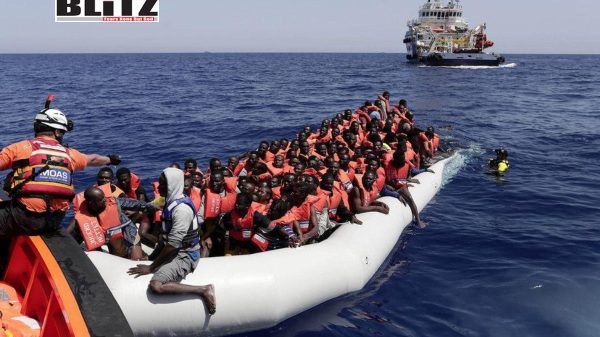
European policymakers often frame migration in abstract terms – “irregular flows,” “external border management,” “capacity building.” Such language creates emotional and moral distance. South of the Mediterranean, however, deterrence has a very tangible form. Since 2017, European governments and EU institutions have funded, trained, and equipped Libyan forces to intercept migrants before they reach European waters. The result has been a dramatic rise in sea interceptions.
Between 2017 and 2024, Libyan forces intercepted and forcibly returned more than 130,000 people attempting to cross the central Mediterranean. These operations are frequently labeled “rescues,” yet the outcome is almost always forced return to detention, extortion, or disappearance. In practice, interception has become a revolving door into captivity.
The core moral hazard is structural. Europe pays to stop movement, not to ensure protection. In a fragmented country like Libya, armed groups respond rationally to these incentives. Migrants become commodities whose value can be extracted repeatedly. Detention produces ransom opportunities. Ransom produces cash. Cash sustains militias and patronage networks. When payment fails, violence becomes cheaper than care. In this environment, killing is not random — it is economically and politically functional.
Libya’s detention system operates across three overlapping layers. First are “official” centers nominally under state bodies, most notably the Directorate for Combating Illegal Migration (DCIM). These facilities receive international attention, occasional monitoring, and limited humanitarian access.
The second layer consists of semi-official detention sites run by militias that are formally affiliated with state ministries but operate autonomously. Their authority rests not on law but on force, and their integration into government structures provides political cover.
The third layer is entirely clandestine. These are improvised prisons in warehouses, farms, factories, desert compounds, and abandoned buildings. They exist outside any formal oversight. Migrants are routinely transferred between all three layers, sold and resold as assets. A person intercepted at sea may pass through multiple facilities, each extracting value through ransom demands, forced labor, or abuse.
This fluid system ensures that responsibility is diffused. No single actor bears accountability. Jurisdiction dissolves across institutional and geographic seams, allowing violence to persist without clear perpetrators.
Survivor testimonies from across Libya reveal consistent patterns. Men report being tortured to pressure relatives abroad into paying ransom. Women face systematic sexual violence used as a tool of control and coercion. Children are subjected to beatings, forced labor, or exploitation within armed groups. Disease spreads rapidly in overcrowded facilities, where medical care is minimal or nonexistent.
Exact death rates are impossible to verify, but humanitarian organizations estimate that in some detention centers, as many as one in ten detainees may not survive prolonged captivity. Death often occurs off record, unnoticed beyond the immediate facility, reinforcing a system in which loss of life carries little consequence.
The mass graves near Kufra are particularly revealing. Kufra lies deep in Libya’s southeast, a critical convergence point for routes from Sudan, Chad, Eritrea, and the Horn of Africa. Control over the area has shifted among armed groups linked to transnational trafficking networks stretching across the Sahel.
The condition and location of the bodies strongly indicate execution rather than neglect. In such environments, killing serves multiple purposes: it terrorizes detainees, eliminates those unable to pay, and signals dominance to rival groups. Violence becomes a form of governance. Death itself becomes a message.
The supply of migrants entering Libya is not diminishing. It is accelerating. Climate stress across the Sahel has reduced agricultural yields by up to 30 percent in some regions over the past decade. Lake Chad has lost approximately 90 percent of its surface area since the 1960s, devastating livelihoods. Armed violence across Mali, Burkina Faso, Niger, and northern Nigeria has displaced over six million people.
Sudan’s ongoing civil war has displaced more than eight million internally and driven hundreds of thousands toward Libya’s eastern and southern corridors. Governance collapse across much of Africa’s north and center ensures that Libya’s role as a migrant trap will persist.
Deterrence policies that assume migration can be “turned off” ignore these structural realities.
European leaders often point to declining arrival numbers as evidence of policy success. Yet this metric conceals deeper failures. While arrivals briefly decreased after 2017, mortality increased. Smugglers adapted by launching fewer but more overcrowded boats. Shipwreck rates rose. The Mediterranean became deadlier.
Meanwhile, Libya absorbed the human fallout. By 2024, an estimated 700,000 migrants were present in Libya at any given time, many cycling repeatedly through detention. The suffering did not end – it was displaced.
Complicity does not require cruel intent. It emerges when policymakers accept foreseeable consequences. European auditors have acknowledged that EU-supplied vehicles and equipment were used in migrant roundups feeding abusive detention systems. Funding nevertheless continued. Diplomatic engagement with Libyan power brokers intensified, including with eastern authorities whose control depends on repression.
Stability became defined narrowly as containment. As long as boats stopped arriving, legitimacy was extended to actors regardless of how that stability was produced.
Libya’s political fragmentation compounds the crisis. Western authorities in Tripoli lack a monopoly on force. Eastern administrations enforce order through coercion. Southern regions operate as frontier markets where traffickers, tribal networks, and militias converge. Migrants move through all three zones. Each extracts value. None provides protection.
The killing fields represent the final stage of this system. Torture extracts payment. Forced labor extracts value. Gender-based violence enforces compliance. Killing removes costs. A migrant unable to pay a ransom of several thousand dollars loses market value. Execution becomes, in brutal terms, “efficient.”
Despite its scale, the system has vulnerabilities. It depends on secrecy, financial flows, and political protection. Exposure has already forced some networks to operate more covertly. Financial tracking of ransom payments remains limited but technically feasible. Targeted sanctions against individual commanders remain underused despite substantial evidence.
Migration cannot be managed at sea alone, nor outsourced to fractured states. Any strategy based purely on deterrence will generate violence where oversight is weakest. Alternatives exist: legal migration pathways, labor mobility agreements, humanitarian visas, and meaningful investment in protection along routes. Accountability mechanisms tied to funding can alter incentives. None of these are quick solutions. All require political courage.
Libya’s killing fields confront Europe with an uncomfortable truth. Border control has been achieved not through order, but through terror displaced southward. Distance has enabled denial. Mass graves collapse that distance.
The central question is no longer whether Europe knew. It is how long it will accept a system in which deterrence is paid for in unmarked graves beneath the Libyan sun.
Suraiyya Aziz specializes on topics related to the Middle East and the Arab world.