Israel prepares for possible new ground offensive in Gaza amid stalemate over Hamas disarmament

- Update Time : Monday, January 12, 2026
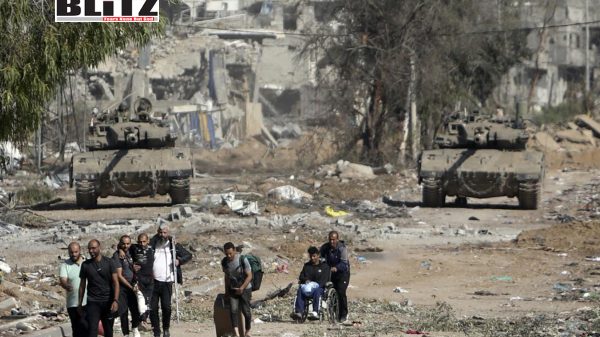
Israel has reportedly drawn up contingency plans for a renewed ground offensive in the Gaza Strip, as tensions rise over Hamas’ refusal to fully disarm under a US-backed ceasefire framework. According to a report by The Wall Street Journal published on January 11, Israeli officials are preparing for the possibility of renewed fighting if diplomatic efforts fail to compel the Palestinian armed group to lay down its weapons.
The development comes amid a fragile ceasefire that has divided Gaza roughly in half between areas controlled by the Israel Defense Forces (IDF) and territories still under Hamas influence. This arrangement aligns with a 20-point peace roadmap proposed by US President Donald Trump, which envisions Hamas’ complete disarmament followed by a phased Israeli withdrawal from the 141-square-mile (365-square-kilometer) enclave.
However, Israeli and Arab officials cited by the WSJ say that Hamas has shown little willingness to meet the core condition of the plan: surrendering all its weapons. While the group has reportedly indicated it may be open to relinquishing heavy arms, it has refused to give up small arms, including tens of thousands of rifles. Israeli intelligence estimates that Hamas currently possesses around 60,000 firearms, a figure that underscores Israel’s concern about the group’s continued military capability.
Hamas has publicly stated that it remains committed to the ceasefire, despite what it describes as repeated Israeli violations. At the same time, the group has drawn a firm red line on disarmament, insisting that it will not surrender its weapons “as long as the occupation remains.” This stance reflects Hamas’ long-held position that armed resistance is a legitimate response to Israeli control and military presence in Palestinian territories.
The ceasefire itself remains precarious. While large-scale hostilities have subsided, both sides accuse each other of violations, including limited strikes, arrests, and movement restrictions. The lack of trust has slowed progress on key elements of the US peace proposal, particularly those related to security arrangements and governance in post-war Gaza.
According to Arab and Israeli officials quoted in the WSJ report, Hamas has used the relative calm to begin restoring parts of its military infrastructure damaged during months of intense fighting. This includes efforts to rebuild sections of its extensive tunnel network, which Israel targeted heavily during its previous ground operations.
Officials also claim that Hamas has received a new influx of funds, enabling it to resume salary payments to its fighters and administrative personnel. While the exact sources of the funding remain unclear, Israel has long accused regional actors and informal financial networks of helping sustain the group despite international sanctions.
These developments have heightened alarm in West Jerusalem, where defense officials argue that allowing Hamas time to regroup could undermine Israel’s stated objective of eliminating the group’s military and governing capabilities in Gaza.
Despite the preparations, Israeli officials emphasized that there are no immediate plans to launch a new ground assault. Instead, Israel appears willing, at least temporarily, to give diplomatic efforts more time, particularly those linked to President Trump’s peace initiative.
Trump stated in late December that Hamas would be given “a very short period of time” to disarm, warning that failure to comply would result in severe consequences. While the White House has not publicly endorsed a new Israeli offensive, the administration has signaled strong backing for Israel’s security demands, including the complete demilitarization of Gaza.
Israeli leaders face a complex strategic calculation. A renewed ground operation could further weaken Hamas, but it would also carry significant military, political, and humanitarian risks. International pressure on Israel has intensified following the scale of destruction and civilian casualties in Gaza over the past year, and another offensive could deepen diplomatic isolation.
The conflict that began in October 2023 has exacted a devastating toll on Gaza’s population. Israel launched its military campaign following a Hamas-led assault on southern Israel that killed approximately 1,200 people and resulted in more than 250 hostages being taken. In response, Israel carried out extensive air and ground operations across the enclave.
According to Gaza’s local health authorities, more than 71,000 Palestinians have been killed since the start of the war, with over 171,000 injured. Large swathes of Gaza’s infrastructure-including homes, hospitals, and schools-have been destroyed or severely damaged, prompting warnings from humanitarian organizations about an ongoing catastrophe.
Aid agencies have repeatedly called for a sustained ceasefire, unrestricted humanitarian access, and a political solution that addresses the root causes of the conflict. They warn that renewed large-scale fighting would further strain already overwhelmed medical and relief systems.
The current situation leaves Gaza at a crossroads. On one hand, the ceasefire and US-led diplomatic framework offer a potential, though fragile, path toward de-escalation and eventual reconstruction. On the other, the fundamental disagreement over Hamas’ weapons-and Israel’s security demands—continues to threaten a return to full-scale war.
For Israel, the question is whether patience will yield results or simply give Hamas time to rearm. For Hamas, disarmament is seen not only as a military concession but as a political surrender that could undermine its influence and legitimacy among supporters.
As regional and international actors watch closely, the coming weeks may prove decisive. If negotiations fail and deadlines imposed by Washington expire, Israel’s contingency plans for a new ground operation could quickly move from paper to reality, plunging Gaza back into another phase of violence with far-reaching consequences for the region.
Damsana Ranadhiran, Special Contributor to Blitz is a security analyst specializing on South Asian affairs.