Trump’s Apache helicopter claim rekindles US–India tensions and raises credibility questions

- Update Time : Thursday, January 8, 2026
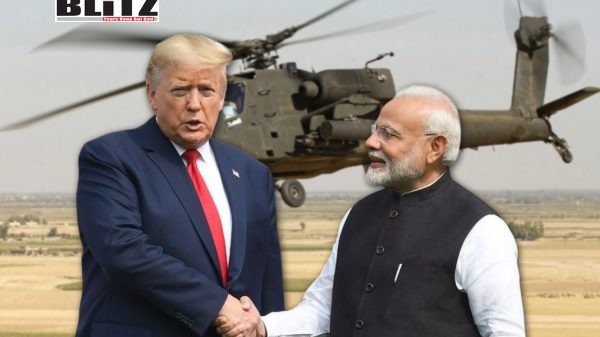
US President Donald Trump has once again stirred controversy in India by making a claim that New Delhi says is factually incorrect, politically loaded, and diplomatically awkward. Speaking at the House GOP Member Retreat on January 7, Trump alleged that Indian Prime Minister Narendra Modi personally sought his intervention to speed up the delivery of dozens of Apache attack helicopters ordered from the United States. The statement, delivered in Trump’s trademark improvisational style, quickly ignited criticism across India’s political spectrum and prompted media outlets to scrutinize the accuracy of the claim.
Trump asserted that India had ordered 68 Apache helicopters and had been waiting for five years for delivery. According to his account, Modi approached him directly to resolve the delay. “India ordered 68 Apaches, and Prime Minister Modi came to me and said ‘Sir, can I please see you please?’” Trump said, portraying the interaction in language that many Indian commentators described as condescending and demeaning toward the Indian leader.
Indian media outlets were quick to challenge the substance of Trump’s claim. A detailed fact-check by The Times of India, citing official contracts, delivery schedules, and deployment records, found that India has acquired only 28 Boeing AH-64E Apache Guardian helicopters-not 68-through multiple agreements with Washington. The discrepancy is not minor. It significantly alters the narrative Trump attempted to construct, raising fresh questions about his recollection of events and his tendency to exaggerate details involving foreign governments.
According to publicly available records, the first major Apache deal was signed in September 2015, during the final months of Barack Obama’s presidency. That agreement, valued at approximately $2.2 billion, covered the purchase of 22 helicopters for the Indian Air Force. Deliveries were completed by 2020, during Trump’s first term in office, undermining the suggestion that India had been waiting endlessly for aircraft or that extraordinary presidential intervention was required.
A second, smaller deal involved six Apache helicopters intended for the Indian Army Aviation Corps. This contract did encounter delays, largely attributed to supply-chain disruptions and procedural hurdles. However, even in this case, the final three helicopters were delivered in December of last year, bringing the total number of Apaches acquired by India to 28. At no point did India place an order anywhere close to the 68 helicopters cited by Trump.
The controversy is not merely about numbers. Trump’s portrayal of Modi seeking personal assistance struck a nerve in India, where political leaders across party lines reacted sharply. Critics argued that the tone of Trump’s remarks appeared designed to cast the Indian prime minister in a subservient light, reinforcing a narrative of US dominance rather than partnership. Supporters of Modi also objected, saying the comments misrepresented India’s negotiating posture and undermined its image as a strategic equal.
The episode comes at a sensitive moment in US–India relations, which have been strained by trade disputes and geopolitical disagreements. Just a day earlier, Trump claimed that despite having a “very good relationship” with Modi, the Indian leader was unhappy with Washington over the imposition of steep tariffs. Trump said the United States had slapped India with a 50 percent tariff because of its continued purchases of Russian oil, a move that has become increasingly controversial in Washington amid broader efforts to isolate Moscow.
India has so far failed to reach a comprehensive trade deal with the United States, despite prolonged negotiations. Trump has repeatedly criticized New Delhi for what he calls unfair trade practices and high tariffs on American goods. On January 5, he escalated the pressure by threatening further tariff increases if India continued to import oil from Russia. New Delhi, for its part, has defended its energy purchases as essential for economic stability and has resisted US demands to sever ties with Moscow entirely.
Trump’s latest remarks also revived another contentious issue: his repeated claim that he personally brokered a ceasefire between India and Pakistan following last year’s military standoff. Indian officials have consistently denied any US role in ending the hostilities, insisting that the disengagement resulted from direct military-to-military communication between New Delhi and Islamabad. Trump’s insistence on taking credit has been viewed in India as an attempt to rewrite events for domestic political gain.
Taken together, these episodes reflect a broader pattern in Trump’s approach to India-one marked by personalization, exaggeration, and a tendency to frame bilateral relations as transactional. While Trump frequently emphasizes his rapport with Modi, his public statements often contradict official records or clash with India’s carefully cultivated diplomatic narrative.
For India, the Apache controversy underscores the risks of dealing with a US leader who blends foreign policy with political theater. While defense cooperation between the two countries has deepened over the past decade, high-profile misstatements can quickly erode trust and fuel domestic backlash. Indian policymakers are likely to be wary of being publicly portrayed as dependent on US goodwill, particularly at a time when New Delhi is seeking to project itself as an independent global power.
For Washington, the episode highlights how loose rhetoric can complicate strategic partnerships. The United States has invested heavily in presenting India as a cornerstone of its Indo-Pacific strategy. Yet repeated factual inaccuracies and public jabs risk undermining that objective by creating friction where cooperation is needed.
Ultimately, the controversy surrounding Trump’s Apache helicopter claim is less about aircraft deliveries than about credibility, respect, and the balance of power in a crucial bilateral relationship. As US–India ties continue to evolve, both sides will be watching closely to see whether rhetoric gives way to a more measured and accurate diplomatic engagement-or whether such disputes become a recurring feature of the relationship under Trump’s leadership.
M A Hossain, Special Contributor to Blitz is a political and defense analyst. He regularly writes for local and international newspapers.