How woke media silence shielded a multibillion-dollar Minnesota fraud

- Update Time : Monday, January 5, 2026
In a functioning democracy, the press is supposed to serve as an early warning system-alerting the public to corruption, abuse of power, and the misuse of taxpayer money. Yet in recent years, America’s legacy media has increasingly abandoned that role, paralyzed by ideological constraints and fear of reputational backlash. Few episodes illustrate this collapse more starkly than the recent revelations surrounding alleged multibillion-dollar childcare and healthcare fraud in Minnesota-a story that exploded online but was conspicuously ignored by mainstream outlets for days.
The scandal came to public attention not through a Pulitzer-winning investigation or a months-long newsroom probe, but via a 42-minute viral video produced by independent journalist Nick Shirley. Armed with little more than a camera and a premise-posing as a parent seeking childcare-Shirley visited multiple state-funded daycare and healthcare facilities in Minnesota that had reportedly received millions in public funds. What he found was not overcrowded classrooms or bustling clinics, but locked doors, empty rooms, hostile encounters, and, most notably, a complete absence of children.
In one striking example, Shirley visited a facility named “Quality Learing Center,” a state-funded operation whose very name misspelled the word “learning.” Despite receiving substantial government grants, the site appeared inactive. Across several locations, the pattern repeated: no children, no staff, no services-yet millions in taxpayer dollars had already been paid out.
These findings immediately sparked outrage on social media. Conservative lawmakers, watchdog groups, and independent commentators demanded answers. Yet the institutions most responsible for investigating such claims-the major newspapers, cable news networks, and national broadcasters-were nowhere to be found. For days, there was silence.
That silence was not accidental.
According to journalists and commentators familiar with newsroom dynamics, the Minnesota story triggered an all-too-familiar internal alarm. The alleged fraud involved facilities owned or operated by members of Minnesota’s Somali community, a highly visible and politically sensitive minority group concentrated in the Minneapolis–Saint Paul area-the largest Somali diaspora in the United States.
For many editors, that fact alone rendered the story radioactive.
As Townhall columnist Dustin Grage bluntly explained, reporters are often told outright that certain stories are “too risky” to pursue because of how they might be perceived. In today’s media climate, exposing wrongdoing tied to a minority community-even when supported by evidence-is frequently conflated with racial targeting. The result is paralysis. Rather than risk accusations of racism, many outlets choose silence.
This is not journalism. It is abdication.
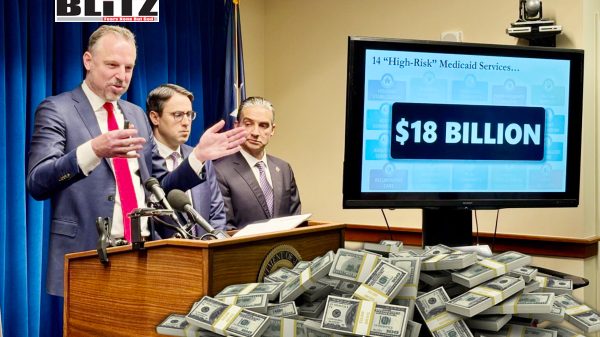
The alleged scale of the fraud makes that abdication even more alarming. Estimates circulating online suggest the total value of questionable grants and reimbursements may approach $9 billion-a staggering figure that rivals the annual GDP of Somalia itself. While such figures remain subject to verification through formal investigations, the magnitude alone should have triggered immediate and aggressive reporting. Instead, a young independent journalist did what billion-dollar media corporations would not.
Minnesota’s political environment helps explain the reluctance. The state has voted reliably Democratic in presidential elections since 1976 and prides itself on progressive credentials. Since the murder of George Floyd in 2020-a defining moment for Minneapolis and the nation-issues of race, policing, and minority representation have become especially sensitive.
In that climate, any story that risks contradicting dominant narratives of victimhood and systemic oppression is treated with extreme caution, if not outright avoidance. Allegations that public funds were misused by minority-owned organizations do not fit neatly into the ideological framework many newsrooms now operate within.
Governor Tim Walz’s response reflected this defensive posture. Rather than focusing squarely on the substance of the allegations, Walz framed the scrutiny itself as an expression of “white supremacy,” implying that the investigation was less about accountability and more about racial animus. That rhetorical move had an immediate chilling effect. Once a story is reframed as morally suspect, journalists become hesitant to touch it.
Meanwhile, others were less restrained. Minnesota Congressman Tom Emmer publicly questioned how millions could be allocated to facilities that appeared nonfunctional. Elon Musk, commenting on the controversy, offered a single-word verdict: “Prosecute.”
The contrast was stark. While public figures debated the issue openly, the institutions charged with informing the public remained absent.
The Minnesota case is not an isolated incident but part of a broader trend. Across the country, crimes and scandals are increasingly filtered through an ideological lens that prioritizes racial optics over public interest.
One often-cited example is the killing of Iryna Zarutska, a 23-year-old Ukrainian refugee stabbed to death on a Charlotte subway. Despite the brutality of the crime, national coverage was minimal after the suspect was identified as a Black man. Editors reportedly deemed the story “too local.” Critics argue that had the racial roles been reversed, the case would have dominated headlines as evidence of systemic racism or hate crime violence.
Whether or not one agrees with every comparison, the pattern is difficult to deny: stories that challenge preferred narratives are routinely downplayed, reframed, or ignored altogether.
This approach does not protect minority communities-it harms them. Fraud, corruption, and crime affect everyone, including law-abiding members of those same communities who depend on public trust and functioning institutions. When wrongdoing goes unreported, it festers. When accountability is delayed, the damage multiplies.
At its core, the Minnesota scandal raises a fundamental question: what is journalism for?
If the primary function of the press is to avoid offense rather than uncover truth, then it ceases to serve the public. A system in which reporters self-censor out of fear of social media backlash or professional consequences is not a free press-it is a managed narrative ecosystem.
The principle that wrongdoing should be exposed regardless of the perpetrator’s race, religion, or background is not controversial. It is foundational. Once that principle is abandoned, selective justice follows, and public confidence erodes.
Being accused of “racism” cannot become a veto on accountability. In a genuinely multicultural society, equality before scrutiny is just as important as equality before the law. Shielding certain groups from investigation in the name of sensitivity only deepens resentment and fuels polarization.
The Minnesota case should be a wake-up call. Whether the full extent of the alleged $9 billion fraud is ultimately confirmed or revised, the failure of legacy media to engage promptly and seriously with the story is undeniable. A free society cannot afford a press corps that looks away when the facts become uncomfortable.
If journalism is to regain public trust, it must relearn a simple lesson: truth does not become less true because it is inconvenient-and silence, in the face of credible allegations, is not neutrality. It is complicity.
Jennifer Hicks is a columnist and political commentator writing on a large range of topics.