How Dhaka banked on an Al Jazeera deep-fake to fuel anti-India hysteria after Osman Hadi’s murder

- Update Time : Friday, January 2, 2026
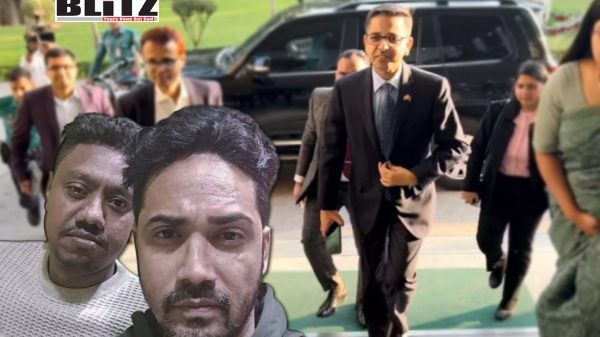
Following the attack on Osman Hadi, Al Jazeera deep-fake played role behind anti-India and anti-Hindu notoriety although the murder of anti-India Islamist activist Osman Hadi was not merely a criminal incident – it rapidly morphed into a geopolitical instrument. Within hours of the attack, before any credible investigation had been concluded, the interim administration in Dhaka chose to externalize the blame, pointing fingers at India with remarkable urgency.
What followed was a carefully staged sequence of diplomatic pressure, street agitation, and media amplification – much of it resting on a claim that now appears fundamentally flawed: that Hadi’s alleged killers had fled to India. At the center of this narrative stood a sensational yet dubious report circulated by Qatar-based Al Jazeera’s i-Unit, later exposed as relying on deep-fake imagery and unverified propaganda.
A murder turned into a political spectacle
Following the attack on Osman Hadi, which sent shockwaves through the Muhammad Yunus-led interim dispensation, Bangladesh’s foreign ministry summoned the Indian High Commissioner and formally sought New Delhi’s cooperation to prevent suspects from “fleeing to India”. Almost immediately, authorities began suggesting – without presenting forensic or legal proof – that Hadi’s killers had already crossed the border.
These claims ignited a wave of orchestrated street protests. Islamist groups poured into the streets of Dhaka, Rajshahi, and Chittagong, chanting anti-India slogans and demanding the extradition of Hadi’s “killers”. Indian diplomatic missions became focal points of agitation. In Dhaka, a mob attempted to march towards the Indian High Commission before being stopped by police. In Chittagong, protesters surrounded the Indian envoy’s residence. Similar scenes unfolded in Rajshahi. What should have been a murder investigation was quickly transformed into a theatre of anti-India rhetoric.
The Al Jazeera i-Unit claim
The cornerstone of this narrative was laid by a journalist affiliated with Al Jazeera’s i-Unit, who claimed that Faisal Karim Masud – described as Hadi’s killer – had crossed into India and taken shelter in Guwahati, Assam. To support this assertion, a still photograph allegedly showing Masud with an “accomplice” was circulated, with the claim that it had been obtained by intercepting the killers’ mobile phones.
The report was seized upon with alarming haste inside Bangladesh. Syeda Rizwana Hassan, Adviser overseeing the Information Ministry, publicly stated that India had assured Dhaka of extraditing Hadi’s killers if they had indeed crossed into Indian territory. Yet this statement came even as Indian authorities, including the West Bengal Police, made it clear that no such individuals had been arrested in India and that no evidence supported the allegation of their presence on Indian soil.
Despite this, Dhaka continued summoning the Indian envoy and reiterating concerns about India allegedly “giving shelter” to Hadi’s killers – an approach that emboldened anti-India elements and coincided with a disturbing uptick in attacks on Hindu communities.
Deep-fake imagery and manufactured outrage
Subsequent scrutiny revealed that the image and video circulated by Al Jazeera were not authentic. They were, in fact, generated using deep-fake technology. The video was aggressively amplified on social media platform X by an account named “Pakistan Defence”, which falsely claimed that Al Jazeera had “confirmed” Indian involvement in Osman Hadi’s killing.
The disinformation ecosystem expanded further when an obscure website, Times of Islamabad, published a propaganda piece on December 22, 2025, alleging a “confirmed role” of India’s Research and Analysis Wing (R&AW) in the assassination. The article relied entirely on innuendo, conjecture, and the same unverified claim that the killers had fled to India.
These coordinated narratives bore all the hallmarks of an influence operation rather than investigative journalism.
Faisal Karim Masud breaks the script
The propaganda edifice began collapsing on December 30, 2025, when Faisal Karim Masud – branded by some as Hadi’s killer – released a video statement claiming he had fled Bangladesh immediately after the attack and traveled to Dubai, not India. He asserted that the murder was carried out by Jamaat-Shibir operatives and categorically denied any involvement in the killing. According to Masud, his association with Osman Hadi was strictly business-related.
An image of Masud’s UAE visa was later obtained from a source, further undermining the India-escape narrative.
Within 24 hours, Masud released a second video statement, reportedly from Dubai, stating unequivocally: “I have not in any way, initially or later, been involved. This is completely false”. He described the accusations against him as a “witch hunt” and said he had left Bangladesh to protect himself.
Masud elaborated that he was a software engineer and businessman whose IT ventures had suffered losses following the student-led uprising in July last year that culminated in the ouster of former prime minister Sheikh Hasina in August 2024. He claimed he approached Osman Hadi seeking help in securing government-linked IT contracts under the interim administration and paid him five lakh taka purely for lobbying purposes.
In a third video message, Masud claimed to be in Sharjah and detailed how he had been introduced to Hadi through Kawsar Mollah, whom he identified as a Jamaat activist – further complicating the narrative pushed by Islamist street agitators.
A larger, darker design?
From day one, I have consistently stated that Pakistan’s Inter-Service Intelligence (ISI) had both the motive and the operational capacity to orchestrate Osman Hadi’s murder. The objective, in my assessment, was not merely assassination but destabilization – creating a volatile environment conducive to delaying Bangladesh’s February 12 elections indefinitely.
The blueprint, according to informed assessments, was chalked out from the ISI’s so-called “Dhaka Cell”. Following the murder, a coordinated disinformation campaign was unleashed, falsely claiming that the killers had fled to India, then to Meghalaya’s Garo Hills, even circulating a random TikTok video depicting ordinary people and labeling them as Hadi’s killers.
This campaign was accompanied by calls – spread by paid agents and social media operatives – to attack the offices of The Daily Star, Prothom Alo, Udichi, and Chhayanaut, underscoring how the murder was weaponized to inflame chaos and suppress independent voices.
Truth as the first casualty
The Osman Hadi case stands as a grim reminder of how truth becomes the first casualty when murder, media manipulation, and geopolitical rivalries intersect. By banking on an Al Jazeera deep-fake and unverified propaganda, sections of the Bangladeshi establishment allowed a criminal investigation to be hijacked by disinformation – fueling anti-India hysteria and placing minority communities at risk.
If Bangladesh is to preserve its democratic trajectory and credibility, it must resist the temptation to outsource blame and instead demand evidence, transparency, and accountability. Otherwise, the real beneficiaries will not be justice or stability – but shadowy external actors who thrive on chaos, delay elections, and pit neighbors against each other through lies carefully dressed up as news.
An internationally acclaimed multi-award-winning anti-militancy journalist, writer, research-scholar, counterterrorism specialist and editor of Blitz. He regularly writes for local and international newspapers on diversified topics, including international relations, politics, diplomacy, security and counterterrorism. Follow him on 'X' @Salah_Shoaib