

Myanmar’s junta election falters amid war, low turnout, and global rejection

- Update Time : Monday, December 29, 2025
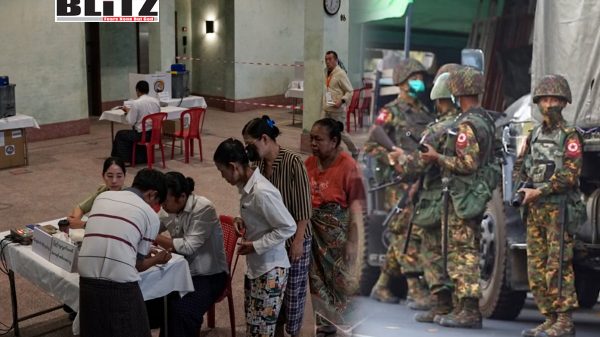
Myanmar’s military junta has pushed ahead with the first phase of its long-promised general election, closing the initial round on December 28 amid widespread skepticism, armed conflict, and signs of historically low voter participation. Touted by the generals as a pathway to political stability, the election has instead reinforced international concerns that the process is little more than a carefully managed exercise designed to entrench military rule under a thin civilian façade.
This is the first nationwide vote since the February 2021 coup that toppled the elected government of Nobel Peace Prize laureate Aung San Suu Kyi. The coup not only ended a decade-long experiment with limited democratic reform but also plunged Myanmar into a protracted civil war that now spans much of the country. Nearly four years later, the junta’s promise that elections would restore order rings hollow to many citizens living amid violence, displacement, and economic collapse.
The election unfolds under extraordinary restrictions. Key opposition parties have been dissolved, including Suu Kyi’s National League for Democracy (NLD), which won a landslide victory in the 2020 election that the military later claimed—without evidence—was fraudulent. Criticizing the election itself has been criminalized, independent media has been crushed, and thousands of political prisoners remain behind bars.
Suu Kyi herself remains in detention, effectively erased from the political landscape she once dominated. Her removal, along with the elimination of meaningful opposition, has led the United Nations, Western governments, and human rights organizations to declare the vote neither free nor fair. Rather than offering voters a genuine choice, the election appears structured to legitimize the junta’s continued grip on power.
At the center of the process is the Union Solidarity and Development Party (USDP), a military-aligned political force led by retired generals. The USDP is fielding roughly one-fifth of all candidates nationwide, far outnumbering weakened or marginal civilian parties. Analysts widely expect the party to dominate the new parliament and form the next government in close coordination with the armed forces.
Lalita Hanwong, a Myanmar expert at Thailand’s Kasetsart University, argues that the election is fundamentally designed to prolong military domination rather than return power to civilians. According to her assessment, the USDP and its allies are expected to consolidate authority through parliamentary mechanisms that preserve the military’s central role in governance.
The USDP’s history reinforces these concerns. Founded in 2010, the party governed Myanmar in tandem with the military after an election boycotted by the opposition. It was only swept aside in 2015 when the NLD surged to victory amid high voter enthusiasm-conditions that starkly contrast with today’s environment of fear and apathy.
Reports from across Myanmar suggest voter turnout in the initial round was significantly lower than in previous elections. Residents in major cities such as Yangon and Mandalay described polling stations that were largely empty for much of the day. While some booths near military housing areas saw moderate activity, many others saw little movement.
In conflict-ridden regions, participation was even weaker. In Hakha, the capital of Chin State, streets were reportedly deserted after a local resistance group urged residents to boycott the vote. One elderly resident bluntly summarized the prevailing sentiment: people were simply not interested.
The lack of enthusiasm stands in sharp contrast to Myanmar’s recent electoral history. Turnout reached approximately 70 percent in both the 2015 and 2020 elections, even during the latter’s COVID-19 restrictions. By comparison, the current process has generated little excitement and even less legitimacy.
Importantly, the junta’s electoral framework does not require a minimum turnout, allowing the vote to proceed-and be declared valid-regardless of how few people participate. Critics argue this legal structure further undermines any claim that the election reflects popular will.
Beyond questions of credibility, the election is taking place amid an escalating civil war. Armed resistance groups formed after the coup, alongside long-established ethnic armed organizations, are battling the military across large swathes of the country. The junta does not have full control over many of the 330 townships it claims to include in the phased voting process.
The conflict has displaced an estimated 3.6 million people and created one of Asia’s worst humanitarian crises. Entire communities are focused on survival rather than politics, further eroding the relevance of an election held under military supervision.
Junta leader Min Aung Hlaing, voting in the heavily guarded capital of Naypyitaw, sought to project normalcy and confidence. Appearing on state media, he dipped his finger in indelible ink and smiled for the cameras, dismissing questions about presidential ambitions by pointing to parliamentary procedures.
Yet few analysts doubt that Min Aung Hlaing ultimately seeks to formalize his authority through the presidency or a similar position. The election, critics argue, is less about democracy and more about transitioning from direct military rule to a controlled hybrid system that shields the generals from accountability while maintaining their dominance.
The United Nations has firmly rejected the election as a solution to Myanmar’s crisis. Tom Andrews, the UN special envoy for human rights in Myanmar, described the vote as a dead end rather than a pathway toward peace or reconciliation.
Even the junta acknowledges the scale of international criticism, though it insists the election will deliver stability and a “better future.” Analysts remain unconvinced, warning that any government emerging from the process is unlikely to gain broad diplomatic recognition, especially while violence continues and political repression remains entrenched.
Ultimately, Myanmar’s election appears less a democratic milestone than a symbolic maneuver by a military regime under pressure. With opposition silenced, voters disengaged, and much of the country at war, the ballot box offers little hope of resolving the deep political and social fractures that have defined Myanmar since the 2021 coup.
Rather than restoring legitimacy, the election risks further entrenching a system rejected by much of the population-one that governs through force, controls political outcomes, and remains isolated from the international community. As Myanmar’s crisis deepens, the gap between the junta’s promises and the lived reality of its people continues to widen.
Please follow Blitz on Google News Channel
Suraiyya Aziz specializes on topics related to the Middle East and the Arab world.