
Five eyes agencies publish global red flags to detect foreign bribery

- Update Time : Friday, December 26, 2025
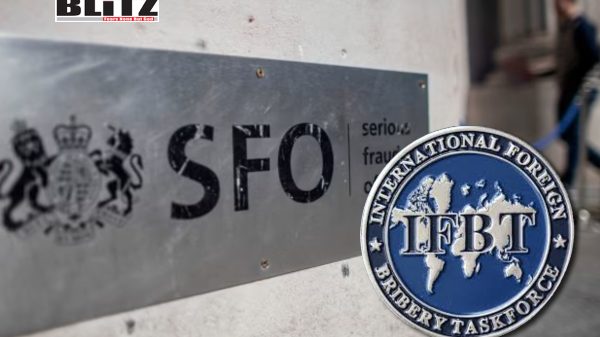
The growing complexity of global business has created fertile ground for corruption to cross borders with unprecedented ease. In response, the UK’s Serious Fraud Office (SFO), in collaboration with law enforcement agencies across the Five Eyes intelligence alliance, has taken a significant step toward strengthening global anti-corruption efforts. For the first time, the International Foreign Bribery Taskforce (IFBT) has jointly published a comprehensive set of guidelines titled “Indicators of Foreign Bribery,” aimed at helping businesses, professionals, and the public recognize warning signs of illicit conduct involving foreign officials.
This landmark guidance reflects a coordinated international effort by some of the world’s most powerful investigative bodies, including the SFO, the UK’s National Crime Agency (NCA), the Australian Federal Police (AFP), the Royal Canadian Mounted Police (RCMP), New Zealand Police, the New Zealand Serious Fraud Office, and the United States Federal Bureau of Investigation (FBI). Drawing on decades of collective casework experience, the document offers a rare insight into the patterns, behaviors, and structures that frequently underpin foreign bribery schemes.
Foreign bribery remains one of the most damaging forms of economic crime. It undermines fair competition, distorts markets, erodes public trust in institutions, and weakens governance in both developed and developing economies. Unlike domestic corruption, foreign bribery often involves complex cross-border transactions, shell companies, intermediaries, and opaque financial arrangements designed to conceal the flow of illicit funds.
Recognizing these challenges, the IFBT’s guidance emphasizes the need for early detection rather than reactive enforcement alone. By equipping businesses and professionals with practical indicators, law enforcement agencies hope to disrupt bribery schemes before they mature into full-scale criminal operations.
Balinder Matharu, Head of Intelligence Analysis at the Serious Fraud Office, underscored the importance of this proactive approach. He described foreign bribery as “a complex problem that demands a global response,” noting that the guidance consolidates decades of investigative and intelligence expertise. Crucially, he emphasized that prevention is preferable to prosecution, highlighting the value of collaboration between law enforcement and the private sector.
The published indicators are not intended to function as definitive proof of wrongdoing. Instead, they serve as red flags-signals that, when viewed collectively and within the appropriate context, may suggest an elevated risk of foreign bribery. The guidance explicitly warns against assessing any single indicator in isolation. Legitimate businesses may occasionally display one or more of these characteristics for lawful reasons.
However, patterns matter. When multiple indicators converge, particularly in high-risk sectors or jurisdictions, they warrant closer scrutiny and, potentially, reporting to authorities.
Among the indicators identified by the taskforce are signs of unexplained wealth. For example, individuals who own high-value property portfolios that appear disproportionate to their known income may be benefiting from illicit payments. While wealth alone is not criminal, a mismatch between earnings and assets is a recurring feature in bribery and corruption cases.
Another red flag involves the misuse of charitable organizations. The guidance notes that registering a charity under the same name as a company can sometimes be a tactic to disguise improper payments or create an appearance of legitimacy. Charitable fronts have historically been used to channel bribes under the guise of donations, particularly in jurisdictions with weak regulatory oversight.
Secrecy is also a recurring theme. Parties that require unusual levels of confidentiality around transactions or contracts, or that are reluctant to share financial records, may be attempting to conceal corrupt arrangements. While confidentiality is a normal feature of some commercial dealings, excessive secrecy-especially when combined with other risk factors-should raise concern.
Complex ownership structures represent another common indicator. The use of layered corporate entities, offshore companies, and nominee shareholders can obscure the true beneficial owner of a business. While such structures may sometimes serve legitimate tax or operational purposes, they are frequently exploited to hide bribery payments and launder proceeds of corruption.
Finally, the guidance highlights risks associated with contract awards that defy commercial logic. When contracts are awarded to parties that lack the apparent experience, capacity, or technical capability to deliver the work, bribery may be a motivating factor. Such decisions often bypass competitive tendering processes and result in substandard outcomes, inflated costs, or project failures.
The IFBT guidance also acknowledges that many foreign bribery indicators overlap with those associated with other financial crimes, particularly money laundering. This overlap reinforces the need for holistic risk assessments rather than narrow compliance checklists. Businesses are encouraged to evaluate suspicious behavior within the broader context of their operations, industry norms, and geographic exposure.
For compliance teams, this means integrating foreign bribery indicators into existing anti-money laundering (AML) and counter-terrorist financing (CTF) frameworks. High-risk sectors such as extractives, defense, infrastructure, pharmaceuticals, and large-scale public procurement are particularly encouraged to review and strengthen their internal controls.
A central message of the guidance is that combating foreign bribery is not solely the responsibility of law enforcement. Businesses, financial institutions, professional service providers, and even individual citizens play a crucial role in identifying and reporting suspicious activity.
The IFBT encourages anyone who encounters behavior indicative of foreign bribery to report it to the appropriate authority within their jurisdiction. In the United Kingdom, reports can be made directly to the Serious Fraud Office or the National Crime Agency. Similar reporting mechanisms exist across other Five Eyes countries, reflecting a shared commitment to transparency and accountability.
By publishing this guidance collectively, the taskforce is also sending a clear deterrent message: international cooperation among enforcement agencies is stronger than ever. Companies that attempt to exploit jurisdictional gaps or regulatory inconsistencies will find it increasingly difficult to avoid scrutiny.
The release of “Indicators of Foreign Bribery” marks a significant milestone in the global fight against corruption. It represents not only a practical tool for early detection but also a symbol of unified resolve among leading law enforcement agencies.
As global commerce continues to expand and evolve, so too must the mechanisms designed to protect its integrity. By empowering businesses and professionals with actionable intelligence, the IFBT aims to foster a culture of vigilance, ethical conduct, and shared responsibility.
In an era where economic crime grows more sophisticated by the day, this collaborative initiative underscores a fundamental truth: preventing corruption requires transparency, cooperation, and a willingness to act before damage is done.
Damsana Ranadhiran, Special Contributor to Blitz is a security analyst specializing on South Asian affairs.