Rubio announces visa bans on European officials accused of censoring American speech

- Update Time : Thursday, December 25, 2025
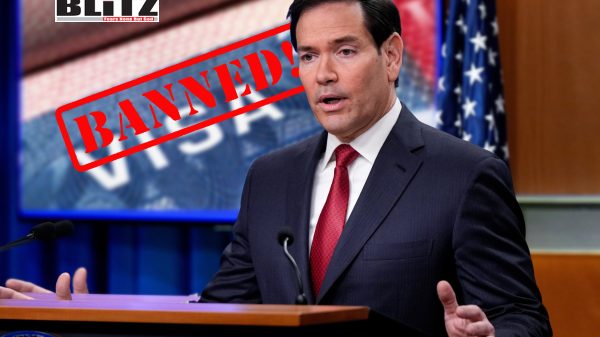
A new fault line has opened in transatlantic relations as the United States moves to penalize European figures accused of pressuring American technology companies to suppress political speech. US Secretary of State Marco Rubio announced on December 24 that Washington will impose visa bans on several Western Europeans whom the Trump administration accuses of engaging in what it calls “extraterritorial censorship” of American viewpoints.
The decision marks a significant escalation in a long-simmering dispute between Washington and Brussels over digital regulation, free expression, and the global reach of European Union law. It also signals a broader shift in US foreign policy under the Trump administration, which has increasingly framed European content moderation efforts as a direct threat to American constitutional values.
In a post on X, Rubio accused unnamed “ideologues in Europe” of leading “organized efforts to coerce American platforms to punish American viewpoints they oppose.” He made clear that the US government views these actions not merely as regulatory disagreements but as unacceptable interference in domestic political discourse.
“The Trump Administration will no longer tolerate these egregious acts of extraterritorial censorship,” Rubio wrote, adding that the State Department would bar “leading figures of the global censorship industrial complex” from entering the United States. He warned that the list could expand if European officials and activists do not “reverse course.”
Shortly afterward, US Under Secretary of State for Public Diplomacy Sarah Rogers publicly identified five individuals affected by the visa restrictions: two French nationals, two British nationals, and one German national. According to Rogers, the group includes leaders of organizations focused on combating digital hate speech, as well as former European Commissioner Thierry Breton, a central figure in shaping the EU’s digital regulatory framework.
Rogers described Breton as the “mastermind” behind the European Union’s Digital Services Act (DSA), legislation that has become the focal point of US criticism. She cited Breton’s August 2024 warning to Elon Musk regarding a livestreamed interview with then-presidential candidate Donald Trump on X. At the time, Breton cautioned that the platform could face scrutiny if the broadcast led to the “amplification of harmful content.”
The EU’s Digital Services Act, approved unanimously by all 27 member states in 2022, aims to combat illegal content, disinformation, and online harm by imposing new obligations on large technology platforms. European officials argue that the law is designed to protect users, ensure transparency, and uphold democratic integrity in the digital space.
However, critics in the United States see the DSA very differently. They argue that its vague definitions of “harmful content,” combined with heavy fines and enforcement powers, give European regulators undue leverage over global platforms-many of which are American-owned. From Washington’s perspective, this effectively allows European authorities to shape what Americans can see, say, or share online.
Thierry Breton pushed back strongly against the US accusations. In a post on X responding to the visa ban announcement, he reminded American audiences that the DSA was approved by every EU member state and framed the controversy as a misunderstanding of where censorship truly originates. “To our American friends: ‘Censorship isn’t where you think it is,’” he wrote.
The US move has found support among several prominent technology figures who have long criticized European digital regulation. Telegram founder Pavel Durov recently warned that European regulators are increasingly targeting platforms that allow dissenting or nonconforming speech.
Writing on X earlier this month, Durov claimed that the EU “imposes impossible rules so it can punish tech firms that refuse to silently censor free speech.” His comments followed a €120 million fine imposed on X under the Digital Services Act. While the European Commission insisted that the penalty was unrelated to censorship, critics argue that enforcement actions like these inevitably pressure platforms to err on the side of suppression.
Durov has gone further, alleging direct political interference. He has claimed that EU intelligence officials pressured him to restrict conservative content during election periods in Romania and Moldova-an accusation that, if substantiated, would raise serious questions about the political neutrality of European regulatory enforcement.
At its core, the dispute reflects a fundamental philosophical divide between the United States and the European Union. The US approach to free speech, rooted in the First Amendment, prioritizes protection from government interference even at the cost of tolerating offensive or misleading content. Europe, by contrast, places greater emphasis on harm prevention, social cohesion, and the regulation of speech deemed dangerous or destabilizing.
The Trump administration has framed this difference as more than a cultural disagreement. By imposing visa bans, Washington is signaling that it views European digital policies as an international issue with real consequences for diplomatic relations. The use of immigration restrictions as a tool of speech policy enforcement is highly unusual and underscores how seriously the administration views the matter.
The visa bans are likely to further strain already tense relations between Washington and Brussels. European officials are expected to reject the US accusations and defend their regulatory sovereignty, while US lawmakers sympathetic to free speech absolutism may push for even stronger countermeasures.
At stake is not only the future of transatlantic cooperation on technology policy but also the question of who sets the rules for global digital discourse. As American platforms operate across borders, and European laws increasingly apply beyond EU territory, conflicts like this are likely to multiply.
For now, Rubio’s announcement represents a clear warning shot. Whether it leads to policy changes in Europe or simply hardens positions on both sides remains to be seen. What is certain is that the battle over online speech has moved from regulatory offices into the realm of high-stakes diplomacy, with consequences that could reshape the digital world order for years to come.
Damsana Ranadhiran, Special Contributor to Blitz is a security analyst specializing on South Asian affairs.