Oman and India demonstrate the strategic power of economic statecraft

- Update Time : Thursday, December 25, 2025
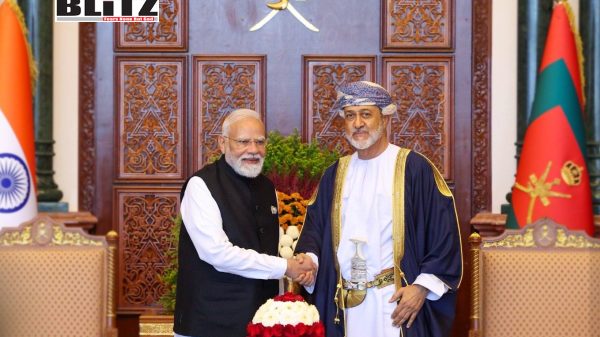
In an era marked by geopolitical fragmentation, sanctions regimes, trade wars, and military standoffs, states are increasingly rediscovering the strategic value of economic tools. The recent Comprehensive Economic Partnership Agreement (CEPA) between Oman and India stands as a textbook example of how economic statecraft can serve national interests more effectively-and more sustainably-than coercive or militarized approaches. By prioritizing trade liberalization, investment facilitation, and market access, both countries are demonstrating how “carrots” rather than “sticks” can reshape bilateral relations while enhancing strategic autonomy in an uncertain global environment.
The CEPA signed between Oman and India offers duty-free access to more than 98 percent of India’s exports to Oman, while India has agreed to liberalize tariffs on nearly 77.8 percent of its total tariff lines, covering over 94 percent of imports from Oman by value. Bilateral trade between the two countries reached approximately $10.6 billion in 2025, reflecting a steady upward trajectory. More than 6,000 India–Oman joint ventures already operate in the sultanate, and India’s outward foreign direct investment (FDI) in Oman stands at around $675 million. The agreement aims to further boost India’s exports of textiles, engineering goods, pharmaceuticals, and agricultural products, while granting Oman improved access to the vast Indian market for products such as dates and petrochemicals.
This development is not merely a commercial transaction; it is a strategic maneuver rooted in the logic of economic statecraft. In his seminal 1985 book Economic Statecraft, political scientist David Baldwin reexamined the effectiveness of economic tools as instruments of foreign policy. Baldwin defined statecraft as the methods states use to influence the behavior of other actors in the international system, emphasizing that economic instruments occupy a crucial space between diplomacy and military force. These instruments include positive measures-“carrots”-such as aid, investment, trade preferences, and subsidies, as well as negative measures-“sticks”-such as sanctions, embargoes, and asset freezes.
Baldwin argued that economic techniques often possess greater credibility than diplomacy or propaganda because they tend to impose real costs on the sender as well as the target. Yet they are generally less escalatory and less destructive than military instruments. This insight is particularly relevant today, as states confront the limitations of sanctions-heavy foreign policies that frequently backfire, entrench adversarial positions, and harm civilians more than political elites.
The intellectual roots of economic statecraft stretch back even further. In 1945, Albert O. Hirschman published National Power and the Structure of Foreign Trade, a groundbreaking study that explored how trade relationships can translate into political influence. Hirschman argued that when countries become economically dependent on trade with a powerful partner, they may be willing to grant political, military, or economic concessions to preserve those commercial ties. Importantly, Hirschman emphasized that such influence often operates indirectly and voluntarily, as states gradually adjust their policy preferences to align with those of economically significant partners.
Later scholars such as Andreas Grimmel and Viktor Eszterhai have applied these theoretical frameworks to contemporary cases, most notably China’s Belt and Road Initiative. They distinguish between Baldwin’s more targeted, behavior-specific use of economic tools and Hirschman’s broader strategy of reshaping policy orientations over time. The India–Oman CEPA fits squarely within this analytical spectrum, combining immediate trade incentives with long-term structural interdependence.
The broader geopolitical context makes this agreement particularly significant. The global order is increasingly characterized by strategic uncertainty, great-power competition, and the weaponization of interdependence. States are diversifying their partnerships to reduce vulnerability to unilateral pressure. For India, economic statecraft has become a central pillar of foreign policy, especially as it faces external economic coercion. The imposition of a 50 percent tariff on certain Indian goods by the United States illustrates the risks associated with overreliance on any single market or political partner.
In response, New Delhi has accelerated efforts to conclude trade agreements across multiple regions. India has signed more than 15 trade deals in recent years and is currently negotiating agreements with the European Union, Chile, New Zealand, and others. These initiatives serve multiple purposes: they mitigate the impact of protectionist measures, expand export opportunities, and enhance India’s leverage in global economic governance. From a Baldwinian perspective, such agreements help offset the negative effects of “sticks” by multiplying alternative economic channels. From a Hirschmanian perspective, they gradually embed India more deeply into global trade networks, increasing its influence and resilience.
Oman, for its part, is also deploying economic statecraft to navigate a rapidly changing global economy. Like many Gulf Cooperation Council (GCC) states, the sultanate is undergoing a profound economic transformation driven by fluctuating oil revenues, climate change pressures, and shifting global demand. According to the World Bank’s 2025 report Global Economic Prospects, these challenges have compelled GCC economies to accelerate diversification and structural reform.
Oman’s response has been both ambitious and pragmatic. As analyst Qasim Al-Maashani notes, the sultanate has implemented significant fiscal reforms to reduce public deficits and manage debt. It has launched privatization initiatives, restructured public investment programs, and sought to improve the business environment to attract foreign capital. Central to this strategy is Oman Vision 2040, which sets clear targets: foreign direct investment inflows equal to 10 percent of GDP, a non-oil share of GDP exceeding 90 percent, real GDP growth of 5 percent, and a 90 percent increase in real GDP per capita.
Trade agreements are a crucial mechanism for achieving these goals. Oman already has free trade agreements with the United States, Singapore, and Australia, and the CEPA with India significantly expands its economic horizon. By deepening ties with one of the world’s fastest-growing major economies, Oman reduces its dependence on hydrocarbons and traditional partners while embedding itself in emerging Asian supply chains.
The India–Oman agreement also mirrors a broader trend in the Gulf. The United Arab Emirates concluded its own CEPA with India in February 2022, and the results have been striking. Bilateral trade between India and the UAE has grown from $72.8 billion to approximately $100 billion since the deal was signed. The UAE has embraced economic statecraft primarily through positive incentives, concluding trade agreements with Indonesia, Israel, Turkey, Cambodia, Malaysia, New Zealand, and Kenya, while pursuing negotiations with Chile, the Philippines, and Ukraine.
India, meanwhile, continues to strengthen its strategic dialogue with the Gulf as a whole. Negotiations with Qatar are underway, and New Delhi increasingly views the region not merely as an energy supplier but as a strategic economic partner. This evolving relationship reflects a conscious shift away from security-centric frameworks toward economic interdependence as a foundation for stability.
As Baldwin observed, military instruments may carry the highest level of credibility, but their costs-human, economic, and political-are often prohibitive. Economic measures, by contrast, can exert substantial pressure or provide meaningful incentives without provoking violent responses. They are not simply second-best alternatives to force but, in many cases, first-best policy options.
The CEPA between Oman and India exemplifies this logic. By prioritizing trade, investment, and market access, both countries are pursuing a “win-win” strategy that enhances prosperity while quietly expanding influence. In a world where coercive power increasingly generates resistance and instability, economic statecraft-especially when rooted in cooperation rather than punishment-appears to be the most effective and sustainable path forward.
Sonjib Chandra Das is a Staff Correspondent of Blitz.