In Pakistan, seeking peace and accountability ends in disappearance

- Update Time : Wednesday, December 24, 2025
On November 12, 2025, Khyber Pakhtunkhwa’s Pakistan Tehreek-e- Insaaf (PTI) of Sohail Afridi convened what it called a grand “peace” jirga in Peshawar. It brought clerics, tribal elders, civil society figures, political activists and students under the banner of dialogue to discuss a worsening security environment amid tensions with the Taliban-led government in Afghanistan.
While the language of peace, consultation and consensus filled the halls of KP government, but it rang hollow for the hybrid government of Islamabad and Rawalpindi. Two student activists from the University of Peshawar, Khubaib Wazir and Adnan Wazir, who attended the jirga never made it back to their hostels. According to local reports and eyewitness accounts, the duo, associated with the Waziristan Student’s Society, were intercepted and abducted on their way from the jirga by men in plain clothes believed to be state security personnel. Since then, they have vanished without charge, warrant or acknowledgment. Their families have received no official notice. Their university has no explanation. The state insists on silence.
In Pakistan, this pattern has a name and is called enforced disappearance. It is a policy so entrenched that it no longer shocks, only confirms. And the irony is brutal. A meeting convened in the name of peace ended with the disappearance of those who believed participation itself was an act of citizenship.
While the family and fellow students continue to seek answers, many state-aligned voices quickly floated insinuations that the two students may have been taken away because of alleged links to the proscribed Pashtun Tahafuz Movement (PTM), a rights movement that emerged from student activism in the former tribal areas. The accusation itself is revealing as the PTM’s central offense has never been violence but daring to question the state narrative. It has questioned the conduct of Pakistan’s security forces in Pashtun tribal regions, particularly former Federally Administered Tribal Areas (now merged into Khyber Pakhtunkhwa), documenting landmines left behind after military operations, extrajudicial killings, sexual violence and, above all, disappearances. For that, it was first harassed, then banned.
The fellow colleagues of disappeared students have rejected the PTM linked insinuations outright and insisted that both Khubaib Wazir and Adnan Wazir were associated with the Waziristan Students’ Society as “stage secretary” and former media coordinator, respectively. In most countries, it would trigger debate. In Pakistan, it triggers disappearance.
What happened to Khubaib Wazir and Adnan Wazir is not an aberration or the excess of a rogue unit. It is the continuation of a long-standing policy that treats dissent as a security threat and the disappearance of citizens as a legitimate instrument of governance. For decades, Pakistan’s Army and security services have used enforced disappearances as a tool to discipline regions and silence voices that question the military’s conduct or its dominance over the state.
The geography of this policy is telling. It has been most pervasive in the tribal regions of Khyber Pakhtunkhwa and Balochistan. These provinces, which have faced systematic political marginalisation, have borne the disproportionate brunt of Pakistan’s counterinsurgency campaigns over decades. They are also regions where constitutional protections have historically been weakest and military authority strongest, with the military cantonments of Peshawar and Quetta more powerful than any provincial governments.
In fact, even if one takes official numbers of Pakistan government at face value, these are only staggering. According to government’s own Commission of Inquiry into Enforced Disappearances (COIED), established in 2011, at least 10,618 cases were recorded between 2011 and 2025. Of these cases, 3,485 occurred in Khyber Pakhtunkhwa alone. These figures are often cited by the state as evidence of transparency and progress.
But numbers, in Pakistan’s disappearance economy, conceal as much as they reveal. Rights groups, families of the missing and movements like the PTM argue that the true figures are far higher. Many cases are never reported out of fear. Others predate 2011, when the commission was constituted under judicial pressure, and therefore fall outside its official accounting. Even within the commission’s data, “resolved” often means the discovery of a body or the quiet release of a detainee without explanation, apology or accountability.
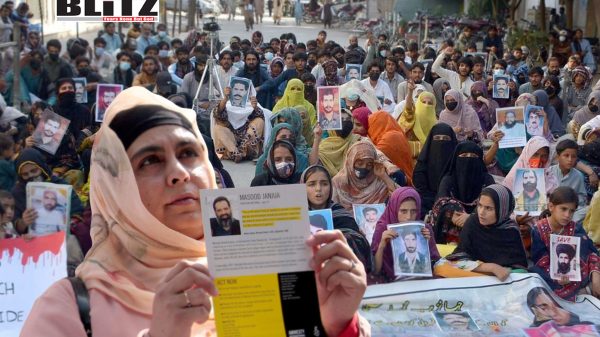
In Khyber Pakhtunkhwa, the estimates by independent organisations, both national and international like Amnesty International, Human Rights Watch, suggest that the number of disappeared could exceed 6,700, with hundreds still unaccounted for. In Balochistan, the gap between official data and lived reality is even wider. While the commission has recorded nearly 5,500 cases, Baloch activists and groups like Voice of Missing Baloch Persons (VMBP) place the number of missing anywhere between 10,000 and 21,000. Thousands more disappeared before any commission existed, when emergency regulations and military operations rendered entire districts legally invisible.
The state’s response to these claims follows a predictable script: denial, deflection and delay. Families are told to be patient. Courts are told the matter involves national security. Parliament is assured that mechanisms exist. Meanwhile, the disappearances continue.
What distinguishes Pakistan’s use of enforced disappearances is not just their scale, but their purpose. They are not merely about extracting information or neutralizing armed militants. They are about producing fear. By making people vanish without trace, the state sends a message to entire communities: questioning the Army’s conduct carries a cost that law cannot mitigate.
This system persists because it is shielded by impunity. No senior military officer has been held accountable for enforced disappearances. No meaningful civilian oversight exists over intelligence agencies. Even when courts intervene, their writ often stops at the cantonment gates. Commissions issue reports; families bury hope.
The language of counterterrorism has long been used to justify this machinery. Pakistan has fought brutal insurgencies and paid a heavy price in civilian and military lives. But enforced disappearance has increasingly been deployed not against armed groups, but against those who question how the war has been fought. In that sense, it is less a security tool than a political one.
The jirga in Peshawar was meant to signal displeasure towards the federal government and the military establishment of Army Chief Asim Munir. Instead, it exposed how even a participation itself in peace seeking jirga can be punished. When students attend a peace conference and are disappeared on the way home, the message is unmistakable: “peace” is acceptable only on the Army’s terms, and silence is its preferred language.
The families of Khubaib Wazir and Adnan Wazir now join thousands of others who mark time not in days or months, but in unanswered petitions and fading photographs. Their story will likely slip from headlines, absorbed into a grim statistic. That, too, is part of the policy. In a country where asking questions can make you vanish; silence is not consent. It is survival.
Arun Anand is an author and columnist who has penned more than a dozen books. He contributes columns on geopolitics to leading Indian and international publications and research journals. Follow him on ‘X’
@ArunAnandLive