
After Assad: Syria’s Captagon empire collapses, but the drug trade adapts

- Update Time : Wednesday, December 24, 2025
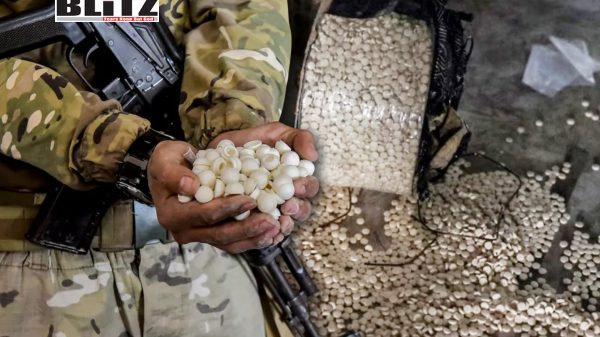
For more than a decade, Syria stood at the center of one of the world’s most lucrative illicit drug trades. Captagon-a powerful amphetamine-like synthetic stimulant-became not only a regional scourge but also a financial lifeline for the Assad regime as war, sanctions, and economic collapse hollowed out the formal economy. Now, according to a new research brief from the United Nations Office on Drugs and Crime (UNODC), that entrenched system has been dramatically disrupted following the fall of Bashar al-Assad’s government in December 2024.
The UNODC assessment marks the most comprehensive international acknowledgment yet that Syria’s role as a global narco-hub has fundamentally changed. The report states that large-scale Captagon production has been “sharply disrupted,” with Syria’s transitional authorities dismantling dozens of laboratories and storage facilities over the past year. Yet while the epicenter of production may have been destabilized, the broader drug economy has not disappeared. Instead, it is adapting-reshaping trafficking routes, diversifying substances, and testing the limits of regional cooperation.
Captagon’s ascent was inseparable from Syria’s descent into war. As the conflict dragged on, the Assad regime and its allied networks increasingly relied on illicit revenue streams to survive. UNODC data show that between January 2019 and November 2025, approximately 80 percent of all Captagon seized in the Middle East originated in Syria. Production facilities operated on an industrial scale, capable of manufacturing millions of tablets, often concealed within legitimate-looking factories or agricultural facilities.
Over time, Syria effectively became the world’s largest Captagon producer. Smuggling routes extended through Jordan, Lebanon, and Iraq, funneling the drug toward Gulf markets where demand-and profit margins-were highest. Captagon was not merely a criminal enterprise; it evolved into a tool of political leverage, regional destabilization, and economic survival.
This system persisted largely intact until Assad’s overthrow in December 2024. Within months, the UNODC reports, Syria’s transitional government dismantled 15 industrial-scale laboratories and 13 smaller storage sites-facilities that once underpinned a multibillion-dollar illicit economy.
In June, Syria’s new interior minister, Anas Khatab, made a sweeping declaration on state television: “We can say that there no longer is any factory that produces Captagon in Syria.” While such statements warrant caution, UNODC researchers confirm that the production landscape has “drastically changed,” with no evidence yet of continued industrial-scale manufacturing inside the country.
However, the agency also issued a sobering caveat. Vast stockpiles produced during the Assad era may still exist and could “sustain supply for a couple of years” if not intercepted. In other words, the fall of Assad disrupted production but did not immediately erase the consequences of years of unchecked manufacturing.
Since December 2024, authorities across the Arab region have seized at least 177 million Captagon tablets-roughly 30 tonnes-according to official figures verified by the UNODC. These record seizures suggest that enforcement efforts have intensified and that regional governments are increasingly aligned in their response.
Bo Mathiasen, UNODC Director for Operations, described the shift as a rare moment of unity. “While the drug market expanded in recent years and divided the region, the need for action is now bringing it together,” he said, pointing to increased intelligence-sharing and joint operations.
Yet the continued flow of Captagon, despite the collapse of its primary production base, underscores the resilience of illicit markets. Traffickers, the UNODC notes, are rapidly adapting by exploring new routes and relying on diversion and repackaging hubs in Western and Central Europe as well as North Africa. Rather than signaling victory, the seizures may reflect a transitional phase in which old networks are being dismantled while new ones take shape.
Perhaps the most critical warning in the UNODC brief concerns policy direction. The agency cautions that focusing exclusively on supply-side crackdowns carries “significant risks.” History shows that when one drug becomes scarce, demand does not disappear-it mutates.
This pattern is already emerging. Shortages have been reported in several traditional Captagon destination markets, but instead of reducing drug consumption, they appear to be accelerating shifts toward alternative substances. Methamphetamine, synthetic cannabinoids, and misused prescription drugs are increasingly filling the void.
Jordan offers a telling case study. Long a frontline state in the battle against Captagon smuggling, the country has seen a decline in Captagon use. However, according to Dr. Mousa Daoud Al-Tareefi, president of The Jordan Anti-Drug Society, users are turning to crystal meth, synthetic cannabinoids known locally as “Joker,” and diverted pharmaceuticals. These substances are often easier to access, cheaper to produce locally, and more difficult for authorities to regulate.
The disruption of Syria’s Captagon industry may represent a historic inflection point, but it does not mark the end of the region’s drug crisis. Instead, it signals a transition toward a more fragmented and potentially more dangerous landscape. Synthetic drugs, in particular, pose unique challenges: they can be produced with minimal infrastructure, transported in smaller quantities, and adapted quickly to enforcement pressure.
Moreover, the social costs are mounting. Addiction, public health crises, and criminal violence do not disappear with regime change. Without comprehensive demand-reduction strategies-treatment, prevention, education, and economic alternatives-the region risks replacing one drug epidemic with another.
The fall of Bashar al-Assad dismantled the political scaffolding that allowed Captagon to flourish on an unprecedented scale. That alone represents a major shift in Middle Eastern security and criminal dynamics. But the UNODC’s findings make clear that enforcement victories are fragile unless matched by long-term policy coordination.
For Syria’s transitional government, the challenge extends beyond dismantling factories. Rebuilding institutions, restoring legitimate economic opportunities, and preventing former trafficking networks from reconstituting under new guises will be decisive tests of credibility.
For the region, the lesson is equally stark. Captagon was never just a Syrian problem; it was a symptom of deeper instability, corruption, and unmet social needs. As traffickers pivot toward new substances and routes, regional cooperation must evolve from reactive seizures to proactive, holistic drug policy.
The narco-state model that thrived under Assad may be gone, but the forces that sustained it remain. Whether the Middle East can turn this moment of disruption into lasting progress will depend not only on cracking down on supply, but on confronting demand-and the political and economic conditions that allow illicit markets to thrive in the first place.
Abul Quashem Joarder, a contributor to Blitz is geopolitical and military expert.