
Italy and GCC forge mediterranean partnership for trade, energy, and connectivity

- Update Time : Tuesday, December 16, 2025
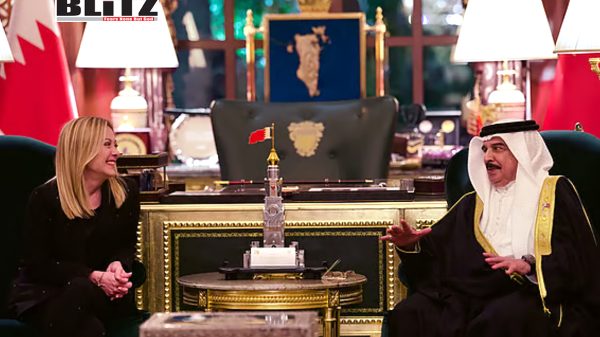
Italian Prime Minister Giorgia Meloni’s participation in the recent Gulf Cooperation Council (GCC) summit in Bahrain marked more than a diplomatic courtesy call. It signaled a deliberate strategic pivot by Rome toward the Gulf and, more broadly, toward a reimagined Mediterranean role that bridges Europe, the Middle East, and Asia. In a speech rich with historical references and geopolitical ambition, Meloni framed Italy as a natural partner for the GCC-a country shaped by geography and history to engage across cultures without losing its own identity. Her message was clear: Italy sees the Gulf not as a peripheral region but as central to its future economic, political, and security calculus.
Meloni’s language was telling. She described the GCC as offering Italy a “historic opportunity,” while portraying her own country as a “nation with an ancient heart and forward-looking attitude.” This self-characterization was designed to resonate with Gulf leaders who often emphasize continuity between tradition and modernization. By stressing that Italy can interact and integrate with other cultures “yet never losing itself,” Meloni subtly aligned Italy’s national narrative with that of GCC states, which similarly balance rapid development with strong cultural identities.
At the core of her argument was geography. Italy, Meloni insisted, “could never conceive of itself without the Mediterranean.” Though the Mediterranean accounts for just 1 percent of the world’s waters, it carries around 20 percent of global maritime traffic, largely due to the Suez Canal. This simple statistic underpinned a larger strategic vision: the Mediterranean and the Gulf are not merely regional seas but interconnected hubs of global trade, energy flows, and security dynamics. Together, they enclose four of the world’s most critical chokepoints-the Strait of Hormuz, Bab al-Mandab, the Suez Canal, and the Strait of Gibraltar-giving them an outsized influence on international stability and commerce.
Meloni reinforced this vision with a historical narrative that challenged modern assumptions about rigid civilizational boundaries. She invoked the Limes Arabicus, the frontier between the Roman Empire and the Arabian Peninsula, arguing that it functioned less as a hard border and more as a zone of transit, communication, and trade. This interpretation allowed her to present Italy–Arab relations not as a modern diplomatic convenience but as the continuation of centuries-old interactions marked by commerce, cultural exchange, and political engagement. The Mediterranean and the Gulf, in her telling, have always been “protagonists of major intercontinental interconnections.”
Building on this historical and geographical foundation, Meloni proposed an ambitious new framework: a “GCC–Med” partnership that would formally link Gulf countries with Mediterranean nations, starting with Italy but extending to Europe, the Middle East, and North Africa. She even floated the idea of hosting a GCC–Med summit to institutionalize this cooperation. Crucially, she emphasized that this partnership should be cooperative rather than adversarial—focused on complementarities, synergies, and mutual strengths rather than zero-sum competition.
The substance of this proposed partnership rests on seven pillars discussed during the summit, each reflecting both Italy’s national interests and broader regional priorities.
The first pillar is connectivity, specifically the India–Middle East–Europe Corridor (IMEC). Endorsed by the G20 in New Delhi in 2023 and backed by the United States, the corridor aims to enhance maritime and land links-particularly rail connections-between South Asia, the Gulf, and Europe. Meloni proposed Trieste, Italy’s historic northern port, as the European terminus of this corridor. While the project initially gained support from Saudi Arabia and other regional players, it has stalled amid the geopolitical fallout from Israel’s war on Gaza. Nevertheless, Meloni signaled that Rome remains committed, even as other European countries now compete to host the corridor’s European endpoint. For Italy, IMEC represents not just infrastructure but a chance to reclaim strategic relevance as a logistical gateway between continents.
The second pillar complements the first: digital connectivity. Meloni highlighted projects such as the Blue-Raman cable system, envisioned as a maritime digital backbone linking India and Europe through the Arabian Peninsula and the Mediterranean. In an era where data flows are as critical as energy shipments, such infrastructure would position Italy and GCC states at the heart of global digital networks. This emphasis reflects a broader understanding that geopolitical influence increasingly depends on control over both physical and virtual connectivity.
Energy diplomacy forms the third pillar, and here Meloni struck a notably pragmatic tone. She called for energy cooperation that is “more pragmatic and less ideological,” signaling a departure from rigid policy frameworks that often dominate European debates. Italy has already signed energy agreements with Saudi Arabia and the United Arab Emirates, alongside broader investment deals with all GCC countries. This approach aligns closely with long-standing Gulf calls for differentiated energy policies that respect national priorities and development needs. For Italy, GCC energy partnerships offer both transitional energy security and a platform for collaboration on future technologies, including renewables and hydrogen.
The fourth pillar focuses on trade and investment, an area where Meloni acknowledged a significant gap between potential and reality. Current two-way trade stands at around $35 billion annually-modest given the combined market size of nearly $4.8 trillion. Investment flows are growing, particularly in the energy sector, but remain limited overall. Meloni argued that Italy can add value by offering financial instruments, industrial know-how, and technological capabilities in advanced sectors. This framing positions Italy not merely as a market but as a partner capable of contributing skills and expertise to Gulf diversification strategies.
The fifth pillar addresses one of the most sensitive geopolitical issues: Gaza and the West Bank. Both Italy and the GCC expressed support for US President Donald Trump’s plan and the Sharm El-Sheikh summit process. Meloni’s personal rapport with Trump and her close ties with Israel place her in a unique position to push for progress, particularly toward the stalled second phase of the plan. Italy is already involved through training Palestinian security forces and supporting reconstruction efforts, but Meloni acknowledged that more immediate action is needed, including personnel contributions to an International Stabilization Force.
Relations with Iran constitute the sixth pillar. Both sides favor a diplomatic approach centered on full International Atomic Energy Agency involvement. Italy has already hosted two rounds of U.S.–Iran talks and signaled its readiness to facilitate further dialogue. This role underscores Italy’s aspiration to act as a mediator and bridge-builder in regional conflicts, leveraging its relatively balanced relationships.
The seventh and perhaps most contentious pillar is interfaith dialogue. Meloni spoke candidly about tensions within Europe related to Muslim minorities and immigration, warning of what she termed “Islamic separatism” and the risks it poses to social cohesion. Such remarks were unusual in a forum with GCC states, which have long promoted interfaith initiatives and do not export migrants to Europe. Her comments appeared aimed as much at domestic audiences as at Gulf leaders. Still, Meloni suggested that structured cultural dialogue could help address misunderstandings-though such efforts may be more effective if broadened beyond the GCC context.
To operationalize these ambitions, Italy and the GCC are finalizing a four-year joint action plan covering political and security dialogue, economic cooperation, and people-to-people engagement. There is a palpable sense of urgency to make up for lost time. Previous Italian governments spoke of strengthening ties with the Global South, including the Gulf, but achieved limited concrete results.
Meloni’s initiative reflects a growing recognition in Italy that EU membership need not—and should not—mean turning away from millennia of engagement with the Middle East and North Africa. Her historical references extended beyond the Limes Arabicus to earlier Roman–Arab interactions, including evidence of Nabataean communities in southern Italy before the Common Era and the Arab origins of several Roman emperors. In Arabia itself, Roman engagement ranged from trade and diplomacy to military garrisons protecting Red Sea routes. These interactions were complex, sometimes violent, but deeply intertwined.
That layered shared history provides a narrative foundation for Meloni’s proposed second phase of Italy–Gulf relations. Whether her ambitious vision materializes will depend on geopolitical stability, sustained political will, and the ability to translate rhetoric into policy. Yet the message from Bahrain was unmistakable: Italy under Meloni intends to reclaim its Mediterranean vocation and, in partnership with the GCC, position itself at the crossroads of continents once again.
Suraiyya Aziz specializes on topics related to the Middle East and the Arab world.