Trump’s immigration crackdown fails: Policy aggression meets practical limitations

- Update Time : Monday, December 15, 2025
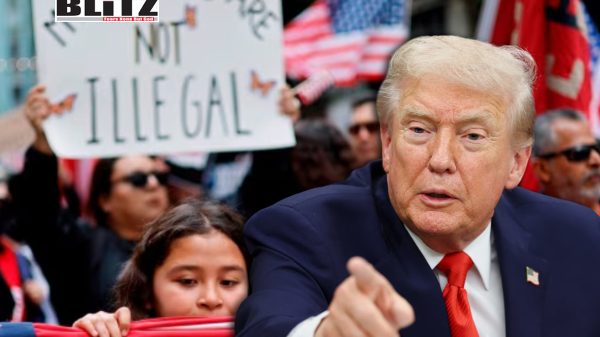
Aggressive immigration enforcement has once again become a defining feature of US President Donald Trump’s agenda, signaling that the administration’s hardline approach to immigration will persist into 2026. From the moment he assumed office, Trump’s strategy has centered on two key objectives: removing as many immigrants as possible and deterring potential newcomers from attempting to enter the United States. While these measures are lauded by his political base, a closer examination reveals that the administration’s efforts are fraught with inefficiencies, legal complications, and economic contradictions. Despite the bold rhetoric, the reality of implementing a nationwide immigration crackdown paints a far less impressive picture.
Trump’s immigration policies are unmistakably aggressive. Immigration and Customs Enforcement (ICE) agents have ramped up raids and deportations, often disregarding court orders in the process. Citizens have been swept up mistakenly, and legal avenues for immigration have been drastically curtailed. The administration has even halted applications from migrants in 19 countries, signaling a broad and sweeping effort to limit new entries. Trump’s aim is clear: intimidate potential migrants while showing his base that he is fulfilling his promise to “Make America Great Again.”
However, the actual outcomes suggest that the strategy is far less effective than claimed. According to the Department of Homeland Security (DHS), roughly 527,000 individuals were “removed” from the United States as of October 2025. While this number is significant on paper, it falls dramatically short of the president’s initial pledge to deport one million people in his first year—a target that would have required deporting approximately 3,000 individuals per day. In practice, deportations averaged around 1,000 per day toward the end of the year, and this figure is likely inflated. Many independent research organizations, including the American Immigration Council and the Migration Policy Institute, question the official numbers, noting that the government has included voluntary “self-deportations” to boost its statistics, claiming that 1.6 million people left the country on their own.
Even if we accept the official figures, the reality is stark. With an estimated 14 million undocumented immigrants currently residing in the US, removing them all would take decades at the current pace. The task is further complicated by the refusal of many countries, including Cuba, Haiti, and Venezuela, to accept their nationals for deportation. As a result, the United States has been forced to send deportees to third countries—a solution fraught with logistical and diplomatic challenges. This limitation alone underscores a fundamental flaw in Trump’s strategy: the administration can issue orders to deport, but practical enforcement is another matter entirely.
The second prong of Trump’s policy—deterrence—is equally problematic. The administration argues that publicizing deportations will discourage prospective migrants from attempting to enter the US. Yet this assumption oversimplifies the complex realities driving migration. Many migrants flee violence, economic instability, and political persecution, factors that often outweigh the threat of deportation. Reports of daily “encounters” at the southern border with Mexico, touted by the administration as evidence of declining migration, are misleading. Historically, many of these encounters involved non-Mexican migrants seeking asylum, who surrendered voluntarily to US authorities. Mexicans and other groups, who might attempt unauthorized entry, typically avoid detection. Declaring that these encounters have fallen to near zero does not necessarily indicate that migration has slowed—it may simply reflect a shift in tactics by migrants.
The economic dimension of Trump’s policy further complicates the picture. While the administration seeks to remove undocumented immigrants, it simultaneously relies on foreign labor to address shortages, particularly in agriculture. In 2024, the US issued approximately 315,000 H-2A agricultural visas, with the number expected to approach 400,000 in 2025. This demonstrates a stark contradiction: while the administration emphasizes deportation and deterrence, it cannot ignore the vital role that immigrants play in sustaining critical sectors of the economy. In this sense, the policy is not only impractical but also counterproductive, revealing a tension between ideological aims and economic realities.
The implications of Trump’s immigration crackdown extend beyond the United States, influencing political debates in other countries, particularly in Latin America. In Chile, far-right presidential candidate José Antonio Kast has promised to expel all unauthorized migrants if elected, echoing the rhetoric of Trump. Yet the feasibility of such measures is highly questionable. Chile is home to approximately 1.6 million immigrants, nearly 10% of the population, with 18% undocumented. Implementing mass deportations would require resources and diplomatic cooperation far beyond Chile’s capacity, particularly given the strained relations with countries like Venezuela, Peru, and Haiti, from which many migrants originate. Kast’s plan, while politically appealing to his base, risks being both inhumane and legally untenable.
Trump’s administration has also sought to export its approach globally. US Secretary of State Marco Rubio has instructed diplomats to press foreign governments to restrict immigration and report on policies deemed overly supportive of migrants. Moreover, the administration’s 2025 National Security Strategy criticizes European migration policies, suggesting that lax approaches to immigration have destabilized the continent. The United States thus positions itself as a model for restrictive immigration policies, implying that other nations should emulate its strategy. However, the practical limitations of deportation and enforcement observed domestically raise serious questions about the viability of exporting such measures internationally.
The broader consequences of Trump’s immigration approach are worth noting. Mass deportations are not only expensive—they strain the budget of ICE and DHS, create administrative backlogs, and generate legal challenges. They also disrupt communities, separate families, and create humanitarian crises. Economically, removing large numbers of workers can exacerbate labor shortages, particularly in industries that rely heavily on immigrant labor, such as agriculture, construction, and service sectors. Politically, the policy may energize a segment of the base, but it risks alienating moderates and international partners, potentially undermining US influence abroad.
Ultimately, the Trump administration’s immigration crackdown illustrates a critical mismatch between political ambition and practical reality. While anti-immigrant measures resonate rhetorically, the logistics of enforcing mass deportations, combined with economic dependencies and international constraints, render the policy largely ineffective. The United States has the resources to pursue a highly aggressive strategy, yet even with these advantages, the administration has struggled to meet its targets. For other countries considering similar approaches, the lessons are clear: aggressive deportation policies are not only costly and legally contentious but also likely to fail in achieving their stated objectives.
Trump’s immigration policies may serve as a cautionary tale. While they can generate political capital domestically and project an image of decisiveness, the realities of enforcement, economics, and international diplomacy severely limit their success. The narrative of mass deportations and deterrence, while compelling to some, does not hold up under scrutiny. As the US continues to navigate its immigration challenges, one thing is clear: in practice, Trump’s crackdown is less a triumph of policy than a testament to the difficulties of trying to govern immigration through fear and force.
Jennifer Hicks is a columnist and political commentator writing on a large range of topics.